Wells
Whole House Water Filter for Well Water
A whole house water filter for well water is usually a sediment stage plus whatever the lab test calls for; no single tank handles sand, iron, bacteria and chemicals at once.
Compiled by the Red Clay Septic & Well desk · Last revised
Ownership note. Red Clay Septic & Well has the same owners as two water-treatment stores, SoftPro Water Systems and Quality Water Treatment. Links on this page to either store go to equipment that store sells. Treatment advice here follows NC DHHS, NC State Extension and EPA guidance checked in October 2026; what a product listing says is the store's own claim, not a test by this site. More on ownership
In these notes
- What does a whole house water filter for well water do?
- Do you need a sediment filter on a well?
- What does a carbon whole house filter remove?
- In what order do well water filters go?
- Which problems need something other than a whole house filter?
- How do you maintain a whole house well filter?
- Questions worth asking
The short version
- Penn State Extension lists sediment filters for "soil, sand, other particles" and carbon for chlorine, pesticides, herbicides, radon, tastes and odors (Penn State Extension).
- NC DHHS says to know total hardness, pH, iron and turbidity before installing any treatment, and to retest afterward.
- UV and chlorine disinfection need clear water, so a sediment filter goes ahead of them, per Penn State Extension.
- NC DHHS puts typical costs at about $500 for a single point-of-use unit and up to $3,000 for a point-of-entry system.
- NSF/ANSI 42 covers aesthetic claims and NSF/ANSI 53 covers health-related claims (NSF).
- Carbon that removes radon collects radioactivity on the filter, EPA notes.
"Whole house filter" covers a lot of different equipment: a clear canister with a pleated cartridge, a spin-down screen on the line from the pressure tank, a tall backwashing tank of carbon. On a private well each one has a narrow job. The useful question is which job your water needs done, and that comes from a test, not from the label on the box.
What does a whole house water filter for well water do?
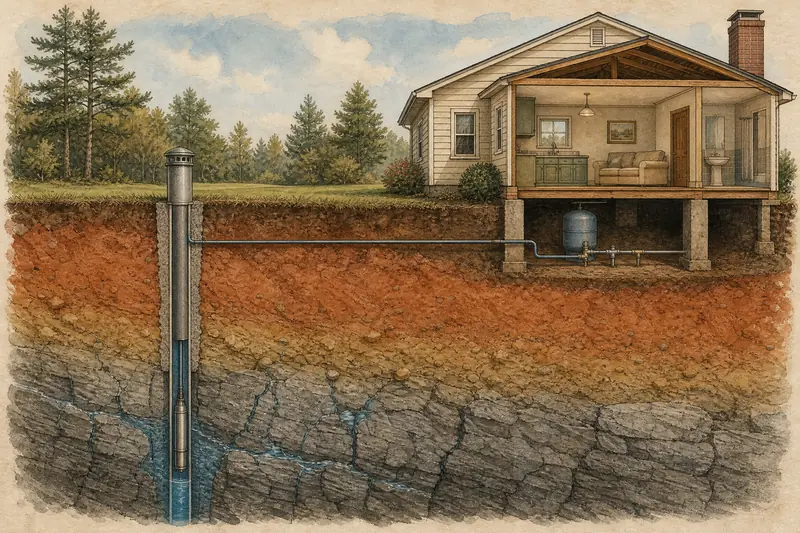
A whole house water filter treats all the water entering the home, which Penn State and NC DHHS call point-of-entry treatment, as opposed to a point-of-use unit under one sink. On a well it usually means catching grit and sand, improving taste and odor, or protecting the equipment downstream.
What it does depends entirely on the media inside. Penn State Extension's buying guide pairs each problem with a different device (Penn State Extension): sediment filters for particles, carbon for certain chemicals and odors, softeners for hardness, neutralizers for corrosive water, UV light for bacteria. NC DHHS's treatment guide does the same, matching sediment filtration to turbidity and listing other methods for iron, pH, nitrate and bacteria (NC DHHS).
So the first step is a full well test. The well water testing page lists what each county health department offers.
Do you need a sediment filter on a well?
Most wells benefit from one, and it is often the first stage of everything else. A sediment filter removes sand, grit and other particles that wear pump parts, clog fixture screens and foul the media in other treatment tanks.
North Carolina's well rules say a finished well should be developed until the water has no more than 5 mL/L of settleable solids and 10 NTU of turbidity (15A NCAC 02C .0107(i)). Water that stays sandy or cloudy after that may point to a problem with the well or pump, or to iron particles, so it is worth asking a licensed well contractor why before filtering it forever. The well pump and pressure tank page covers those parts.
Maintenance is the catch. Penn State says sediment filters "must be routinely changed (POU) or backwashed (POE) to maintain water flow." A cartridge left in too long drops water pressure throughout the house.
What does a carbon whole house filter remove?
Activated carbon mainly removes chlorine, some pesticides and herbicides, radon, and taste and odor compounds, according to Penn State Extension. Carbon is graded under NSF/ANSI 42 for aesthetic claims such as chlorine, taste and odor, and NSF/ANSI 53 for contaminants with a health effect. NSF also cautions that a certified filter is only certified for the contaminants listed on its claim, so read that list.
On a private well, chlorine is usually absent unless the house has a chlorinator or the well was just shocked. That makes carbon most useful on wells with a musty taste, a mild odor, or a specific chemical found in a test.
Radon is a special case. EPA describes point-of-entry granular activated carbon and aeration as the two ways to remove radon from water, and notes that carbon costs less but "radioactivity collects on the filter" (EPA). The radon and uranium page covers that choice.
Catalytic carbon, a treated form, can also handle a little dissolved iron. Penn State says it is effective for dissolved iron under 1.0 mg/L and needs at least 4.0 mg/L of dissolved oxygen.
In what order do well water filters go?
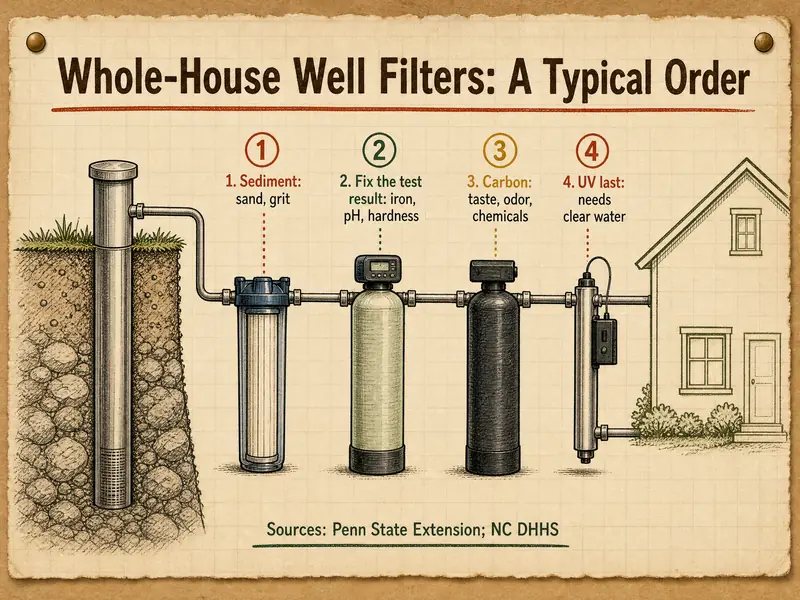
Sediment first, then the equipment that fixes your test results (iron, pH, hardness), then carbon, then UV last. The logic comes from what each stage can tolerate.
Because UV light has to reach every bacterium, Penn State wants the water "completely clear" and puts a sediment stage upstream (Penn State Extension). Its softening guide recommends filtering out oxidized iron before the softener, because iron clogs the resin. And because UV only kills bacteria inside the unit and leaves no residual, it makes sense close to where water enters the house plumbing, after the tanks where bacteria could otherwise grow. Penn State also warns that "bacteria can multiply in filter," so a well with a bacteria problem needs disinfection, not only filtration.
Which problems need something other than a whole house filter?
Several common well problems need specific treatment that a sediment or carbon filter does not provide. NC DHHS, NC DEQ and EPA guidance names the method for each.
| Problem | Named treatment | Where it installs |
|---|---|---|
| Coliform bacteria | Shock chlorination; UV if bacteria return | Whole house |
| Nitrate or nitrite | Anion exchange, distillation or reverse osmosis | Usually one tap |
| Arsenic | Pre-oxidation, then adsorptive media, ion exchange or RO | Whole house or one tap |
| Radon in water | Granular activated carbon or aeration | Whole house |
| Low pH | Neutralizing filter | Whole house |
| Hardness | Cation exchange softener | Whole house |
The bacteria row matters most, because it is the one with an immediate health angle. NC DHHS lists shock chlorination first and UV if contamination persists; the coliform bacteria page has the steps. Arsenic has its own page at arsenic in well water, and for nitrate, reverse osmosis at the kitchen tap is a common answer.
How do you maintain a whole house well filter?
Plan on routine cartridge changes or backwashing, periodic media replacement, and a retest after installation. Penn State Extension says all water treatment equipment needs routine maintenance; carbon "must be periodically replaced when exhausted," and sediment filters must be changed or backwashed. NC DHHS recommends retesting the water after any treatment system goes in, to confirm it works.
Backwashing tanks need a drain and enough pump flow, so check your pump's gallons per minute before buying one. Keep the backwash out of the septic tank; NC State Extension says treatment backwash should not be piped to the septic system (NC State Extension). Penn State also suggests asking vendors for written proof of NSF or WQA certification, and to steer clear of vendors who tout "EPA certification."
A carbon filter and a sediment separator from the linked stores
Once a test shows what you are filtering for, these are two options. SoftPro Water Systems sells a Catalytic Whole House Carbon Filter for well water (sold by SoftPro Water Systems, which has the same owners as this site) with a backwashing valve, in 1.0 to 2.5 cubic-foot sizes for one to five bathrooms; the store says it targets chlorine, chloramines, VOCs and other chemicals plus tastes and odors, and needs a pump delivering 6 to 11 GPM depending on size. Quality Water Treatment sells the SoftPro Spin-Down Sediment Separator (sold by Quality Water Treatment, which has the same owners as this site) in 3/4-inch to 2-inch sizes; the store says its head design uses centrifugal force to separate particles, with a 60-mesh screen after-filter.
Those descriptions are the stores'. Chlorine and chloramine claims matter mostly on chlorinated water, not a typical well. Neither unit disinfects or treats nitrate, arsenic or hardness.
- 10 NTUTurbidity limit when a new NC well is developed15A NCAC 02C .0107
- $500-$3,000Typical cost, one-tap unit to point-of-entry systemNC DHHS
- 4.0 mg/LDissolved oxygen catalytic carbon needs to remove ironPenn State Extension
- 1.0 mg/LDissolved iron limit for catalytic carbonPenn State Extension
Where this comes from
Sources for this page: Penn State Extension's equipment buying, coliform, iron and softening guides; NC DHHS's guide to choosing well treatment; EPA's radon-in-water page; NSF's description of its treatment standards; 15A NCAC 02C .0107; NC DEQ's arsenic brochure; and NC State Extension's septic guide, all read in October 2026. Store details are from each store's own listing. Not included: installer quotes, brand rankings, online forum advice, and any filter testing by Red Clay Septic & Well.
Questions worth asking
How often should a whole house sediment cartridge be changed?
When pressure starts to drop or the cartridge looks loaded, which varies widely with how sandy the well is. Penn State Extension says cartridges must be changed routinely to keep water flowing; some housings have a pressure gauge to make that call easier.
Can a carbon filter remove iron from well water?
Standard carbon is not an iron filter. Catalytic carbon can handle dissolved iron under 1.0 mg/L if the water has at least 4.0 mg/L of dissolved oxygen, according to Penn State Extension.
Will a whole house filter remove bacteria from a well?
Not reliably, and Penn State warns that bacteria can grow inside filters. Coliform bacteria call for shock chlorination and, if they return, continuous disinfection such as UV.
Does a spin-down filter replace a cartridge filter?
Not always. The store describes its spin-down as using centrifugal force plus a 60-mesh screen, which suits sand and grit; fine silt or cloudiness passes a screen that coarse and needs a finer filter.
Is it worth filtering a new well's water right away?
Wait for the county's new-well test results first. North Carolina requires that test within 30 days of the Certificate of Completion, and it tells you whether iron, pH or something else needs a specific treatment.
Should a carbon filter go before or after a softener?
Guidance does not set one order for every house. A common layout puts the iron or pH treatment and the softener ahead of carbon, with sediment first and UV last, and the installer's manual for each unit has the final word.
Read next
Filed under Well notes · septic and well notes for Durham