Wells
Private Wells Near Durham: Testing and Treatment
Private wells near Durham NC draw on three kinds of rock, Triassic Basin, Slate Belt and granite, and each leaves its mark on yield and water quality; a lab test is the only way to know yours.
Compiled by the Red Clay Septic & Well desk · Last revised
In these notes
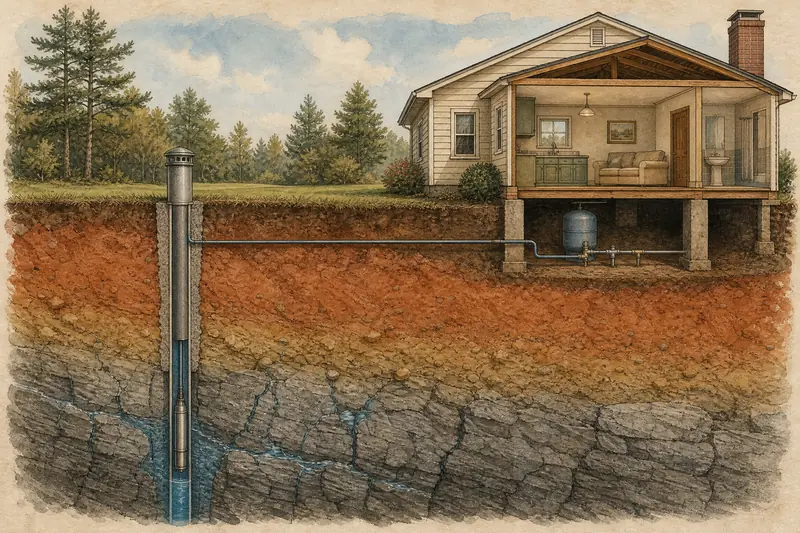
The short version
- About 2.4 million North Carolinians drink groundwater as their primary source, according to NC DHHS.
- The state requires one test, on a new well within 30 days of completion; after that, testing is up to the owner.
- NC DHHS suggests bacteria every year and metals, nitrate and nitrite every 2 years.
- Triassic Basin wells average 11 to 12 gpm, the lowest yields in NC State Extension's summary.
- About 26% of NC wells sampled in 2011-2013 tested positive for coliform bacteria, according to NC DHHS.
- Treatment follows the test: an iron filter, neutralizer, softener, RO unit or UV light each fixes a different problem.
- 2.4 millionNorth Carolinians who rely on groundwater for drinking waterNC DHHS
- 24%Piedmont wells above the 0.05 mg/L manganese staining standardNC DHHS
- 90%Piedmont and Blue Ridge groundwater samples with radon above 300 pCi/LUSGS SIR 2013-5072
- 50 ftWell to septic tank and drainfield for a single-family home15A NCAC 02C .0107
What makes private wells near Durham NC different?
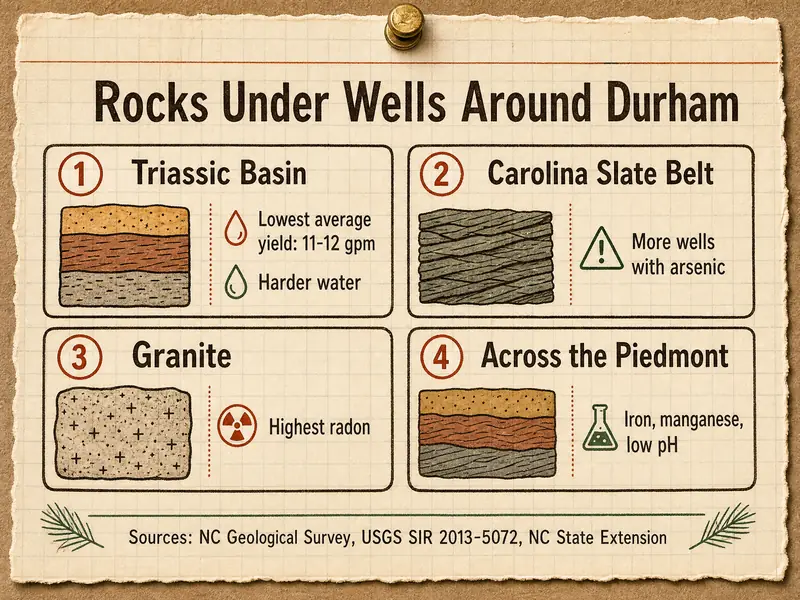
Private wells near Durham NC differ because the rock underneath changes over short distances, and each rock gives water its own character. The NC Geological Survey places parts of Durham, Orange, Chatham and Granville counties in the Triassic Basin, where clay-rich sandstone and siltstone hold little water; Person County is not on its list (NC Geological Survey). Most of Orange County lies on the Carolina Slate Belt, which also reaches Person County and which NC DEQ links to more wells with arsenic. Granite and other crystalline rock carry the highest radon.
Those patterns show up in the numbers. USGS found Triassic Basin groundwater harder and more often above pH 7 than water from crystalline rock, where about 90 percent of samples had pH of 7 or below (USGS SIR 2013-5072). Iron, manganese and acidic water turn up across the whole Piedmont. The same red clay that slows a drainfield sits over most of these wells; see red clay soil for that side.
| Problem | Typical sign | Limit or benchmark |
|---|---|---|
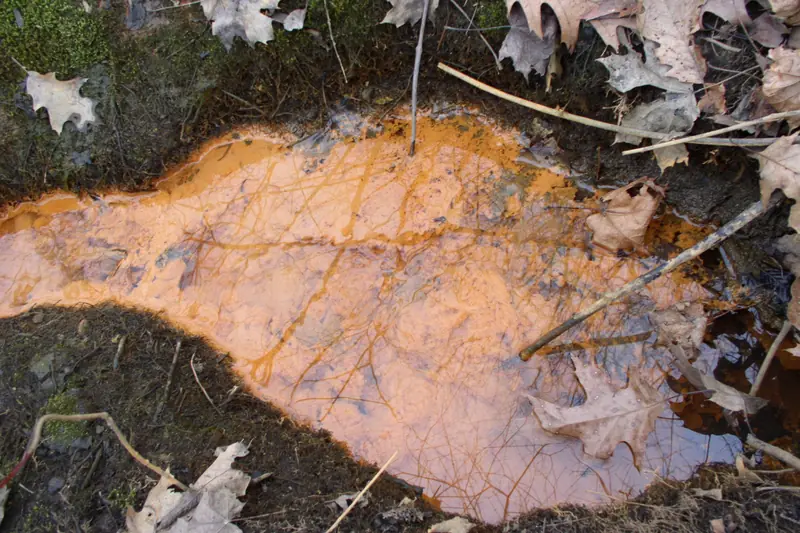
| Iron | Orange or rusty stains | EPA secondary: 0.3 mg/L |
| Manganese | Black or brown stains | EPA secondary: 0.05 mg/L; EPA health advisory: 0.3 mg/L |
| Low pH | Blue-green stains on fixtures | EPA secondary range: pH 6.5-8.5 |
| Arsenic | None; no taste or smell | EPA standard: 10 µg/L |
| Uranium | None | EPA standard: 30 µg/L |
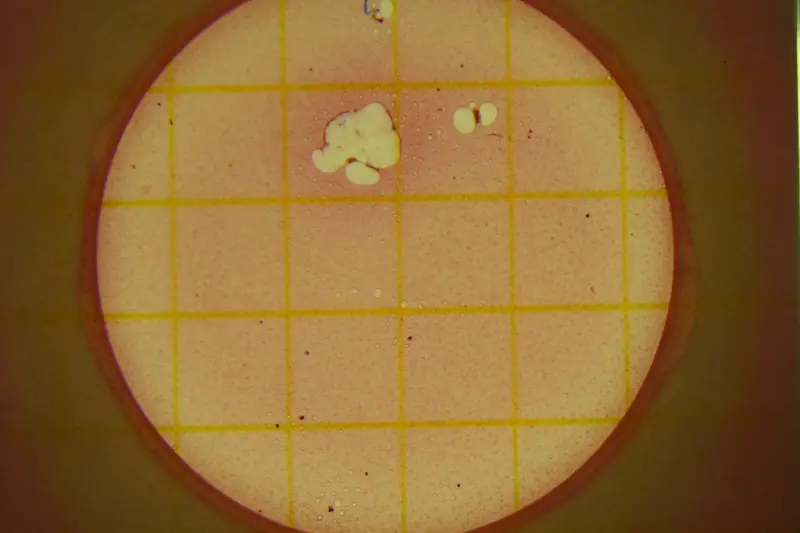
| Coliform bacteria | Usually none | NC DEQ groundwater standard of 1 colony per 100 mL |
Which private well pages cover testing, rules and the well system?
Three pages cover how a well is permitted, built, tested and kept running, starting from the rule that a county health department must permit every new private drinking water well under 15A NCAC 02C .0304. They explain the 30-day new-well test, the DHHS retest schedule, setbacks and casing depths, and the pump and tank that move the water.
Which pages cover well water problems?
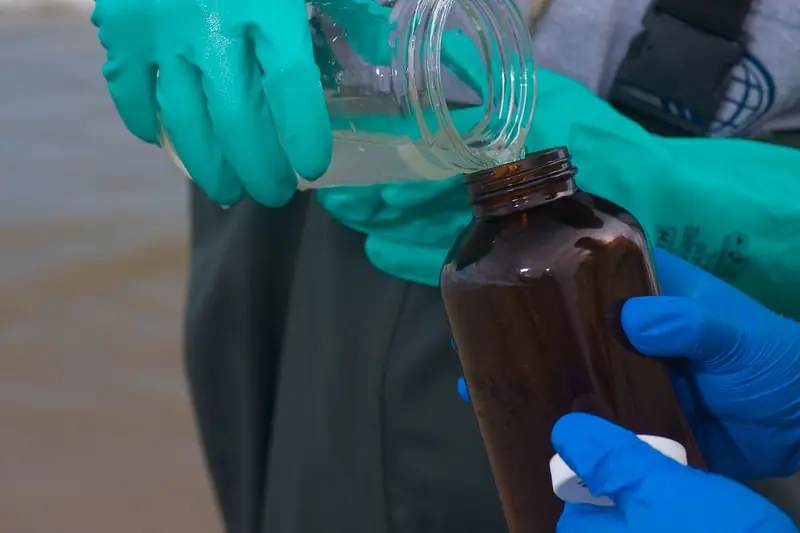
Five pages cover the problems NC DHHS says turn up most in North Carolina wells: in its words, "too much lead, arsenic, iron, manganese, low pH, and harmful bacteria" (NC DHHS FAQ). Radon and uranium get their own page because they are not on the required new-well test.
Which pages cover treatment equipment?
Three pages cover equipment that treats several problems at once or a single tap, and each starts from the same rule NC DHHS gives: know your hardness, pH, iron and turbidity before installing anything, and retest afterward (DHHS treatment guide). Some of these pages, and some problem pages above, link to two water-treatment stores that share owners with this site; each such page says so.
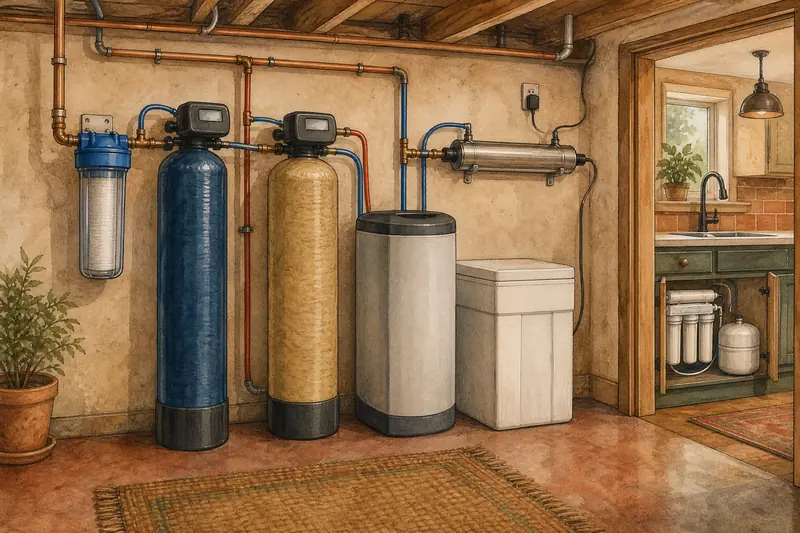 WellsWell water softener: when a Piedmont well needs one
 WellsWhole-house water filter for well water
- WellsReverse osmosis for well water
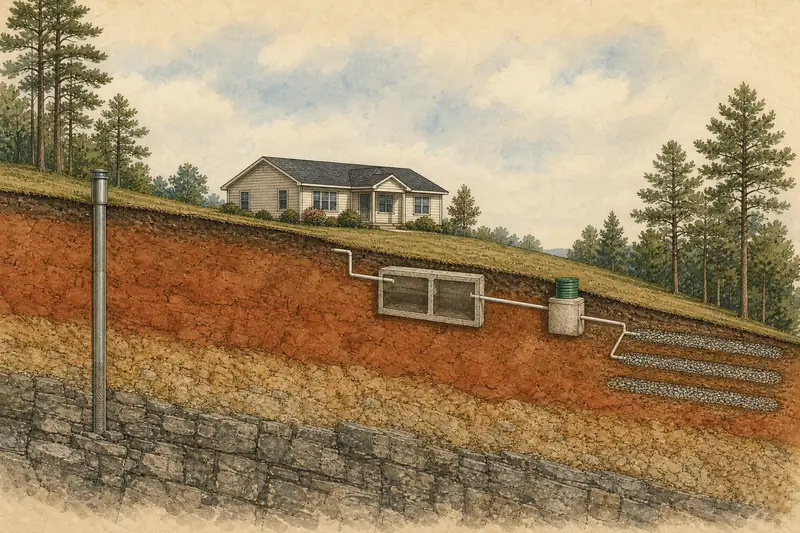
For septic questions on the same lot, start at the septic section; for the 50-foot well-to-septic distance from the septic side, see the drainfield page.
Where this comes from
This index summarizes the wells pages on this site, which rest on 15A NCAC 02C and 18A .3800, the NC DHHS private well program's web pages, NC DEQ and NC Geological Survey publications, USGS reports on Piedmont groundwater, NC State and Penn State Extension, EPA drinking water standards, and county health department pages for Durham, Orange, Chatham, Person and Granville, checked in October 2026. Not covered here: contractor prices, product rankings or forum reports.
Questions worth asking
Does a private well near Durham need to be tested every year?
No law requires it after the first test of a new well. NC DHHS suggests a coliform bacteria test every year and metals, nitrate and nitrite every two years, plus a test after flooding or repairs.
Who regulates private wells in the Durham area?
County health departments issue well permits and take water samples, under state rules in 15A NCAC 02C (construction and permits) and 15A NCAC 18A .3800 (sampling). Granville residents go through Granville-Vance Public Health. This site is a reference, not one of those offices.
Is well water near Durham hard?
It depends on the rock. USGS found Triassic Basin groundwater harder than water from crystalline rock, and its Orange County study found a median hardness of 75 mg/L as calcium carbonate. A test shows your number.
Can a private well and septic system share a small lot?
Yes, if the setbacks fit. Current rules put a single-family well at least 50 feet from the house's septic tank, drainfield and repair area, though older permits may show 100 feet.
What should a home buyer ask about a well?
Ask for the county well permit, any water test results and the well's ID plate details, then order a fresh test. NC State Extension's home-purchase list starts with coliform and nitrate and runs through lead, iron, hardness and pH to sulfate, dissolved solids and corrosivity.
Does City of Durham water come from wells?
No. EPA's records list the City of Durham system as surface water. The city water section covers it.
Filed under septic and well notes for Durham