Wells
Well Water Testing in NC: What, When and Where
Well water testing in NC is required only once, within 30 days of a new well's completion; after that the schedule is yours, and NC DHHS suggests bacteria yearly and metals every two years.
Compiled by the Red Clay Septic & Well desk · Last revised
In these notes
The short version
- A new private well in North Carolina must be sampled within 30 days of its Certificate of Completion under 15A NCAC 18A .3802.
- The required panel is coliform bacteria plus 17 named chemicals and pH; uranium, radon and hardness are not on it.
- After that first test, no further testing of a private well is required by the state.
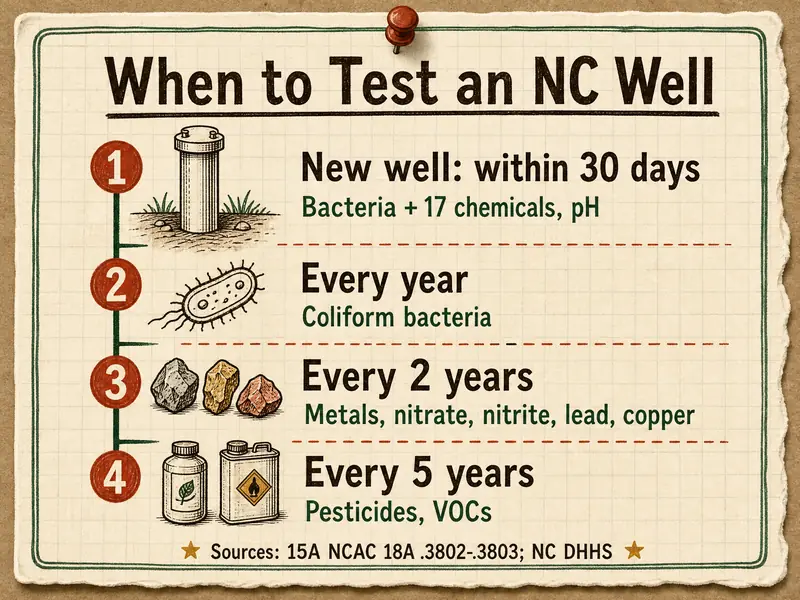
- NC DHHS suggests bacteria every year, metals, nitrate, nitrite, lead and copper every 2 years, and pesticides and VOCs every 5 years.
- Durham County lists $135 each for its bacteria and inorganic tests (application rev. 08/2025); other counties charge different amounts, and fees change.
- Results are compared with EPA public-water limits, such as 10 µg/L for arsenic and 10 mg/L for nitrate as nitrogen.
- 30 daysDeadline to sample a newly completed private well15A NCAC 18A .3802
- 2.4 millionNorth Carolinians who rely on groundwater as their main drinking waterNC DHHS
- 26%NC wells sampled 2011-2013 that tested positive for coliform bacteriaNC DHHS
- $74Most the State Lab of Public Health may charge for a well testUNC School of Government
What does well water testing in NC cover?
Well water testing in NC means sending a sample to a certified laboratory that checks it for bacteria, metals, minerals and a few chemical groups, then comparing each result with a drinking-water limit. Nobody tests a private well on a schedule unless the owner asks. The state requires one round of tests on a new well and leaves the rest to the household.
That matters because about 2.4 million North Carolinians drink groundwater, and NC DHHS notes that fewer than 200,000 wells were tested for contaminants from 2000 to 2010 (NC DHHS well water figures). The same program sums up the usual findings in this state: "too much lead, arsenic, iron, manganese, low pH, and harmful bacteria."
Around Durham the rock under the well shapes the results. Triassic Basin wells tend toward harder water, the Slate Belt has more wells with arsenic, and granite areas carry more radon. The private wells overview sorts those problems by rock type.
What must a new NC well be tested for?
A new NC well must be tested for total coliform bacteria and for arsenic, barium, cadmium, chromium, copper, fluoride, lead, iron, magnesium, manganese, mercury, nitrate, nitrite, selenium, silver, sodium, zinc and pH. That list comes word for word from 15A NCAC 18A .3803. If coliform turns up, the lab checks further for fecal coliform or E. coli.
The local health department collects the samples within 30 days after it issues the well's Certificate of Completion. The rule says the sample comes from a threadless tap ahead of any treatment equipment, and only after the disinfecting chlorine has been flushed out. Chatham County adds the practical side: the wellhead must be finished, the pump installed and powered, and all chlorine pumped out before anyone samples.
Three things are missing from the required list: uranium, radon and hardness. A well drilled into granite or the Raleigh Belt can pass every required test and still carry radionuclides, which is why the radon and uranium page treats those as a separate, optional test. The permit side of a new well, from setbacks to the Certificate of Completion, is on the well permits page.
How often should you retest a private well?
Retest a private well for bacteria every year, for metals, nitrate, nitrite, lead and copper every two years, and for pesticides and volatile organic compounds every five years. That is the current schedule in the NC DHHS private well FAQ (page modified July 2025). If a particular pesticide is used nearby, DHHS suggests testing for it yearly.
Some events call for a test outside the schedule. DHHS lists repairs or replacement of any well part and any flooding that reaches the wellhead. A new baby or a pregnancy is another: DHHS says to test for nitrate, and that boiling does not remove it. A change in taste, color or smell is worth a test too.
Other agencies publish schedules written for a national audience. EPA suggests a yearly check for coliform, nitrate, total dissolved solids and pH, and its RadTown page suggests radionuclides every three years. NC State Extension suggests iron, manganese, sulfate and hardness every three years. These do not conflict much with the DHHS list; they add a few items.
Where do you get well water tested around Durham?
Around Durham, start with your county health department, which takes the sample and sends it to the North Carolina State Laboratory of Public Health or another certified lab. DHHS lists those two routes for new wells, and the same offices take requests for existing wells. A state-certified commercial lab is the other option.
Each county runs its own program:
- Durham County Environmental Health takes requests on a written application and prefers to sample from a spigot at the wellhead.
- Orange County publishes a request form and a list of what each panel covers, and tells owners with treatment to "test the water where you actually drink it."
- Chatham County collects water samples Monday through Wednesday only and sends them to the State Public Health Laboratory.
- Person County says bacteria results usually come back in 48 hours and inorganic results within three weeks.
- Granville County is served by Granville-Vance Public Health, which posts a water sample request form.
This site is not a health department and does not take or test samples. For the county permit and records side of a well, see county permits and records, which covers the same offices.
What does a county well water test cost?
A county well water test around Durham costs roughly $70 to $175 per panel, depending on the county and the test, based on fee schedules checked in October 2026. The State Lab's own charge is capped at $74 by statute, according to the UNC School of Government; county fees cover collection and handling on top of that. Fees change, so confirm before you order.
| County | Bacteria | Inorganic or mineral panel | Other listed tests |
|---|---|---|---|
| Durham | $135 | $135 (metals, pH, hardness, nitrate/nitrite) | Pesticide $135; petroleum $135 |
| Orange | $128.90 | $170.25 | Full panel $174; VOC $174; iron bacteria $134 |
| Chatham | $70 | $110 | Nitrate $70; full panel (existing well) $150; sliding scale |
| Granville (GVPH) | $75 | $100 | Pesticides and other panels $100 |
Person County's fee amounts could not be confirmed for this page; ask the health department. Durham's figures come from its water analysis application (rev. 08/2025), Orange's from its online request form, Chatham's from its fee sheet effective July 1, 2024, and Granville-Vance's from gvph.org. Private labs set their own prices.
How do you read well water test results?
Read well water test results by comparing each number with its limit in the same units, then sorting the problems into health limits and nuisance limits. Health limits come from EPA's primary drinking water standards; nuisance limits, which cover staining, taste and odor, come from EPA's secondary standards. When the State Lab runs the test, the county receives results within about three weeks, along with a results analysis prepared by a toxicologist.
Units trip people up. Arsenic is often reported in mg/L, so 0.010 mg/L is the same as 10 µg/L. A "<" sign means the lab found less than the amount shown. NC DHHS's instructions for the Be Well Informed tool say to enter those non-detects as zero; the tool then suggests next steps based on your numbers.
| Result | Limit | Kind of limit |
|---|---|---|
| Arsenic | 10 µg/L | EPA health standard |
| Nitrate (as nitrogen) | 10 mg/L | EPA health standard |
| Uranium | 30 µg/L | EPA health standard |
| Manganese | 0.05 mg/L stains; 0.3 mg/L health advisory | EPA secondary standard; EPA advisory used by NC DHHS |
| Iron | 0.3 mg/L | EPA secondary standard |
| pH | 6.5 to 8.5 | EPA secondary standard |
| Copper | 1.3 mg/L | Action level for public systems |
| Lead | 0.015 mg/L | Action level for public systems |
Copper and lead limits are written for public water systems, not private wells, and NC DHHS points out that EPA and CDC say no lead level is safe. Once you know the problem, the treatment pages match equipment to it: iron and manganese, acidic water, arsenic and coliform bacteria. Retest after any treatment goes in; DHHS asks owners to do exactly that.
Where this comes from
This page is based on 15A NCAC 18A .3800 (readopted 2021), the NC DHHS Private Well and Health Program pages and handouts, EPA drinking water standards, NC State Extension and EPA testing schedules, and county fee schedules and request forms from Durham, Orange, Chatham, Person and Granville-Vance, all checked in October 2026. Some DHHS pages were unreachable live and were read from saved copies of the same official URLs. Left out: private lab prices, contractor advice and forum reports.
Questions worth asking
Does a home sale in NC require a well water test?
No state rule requires a well test when a house is sold; the only required test is the one on a new well. Lenders and buyers often ask for one. NC State Extension suggests a purchase panel of coliform bacteria, nitrate, lead, iron, hardness, pH, sulfate, total dissolved solids and corrosivity.
Can you collect your own well water sample?
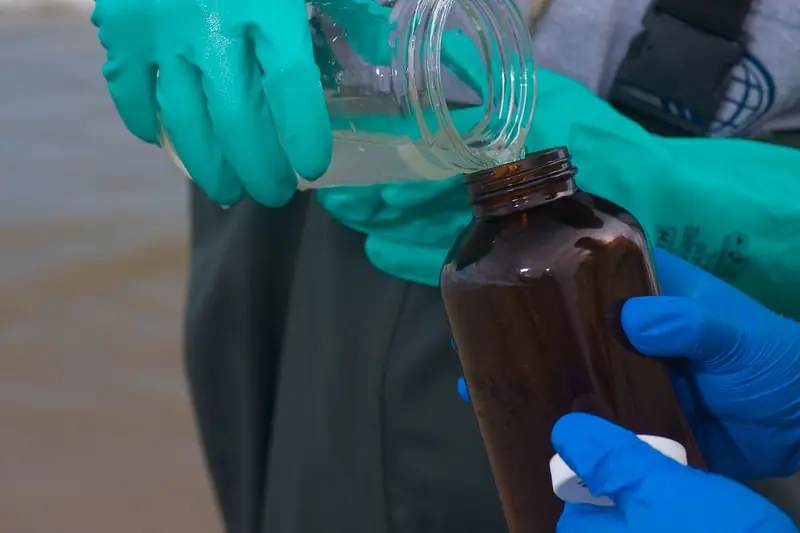
Some private labs send a kit with bottles and instructions for the owner to fill. County programs around Durham generally send staff to collect the sample, which keeps the chain of custody clean and lets them choose the tap. Bacteria samples are sensitive to how the tap is cleaned and flushed, so follow the lab's steps exactly.
Should the sample come from the kitchen tap or the wellhead?
For a raw-water picture, sample at the wellhead or before any treatment; that is what the new-well rule requires. To see what treatment is doing, Orange County suggests an extra test from a faucet after the filter. Doing both shows whether a problem starts in the ground or in the house plumbing.
Is uranium part of a county inorganic panel?
Usually not. Orange County's published inorganic panel and the state's new-well list do not include uranium, and NC DHHS lists certified private labs for uranium, radon and gross alpha. Ask the health department what its panel covers before you assume it.
What happens if a new well fails its required test?
When results go over a public-water limit, the DHHS epidemiology branch prepares a health risk evaluation with advice on water use limits, treatment options and how often to sample again. The owner gets that advice with the results. Treatment, retesting and sometimes shock chlorination follow.
How long do county well test results take?
Person County says bacteria results usually return in 48 hours and inorganic results within three weeks. DHHS says State Lab results reach the county within three weeks. Private labs post their own turnaround times.
Do you need to test for hardness?
Hardness has no health standard, so it is not on the required list. It matters if you are considering a softener: NC State Extension also suggests testing iron and manganese before buying one. The well water softener page covers when one makes sense.
Read next
Filed under Well notes · Durham-area septic and well notes