Septic
Septic Alarm Going Off: What the Pump Tank Is Saying
A septic alarm going off means effluent in the pump tank has risen past the pump-on level, so the pump has stopped keeping up; cut water use, silence the buzzer and get the pump checked.
Compiled by the Red Clay Septic & Well desk · Last revised
In these notes
The short version
- Under 15A NCAC 18E .1103, the high-water alarm runs on its own float, set to trip within 6 inches of the pump-on level.
- The alarm must stay working when the pump is dead, and it must have a silence button outside the panel and a manual test.
- A residential pump tank holds 12 hours of emergency storage, or 24 hours near water-supply and other protected waters (18E Table XVI). That is a design reserve, not a promise.
- NCDHHS lists a "red light or alarm beeping on your septic panel" among the signs of septic trouble.
- NC State Extension advises hiring a state-certified subsurface system operator for any system with a pump.
- A single-pump system (Type IIIb) gets a county compliance inspection every 5 years; low-pressure pipe (Type IVa) every 3 years plus operator visits twice a year.
Why is the septic alarm going off?
A septic alarm going off means the liquid in the pump tank has climbed to the alarm float, which sits just above the level where the pump should have switched on. Wastewater is arriving faster than it leaves. The three usual reasons are a pump that is not running, a pump that runs but cannot move effluent onward, or more water coming in than the system was sized for.
15A NCAC 18E .1103(h) requires "a separate control float" for the high-water alarm, set "within six inches of the pump-on level". Because the alarm float is separate from the pump floats, the alarm still sounds when the pump float has stuck or the pump motor has failed.
Common causes:
- No power to the pump. A tripped breaker, a switch on the control panel left in the off position, or an outage.
- A failed pump or a stuck float. A float that cannot move never tells the pump to start.
- A blocked path downstream. A clogged pump screen, a broken line, or laterals plugged with solids.
- Too much water. Several loads of laundry in a row, a running toilet, or rain and groundwater getting into the tanks.
The NC State Extension Septic System Owner's Guide reads the red light or beeping the same way: a pump not working properly, or a pump tank level "too high and close to failure."
What does a septic pump tank do?
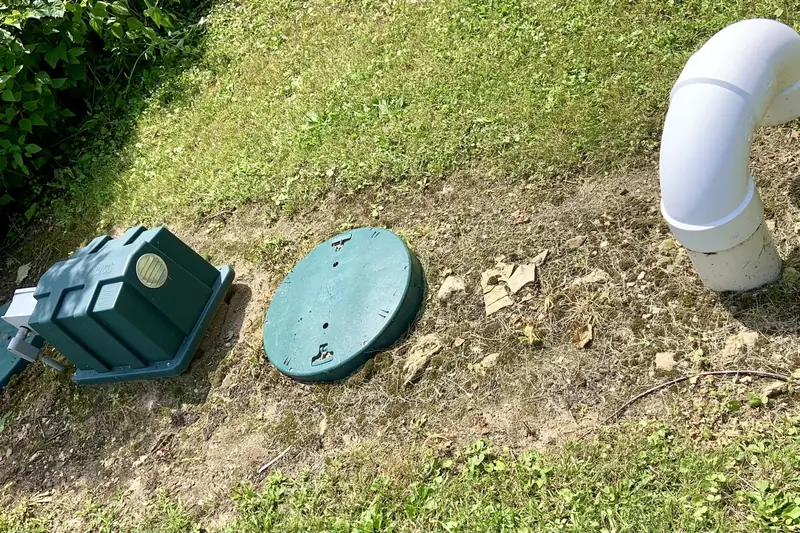
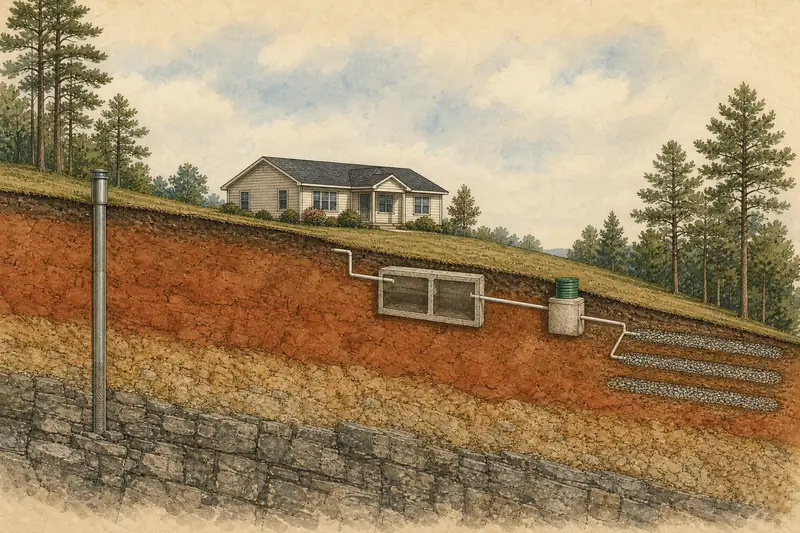
A septic pump tank is a second tank, after the septic tank, that collects settled effluent and pushes it to the drainfield in measured doses. NC requires a pump when gravity cannot carry effluent from the tank to the field, when total lateral length exceeds 750 feet, or when the design calls for a pressure system such as low-pressure pipe (18E .1101(a)). On sloping lots where the usable soil sits uphill of the house, a pump is the only way to get effluent there. On tight clays such as the Triassic Basin soils, low-pressure pipe systems use the pump to spread each dose across the entire field.
The pump tank must hold at least as much liquid as the required septic tank (18E .0802), so a 3-bedroom home with a 1,000-gallon septic tank has a pump tank of 1,000 gallons or more. At least 12 inches of effluent always stays in the bottom to keep the pump submerged. Every pump system also has a control panel within 50 feet of the tank, in line of sight. Its pump run light, elapsed time meter and event counter show a technician how long and how often the pump has run.
For how pump systems compare with gravity trenches and other designs, see septic system types.
What should you check first when the septic alarm sounds?
Check water use in the house first, then the control panel, and leave the tank itself alone.
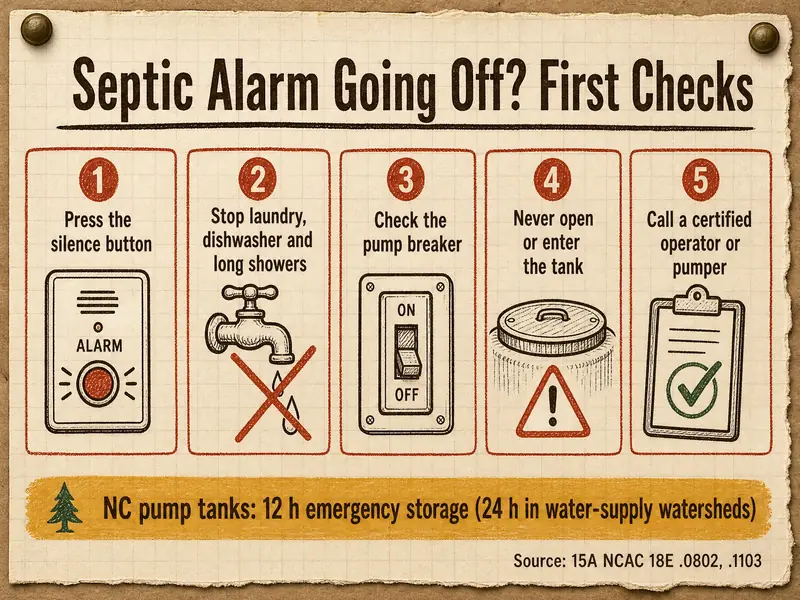
- Silence the buzzer. The rule requires a silencer button or device on the outside of the panel enclosure. Silencing stops the noise; the light stays on until the level drops.
- Stop the big water users. No laundry, dishwasher or long showers. Look for a running toilet or a dripping fixture.
- Look at the panel. Note whether the pump run light is on and whether a breaker for the pump circuit has tripped. If a breaker resets once and trips again, leave it off; that points to a pump or wiring fault.
- Look at the yard. NCDHHS lists "sewage surfacing after the pump turns on" as a sign of failure.
- Do not open or enter the tank. The NCDHHS septic factsheet is blunt: "Don't enter the septic tank." Tanks hold toxic gases, and floats and wiring are live.
- Call the right person. That is the certified operator named on the system's operation permit, if it has one, or a state-permitted pumper and a certified contractor if the pump has to come out.
If the light clears soon after water use drops, the system was probably just overloaded. Note the date and what was running.
How long can you use water after a septic alarm?
Plan on using as little water as possible until someone has found the cause, because the reserve is measured in hours. Under 18E Table XVI, a residential pump tank without standby power must have 12 hours of emergency storage capacity. In the state's water-supply watershed classes and in SA, SB and B waters, the requirement is 24 hours.
That reserve is a design figure. It assumes a tight tank and a correctly set alarm float, and a tank on an older permit may have been built to different rules. An occasional flush is fine; a load of laundry is not.
If the alarm comes back on after being silenced, or the light stays on overnight with little water use, treat it as a malfunction. 18E .1303 says the owner "shall contact the LHD when the wastewater system is malfunctioning," meaning the county health department. See septic repair for what that process looks like.
Why do pump tank alarms go off after heavy rain?
Pump tank alarms often go off after heavy rain because extra water gets into the system faster than the pump can dose it out. On red clay, the ground around the tanks stays saturated for days after a storm, and water finds its way in through loose lids, cracked risers, tank seams or a cleanout cap left open. NCDHHS flood guidance tells owners to "tighten and seal any access points like cleanout caps or tank lids" for this reason.
The other path is plumbing that should never reach the tank. The NCDHHS factsheet says not to direct downspouts, sump pumps or similar discharges into the septic system or toward the drainfield, and 18E .0901(g) requires stormwater, gutter drains and downspouts to be diverted away from the system. A field that is already wet also takes each dose more slowly, which matters most in clay soils.
During an actual flood, NCDHHS advises stopping use of the system and turning off power to septic pumps and alarms, then having electrical parts checked and filters cleaned before turning the power back on. A recurring rain alarm usually means water is getting in somewhere, so have the lids and risers checked.
How is a septic pump tank maintained?
A septic pump tank is maintained on a schedule set by its system type, with regular checks of floats, pump, alarm and panel, and pumping when solids build up. NCDHHS notes that "if your system includes a pump tank, that may need pumping, too," and the EPA says systems with float switches, pumps or mechanical parts should be inspected more often than gravity systems, "generally once a year."
NC's management table assigns each system a type and a visit schedule:
| System type | Who manages it | County (LHD) compliance inspection |
|---|---|---|
| Type IIIb: single pump or siphon to a gravity field | Owner or certified operator | Every 5 years |
| Type IVa: low-pressure pipe (LPP) | Certified operator, 2 visits a year | Every 3 years |
| Type IVb: more than one pump or siphon | Certified operator, 2 visits a year | Every 3 years |
| Type Va: advanced pretreatment up to 3,000 gpd | Certified operator, 2 visits a year up to 1,500 gpd (quarterly in year one) | Every year |
Some counties run monitoring programs. Chatham County inspects systems with "floats, pumps, alarms, valves, and highly technical control panels" because, unchecked, they "could lead to a premature failure."
When a pump, float, effluent filter or control panel wears out, 18E .1301(h) treats a like-for-like replacement as maintenance rather than a repair, so it does not need a new permit. Changing the tank or the dispersal field does. Pumping of both tanks is covered on the septic tank pumping page, and a point-of-sale septic inspection checks that the alarm works and that the pump delivers effluent to the next component.
- 6 inHighest the alarm float may sit above the pump-on level15A NCAC 18E .1103(h)
- 12 hEmergency storage for a home pump tank, no standby power, outside protected watersheds15A NCAC 18E .0802, Table XVI
- 12 inEffluent always left in the bottom of the pump tank15A NCAC 18E .1103(h)
- 24 inMinimum height of the control panel above finished grade15A NCAC 18E .1103(d)
Where this comes from
This page is based on 15A NCAC 18E Sections .0802, .1101, .1103 and .1301 (rules as amended June 1, 2026), the NCDHHS homeowner page, septic factsheet and flood guidance, the NC State Extension Septic System Owner's Guide, EPA's septic care page and Chatham County's monitoring program page, all checked in October 2026. Left out: contractor prices, brand-specific alarm panels and forum troubleshooting. Red Clay Septic & Well is a reference site, not a septic company or a county office.
Questions worth asking
Can I just unplug the septic alarm?
No. The rule requires the alarm to stay working whenever the pump is not, and unplugging it only hides the problem. Use the silence button on the outside of the panel instead; the light keeps showing until the level drops.
Is it safe to flush the toilet when the septic alarm is on?
An occasional flush is usually fine because the pump tank has reserve space above the alarm level. Laundry, dishwashers and long showers are what overrun it. If the light does not go off after several hours of light use, the pump likely is not running.
Who fixes a septic pump in North Carolina?
A state-certified subsurface system operator handles routine checks on pump systems, and a contractor certified by the NC On-Site Wastewater Contractors and Inspectors Certification Board installs or repairs components. Pumpers hold a septage firm permit from the state, not a certification from that board.
Does a septic alarm mean the drainfield has failed?
Not by itself. Most alarms trace to the pump, a float, power or a burst of water use. It becomes a failure under 18E when sewage surfaces, backs up into the house, or the tank needs pumping more than once a month to prevent that.
How is a septic alarm tested?
18E .1103 requires every high-water alarm to allow manual testing and to reset on its own afterward. A working test sounds the buzzer and lights the lamp; if nothing happens, have it serviced.
Should the pump tank be pumped when the septic tank is?
Often, yes. NCDHHS notes that a pump tank may need pumping too. Ask the pumper to check both compartments of the septic tank and the pump tank.
Read next
Filed under Septic notes · the front page of these Piedmont field notes