Wells
Radon and Uranium in NC Well Water
Radon and uranium in well water come from the rock itself; uranium has a 30 µg/L federal limit, radon has none, and neither is on North Carolina's required new-well test.
Compiled by the Red Clay Septic & Well desk · Last revised
In these notes
- Why do radon and uranium show up in NC well water?
- What are the limits for uranium and radon in well water?
- How do you test well water for radon and uranium?
- How is radon removed from well water?
- How is uranium removed from well water?
- Should radon in water change how you test indoor air?
- Questions worth asking
The short version
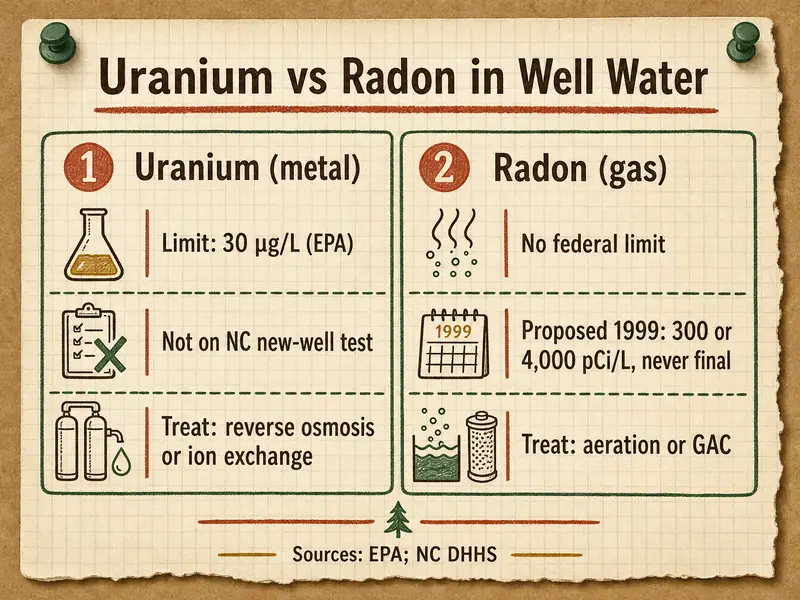
- Uranium in drinking water has an EPA limit of 30 µg/L (EPA drinking water regulations); radon in water has no enforceable federal limit.
- EPA proposed 300 pCi/L for radon, or 4,000 pCi/L where a state runs an indoor-air program, in November 1999 and never finalized either number.
- About 90% of 275 Piedmont and Blue Ridge groundwater samples in a USGS study had radon above 300 pCi/L, with the highest levels in granite.
- Only 0.6% of 310 USGS samples had uranium above 30 µg/L, but NC DHHS reports some NC wells as high as 250 µg/L.
- Neither radionuclide is on the required new-well list in 15A NCAC 18A .3803; testing is up to the owner.
- Reverse osmosis or ion exchange reduce uranium; radon in water calls for whole-house aeration or granular activated carbon.
- 30 µg/LEPA limit for uranium in public drinking waterEPA
- 1999Year EPA proposed a radon-in-water rule that was never finalizedEPA
- 405 pCi/LMedian radon in Orange County well waterUSGS WRIR 00-4286
- 89%Share of radon-in-water cancer deaths EPA attributes to breathing the released gasEPA
Why do radon and uranium show up in NC well water?
Radon and uranium show up in NC well water because they come from the rocks the well is drilled into. Uranium is a metal that occurs naturally in rock, soil and water; radon is a gas that forms as uranium breaks down. NC DHHS says low levels of uranium in wells are "mostly attributed to the underlying bedrock composition."
Rock type decides how much. A USGS study of Piedmont and Blue Ridge groundwater found radon highest in granite, and about 90 percent of its 275 samples were above 300 pCi/L (USGS SIR 2013-5072). In Orange County, an earlier USGS study measured radon from 38 to 4,462 pCi/L with a median of 405, and the highest medians in phyllite and felsic metaigneous rock.
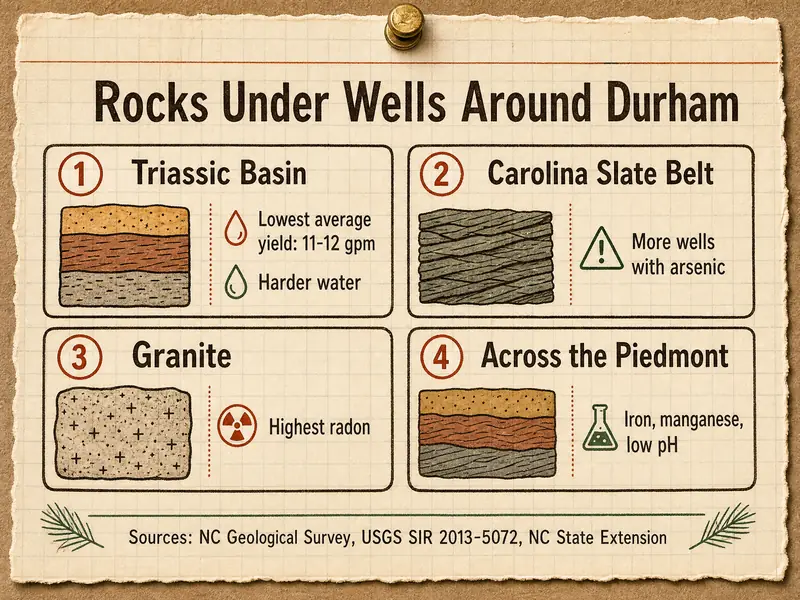
Uranium follows different belts. The DHHS uranium handout names the Raleigh Belt, Carolina Slate Belt and the Charlotte and Milton belts, with the Raleigh Belt highest. The usual range in NC is 0 to 30 µg/L, "with a small amount as high as 250 ug/L." USGS also found Triassic Basin sedimentary rocks had higher median uranium than other sedimentary groups, at about 3 µg/L. The private wells overview shows which problems tend to follow which rocks around Durham.
What are the limits for uranium and radon in well water?
The limit for uranium is 30 µg/L, EPA's maximum contaminant level for public water systems since 2003; for radon in water there is no enforceable federal limit. EPA proposed a radon rule on November 2, 1999, and its regulatory page still says "A Final Rule has not published yet" (EPA radon rule status).
The 1999 proposal had two numbers. Water systems would have had to reduce radon to 300 pCi/L, or to 4,000 pCi/L if the state ran an approved indoor-air radon program. EPA estimated that 4,000 pCi/L in water adds about 0.4 pCi/L of radon to indoor air, and 300 pCi/L adds about 0.03. Some reports call 300 pCi/L the "alternative" level; in EPA's own proposal it is the main limit and 4,000 is the alternative.
None of these numbers applies to a private well. EPA states it "does not regulate private wells," and the public-water limits are used as yardsticks. Other radionuclide limits for public water are 15 pCi/L for gross alpha and 5 pCi/L for combined radium 226 and 228.
| Contaminant | Number | Status |
|---|---|---|
| Uranium | 30 µg/L | Enforceable limit for public water since 2003 |
| Gross alpha | 15 pCi/L | Enforceable limit for public water |
| Radium 226 + 228 | 5 pCi/L | Enforceable limit for public water |
| Radon (no indoor-air program) | 300 pCi/L | Proposed 1999, never finalized |
| Radon (with indoor-air program) | 4,000 pCi/L | Proposed 1999, never finalized |
How do you test well water for radon and uranium?
Test well water for radon and uranium by ordering those tests by name from a certified lab, because the required new-well panel under 15A NCAC 18A .3803 does not include them. NC DHHS suggests a first screen of gross alpha, gross beta, uranium and radon, adding radium 226 and 228 if questions remain (DHHS radionuclides handout).
Where to send the sample is the catch around Durham. The DHHS handout points Wake and Franklin County residents to their county programs and everyone else to private labs certified by the State Laboratory of Public Health for these tests; it lists those labs as of July 2022. Orange County's published inorganic panel does not list uranium, so ask any county what its panel covers before you assume. The well water testing page lists what each county panel covers.
How often is less settled. EPA's RadTown page says well water "should be tested every three years for radionuclides," while the DHHS uranium handout suggests uranium every two years. Radon escapes from water exposed to air, so follow the lab's collection steps exactly.
How is radon removed from well water?
Radon is removed from well water with a whole-house device at the point where water enters the house: an aeration unit or a granular activated carbon (GAC) filter. EPA names those two as the point-of-entry options that remove radon (EPA radon in drinking water). A single under-sink filter does not help much, because the main risk is gas released into the air from showers, washers and faucets all over the house.
EPA notes that GAC filters "tend to cost less than aeration devices," but radioactivity collects on the carbon itself. Aeration strips the gas out of the water and vents it outdoors. NC DHHS puts radionuclide treatment at $1,000 to $15,000 installed; contractors quote the specific system. A reverse osmosis unit is not the radon answer.
How is uranium removed from well water?
Uranium is removed from well water with reverse osmosis or ion exchange, the two methods NC DHHS lists. Because uranium is a health risk mainly through drinking, a point-of-use reverse osmosis system at the kitchen tap is a common choice. DHHS also lists bottled water or a public water connection where one is close.
Match the equipment to the test result. A whole-house well filter built for sediment or taste does not remove uranium, and a softener's certification for hardness says nothing about radionuclides. NSF warns that passing one certification standard is no promise against every contaminant, so check that uranium appears on the product's listing. Retest after installation.
Should radon in water change how you test indoor air?
Yes: radon in well water is one more reason to test the air, and the NC Radiation Protection Section recommends that all homes and buildings in North Carolina be tested for radon. Most indoor radon comes from the soil under the house, and EPA estimates that 89 percent of the cancer deaths linked to radon in drinking water come from breathing gas released into the air, against 11 percent from swallowing it.
Run an air test and a water test together and compare them. High air radon with low water radon points to the foundation, which is a different fix from water treatment. Test kits are sold through the NC Radon Program, according to DHHS. The arsenic page covers the other naturally occurring contaminant tied to Slate Belt rock.
Where this comes from
This page is based on EPA's drinking water regulations and its radon proposal and status pages, the NC DHHS uranium and radionuclides handouts, USGS SIR 2013-5072 and WRIR 00-4286, 15A NCAC 18A .3803, and NSF's description of treatment standards, each checked during October 2026; DHHS documents that would not load live were read in archived form under their official addresses. Not used: equipment prices from sellers, lab-by-lab prices and forum reports.
Questions worth asking
Is radon in well water a bigger risk than uranium?
They work differently. Radon is a gas whose main risk is breathing it after it leaves the water, while uranium's main risk is drinking it, and DHHS links uranium exposure to kidney damage. The test results, not the name, decide which matters for a given well.
Does boiling water remove radon or uranium?
Neither EPA nor NC DHHS lists boiling as a treatment for either one. DHHS lists reverse osmosis and ion exchange for uranium, and EPA lists aeration and carbon for radon. Heating water also releases radon into the room, where EPA places most of the risk.
Can a softener remove uranium?
Ion exchange is one of the two uranium treatments DHHS lists, but a household softener is set up for hardness. Whether a given unit reduces uranium depends on its resin and what its listing says. Test before and after.
Does showering in high-radon water matter?
Showering is one of the ways radon moves from water into indoor air. EPA's estimate puts most of the water-related risk on breathing that gas. Whole-house aeration or GAC targets that exposure.
Do public water users need to worry about radon in water?
Public systems in NC are regulated for radionuclides such as uranium and radium. DHHS notes that people on public water can still have indoor radon from the soil, so the air test still applies.
What does gross alpha mean on a lab report?
Gross alpha measures alpha particles given off by the sample, and DHHS puts it in the first radionuclide screen alongside gross beta, uranium and radon. EPA's limit for public water is 15 pCi/L. A high result is a cue to look at the specific radionuclides, such as radium 226 and 228.
Read next
Filed under Well notes · Durham-area septic and well notes