Septic
Septic Care: Habits That Protect the Drainfield
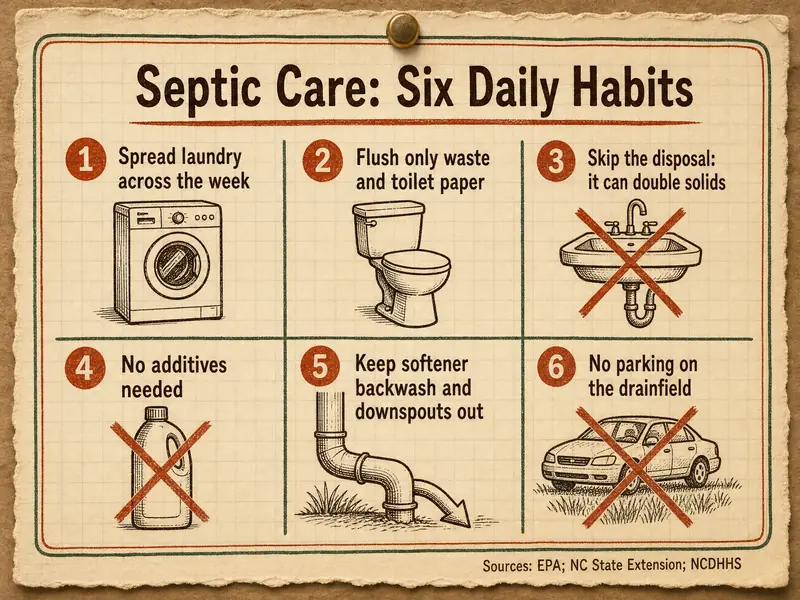
Septic care is mostly about what goes down the drain and how fast: steady water use, only waste and toilet paper in the toilet, no disposal, no additives, and nothing extra piped in.
Compiled by the Red Clay Septic & Well desk · Last revised
In these notes
The short version
- NC State Extension puts typical use near 50 gallons per person per day, and EPA says indoor use can reach 70; one running toilet can add up to 200 gallons a day.
- Extension's AG-439-13 says garbage disposals "usually double" the solids going into the tank, and the NCDHHS factsheet says not to install them.
- EPA's 2024 additives factsheet (EPA 830-F-24-003) does not recommend septic additives.
- EPA's rule of thumb: flush nothing but human waste and toilet paper.
- Extension and NCDHHS both say water softener backwash should not discharge into the septic system.
- 15A NCAC 18E .0901(g) requires stormwater, gutters and downspouts to be diverted away from the system.
What does good septic care look like?
Good septic care looks like a household that spreads its water use out, sends only sewage and toilet paper down the pipes, keeps the drainfield grassed and undisturbed, and has the tank checked on schedule. None of it is expensive. The point is to keep solids in the tank and to give the soil time to absorb each day's flow.
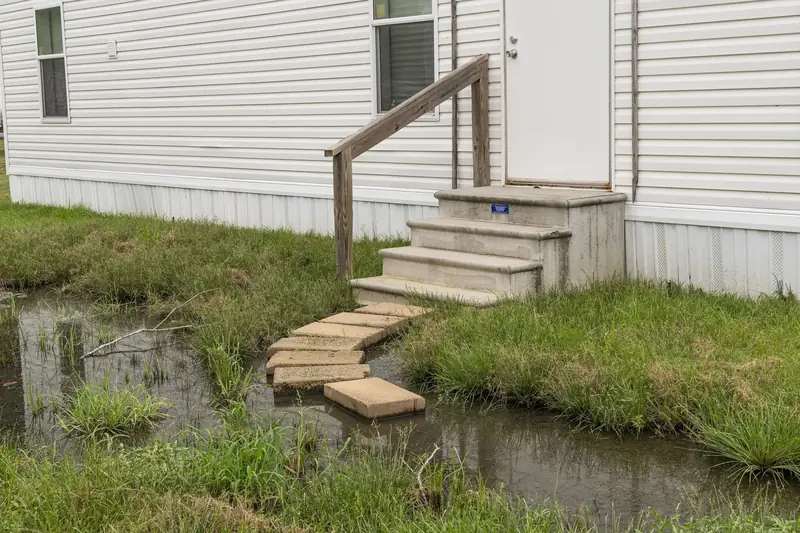
That last part matters more on clay than on sand. 18E allows Group IV clay soils only 0.1 to 0.4 gallons per square foot per day, and NC State Extension notes that soils able to absorb a family's 200 to 250 gallons a day "would become waterlogged if an extra 250 gallons were added." A system on red clay soil has less slack for heavy laundry days, leaks and roof water.
NC's rules also give the owner a few duties. 18E .1303 calls for vegetation over the field and repair area and no soil disturbance or compaction there, and the NCDHHS septic factsheet adds no decks, patios or sheds over the system and no driving or parking on it. Extension advises keeping trees and shrubs at least 25 feet from the drainfield.
Routine service rounds it out. The effluent filter needs a check at least every 2 to 3 years and whenever drains slow, and the tank needs pumping before solids pass one-third of its liquid depth. The septic tank pumping page covers the schedule.
How much water use is too much for a septic system?
Water use becomes too much when daily flow pushes past what the system was permitted for, or when a lot of water arrives in a short time. NC permits a home for 120 gallons a day per bedroom under 18E .0401, so a 3-bedroom house is designed for 360 gallons. NC State Extension puts typical use near 50 gallons per person per day; EPA says indoor use "can be as much as 70 gallons per individual, per day."
Most homes stay under the design number until something goes wrong. A running toilet can add as much as 200 gallons a day, according to EPA, and Extension notes that uncorrected leaks "can more than double the amount of water you use." Check toilets by listening for refill cycles when nothing is in use.
Timing matters as much as totals. EPA advises spreading laundry through the week rather than doing it all in one day, which can flood the field before the tank has time to settle the solids. Toilets account for 25 to 30 percent of household use, and EPA notes that older toilets use 3.5 to 5 gallons per flush against 1.6 gallons or less for high-efficiency models. Low-flow showerheads and faucet aerators cut flow further.
On a pump system, a burst of water is what trips the high-water alarm; see pump tank alarms.
Are garbage disposals and septic systems compatible?
Garbage disposals and septic systems are a poor match, and NC guidance says to avoid them. The NCDHHS factsheet is direct: "Don't install garbage grinders at sinks." NC State Extension says disposals "usually double the amount of solids added to the tank," and EPA says that if you must use one, "your tank will need to be pumped more frequently."
Food scraps break down slowly in a septic tank and settle as sludge or float as scum, so more of the tank fills with solids between pumpings. When solids build up, they are more likely to reach the effluent filter and the field. Some permits go further: the NCREC bulletin for brokers notes that a permit "may state other limitations such as prohibiting the use of a dishwasher or garbage disposal." Check the permit before installing one.
Compost bins and the trash can handle scraps without adding to the tank.
Do septic additives help?
Septic additives do not help a working system, and EPA does not recommend them. Its 2024 Septic Tank Additives factsheet says septic systems already contain the bacteria, enzymes, yeasts and fungi they need, and that additive products "can be ineffective or even harm system operation and the environment."
NC State Extension reached the same conclusion. Research on bacterial additives "has not shown any reduction in the rate of solids buildup nor increases in bacterial activity," so they do not reduce the need for pumping. Some products contain organic chemicals that "may even damage the drainfield or contaminate the groundwater and nearby wells," which matters on lots where the well is 50 feet from the field.
If a system smells or drains slowly, the cause is usually solids, a clogged filter or a wet field, and an additive will not fix any of those. A certified inspector or the county health department can say what is wrong.
What should never go into a septic system?
Nothing should go into a septic system except human waste, toilet paper and normal wash water. EPA's list of things never to flush includes cooking grease or oil, non-flushable wipes such as baby wipes, feminine hygiene products, condoms, dental floss, diapers, cigarette butts, coffee grounds, cat litter, paper towels, pharmaceuticals and household chemicals such as gasoline, pesticides, antifreeze and paint. NCDHHS adds that no wipes of any kind belong in the toilet.
The sink list is similar. NCDHHS says not to pour grease, oils, fats, paint, gas, cleaners, medications, coffee grounds or food scraps down the drain. EPA suggests boiling water or a drain snake instead of chemical drain openers and asks owners to keep even latex paint waste to a minimum.
| Item | Guidance | Source |
|---|---|---|
| Wipes, diapers, cat litter, paper towels | Never flush | EPA; NCDHHS |
| Grease, oil, food scraps, coffee grounds | Keep out of sinks | EPA; NCDHHS |
| Garbage disposal | Don't install; check the permit for a ban | NCDHHS factsheet; NC State Extension; NCREC |
| Septic additives | Not recommended | EPA 830-F-24-003 (2024) |
| Water softener backwash | Don't connect to the septic system | NC State Extension AG-439-13; NCDHHS factsheet |
| Downspouts, sump pumps, roof water | Divert away from the system | 15A NCAC 18E .0901(g); NCDHHS factsheet |
| Hot tubs, pools, HVAC condensate | Don't discharge into the system | NCDHHS factsheet |
Is water softener backwash safe for septic care?
Water softener backwash should not go into a septic system under NC guidance. NC State Extension's AG-439-13 tells owners to keep a softener's backwash line off both the house drains and the tank, and the NCDHHS factsheet lists water softeners alongside downspouts, sump pumps, hot tubs and pools among the discharges to keep out of the system and away from the drainfield.
Neither source explains the reasoning in detail, and the NC guidance does not depend on softener size or salt type. The practical step is to plan a separate discharge point when a softener goes in, and to ask the county health department where it may go on that lot. For well owners, the well water softener page covers when a softener makes sense, starting with a lab test. Homes on City of Durham water do not need one; the city's water is soft.
The same logic covers anything else that adds clean water to the tank. Extension's Why Do Septic Systems Fail? says a sump pump, icemaker or dehumidifier drain "should not be connected into your septic system."
- 50 galTypical water use per person per dayNC State Extension AG-439-13
- 200 galWater a single leaky or running toilet can add per dayEPA
- 2xSolids added to the tank when a garbage disposal is usedNC State Extension AG-439-13
- 25 ftDistance to keep trees and shrubs from the drainfieldNC State Extension
Where this comes from
This page is based on EPA's septic care page and 2024 additives factsheet, NC State Extension publications AG-439-13 and Why Do Septic Systems Fail?, the NCDHHS septic factsheet and homeowner page, 15A NCAC 18E Sections .0401, .0901 and .1303 (rules as amended June 1, 2026) and NCREC's 2016 broker bulletin, all checked in October 2026. Left out: product recommendations, additive brands, contractor advice and forum tips.
Questions worth asking
Are flushable wipes safe for a septic system?
No. NCDHHS says not to flush wipes, and EPA lists baby wipes and other wet wipes among items never to flush. The only paper that belongs in the toilet is toilet paper.
Can bleach and household cleaners go down the drain on septic?
EPA warns against pouring large volumes of toxic cleaners, solvents or oil-based paints down the drain, because they can kill the organisms that treat the waste. Its caution is about large volumes; it sets no limit for ordinary household cleaning.
Do yeast or enzyme treatments help a septic tank?
No. NC State Extension found no reduction in solids buildup from bacterial additives, and EPA says the tank already contains the microorganisms it needs. Pumping on schedule is what removes solids.
Can a hot tub or pool be drained into a septic system?
No. The NCDHHS factsheet lists swimming pools, hot tubs and water features among discharges to keep out of the septic system and away from the drainfield.
How close can trees be to a drainfield?
NC State Extension advises removing or not planting trees and shrubs within 25 feet of the drainfield. Grass is the preferred cover, and 18E requires vegetation over the field.
Where should an HVAC condensate line or sump pump drain?
Away from the septic system and the drainfield. NCDHHS lists HVAC condensate drains and sump pumps among the discharges not to direct into the system, and 18E requires stormwater and downspouts to be diverted.
Does septic care change with a pump system?
The habits are the same, but a pump system adds parts: floats, a pump, an alarm and a control panel. EPA says systems with these components should be inspected more often, generally once a year.
Read next
Filed under Septic notes · septic and well notes for Durham