Septic
New Septic System in NC: From Soil Test to Permit
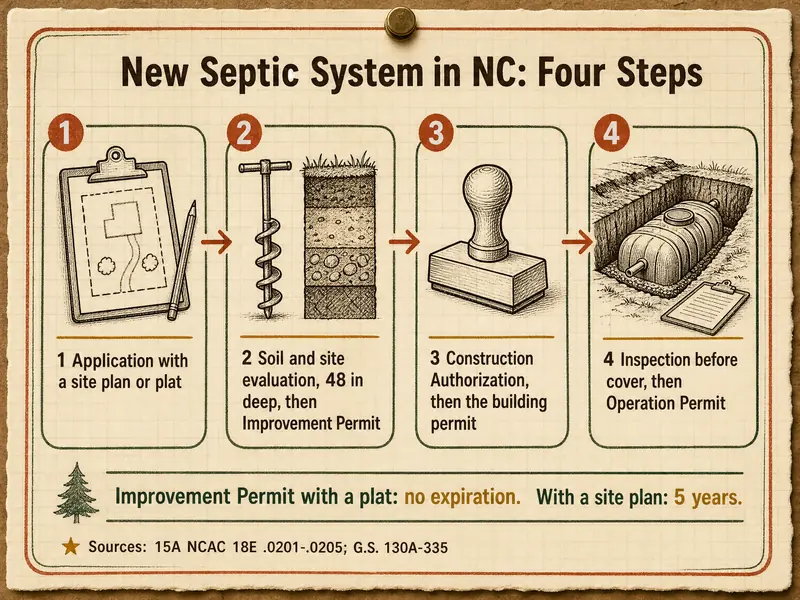
A new septic system in NC needs four approvals in order: an application, a soil and site evaluation that leads to an Improvement Permit, a Construction Authorization, and an inspection before cover that ends in an Operation Permit.
Compiled by the Red Clay Septic & Well desk · Last revised
In these notes
The short version
- 15A NCAC 18E .0201 sets the order: application, Improvement Permit, Construction Authorization, then inspection and Operation Permit.
- The building permit comes after the Construction Authorization, so the septic permit sits on the critical path of any new house on a well-and-septic lot.
- NC uses a field soil evaluation to 48 inches, not a perc test; one unsuitable item, such as wetness within 12 inches, fails the site.
- Design flow is 120 gallons a day per bedroom, which sets a 1,000-gallon tank for up to four bedrooms and 1,250 gallons for five.
- Under G.S. 130A-335(f), an Improvement Permit backed by a surveyed plat does not expire; one based on a site plan lasts five years.
- Residential Improvement Permit fees in the five counties ran from $200 (Person) to $400-$450 (Granville-Vance) on schedules checked October 2026.
- 5 yearsImprovement Permit term when it rests on a site plan rather than a platG.S. 130A-335(f)
- 48 inDepth of the soil and site evaluation, or to a limiting condition15A NCAC 18E .0501(c)
- 12 monthsLife of a pending permit application awaiting the applicant15A NCAC 18E .0202(d)
- 1/4 to 1/3 acreSuitable soil needed for a 4-bedroom system plus its repair areaOrange County Health Department
How do you get a new septic system in NC?
You apply to the county health department, get the site evaluated and permitted, have a certified contractor install the system, and pass a county inspection before the trenches are covered. State rule 18E .0201(b) lays out that sequence, and 18E .0202(a) says to apply before building or moving a home, before building or moving a system, or whenever the design flow will go up.
The local office depends on the county. Durham County's On-Site Water Protection section does site evaluations and construction inspections for septic and well permits. Granville County is served by Granville-Vance Public Health, and Orange, Chatham and Person counties each run their own Environmental Health division. None of them is this site; Red Clay Septic & Well only explains what they do.
Chatham's how-to-apply page gives a good picture of what an application involves: a fee, a site plan, a flood plain determination, a stream identification form when land is being subdivided, and a site visit where the owner shows the property corners. Expect similar requests elsewhere.
A pending application does not wait forever. Under 18E .0202(d), one stalled on the applicant expires 12 months after it was filed, and a new application starts the clock over. Holding tanks are not an option for a new house; 18E .0201(f) bars an Improvement Permit for one.
What is the soil evaluation for a new septic system?
The soil evaluation is a field study of the lot, usually with auger borings or pits, that judges whether the soil can absorb effluent and how much. People call it a perc test, but NC permits rest on the soil and site evaluation in 18E .0501 through .0509, which looks at slope, soil texture, structure, clay type, wetness and depth.
The evaluator works to 48 inches, or to a limiting condition if that comes first, and texture is judged by hand in the field. A few rules decide most Piedmont lots:
In a nutshell
- Seasonal wetness within 12 inches of the natural surface makes a site unsuitable
- Soil less than 18 inches deep over saprolite, rock or parent material is unsuitable
- Expansive, shrink-swell clay is unsuitable
- Trenches need 12 inches of natural soil beneath them to any limiting condition
- Saprolite can be used only with 24 inches of separation and pits dug for the county to inspect
One unsuitable item fails the whole site under 18E .0509(a). If that happens, the county must give a signed written report that names the problem and the rule, and lists any modifications or alternatives that could make the site suitable, such as an interceptor drain, advanced pretreatment or an approved alternative system.
Durham-area soils make this step the one that decides the project. NC State Extension's AG-439-13 says clayey, slowly permeable soils need a larger drainfield than sandy ones. For a three-bedroom house at 360 gallons a day, clay rated at 0.1 to 0.4 gallons per day per square foot calls for 900 to 3,600 square feet of trench bottom, against 450 to 600 on a sandy loam. In the Triassic Basin, which NC Geological Survey maps across parts of Durham, Granville, Orange and Chatham counties, USDA rates soils such as White Store and Creedmoor "very limited," but only the county evaluation decides a permit. The red clay soil page and Triassic Basin soils page go deeper.
Owners can also hire a licensed soil scientist for the evaluation, under 18E .0202(g) and G.S. 130A-335(a2), and the counties list reduced "(a2)" fees for permits prepared that way.
What are the Improvement Permit and Construction Authorization?
The Improvement Permit says the site can support a particular system for a particular house; the Construction Authorization says exactly what may be built and lets the work start. Both come from the county, and under G.S. 130A-336 the Construction Authorization lasts as long as the Improvement Permit and can be issued at the same time.
How long the Improvement Permit lasts depends on the map behind it. G.S. 130A-335(f) makes a permit based on a surveyed plat valid without expiration, as long as the site, the house and the flow stay unchanged, while one based on a site plan is good for five years. Chatham's page describes the same five-year term for site-plan permits.
The building permit comes next. Under 18E .0201(c), the applicant may get a building permit once the Construction Authorization is issued, so lenders and builders often ask for it early. The permits also fix the size of the house: the 18E .0401 design flow, 120 gallons daily for each bedroom, sets the tank at 1,000 gallons for up to four bedrooms and 1,250 gallons for five, with an approved effluent filter in the outlet. The tank size page explains how bedrooms are counted.
Who designs and installs a new septic system?
For most single-family homes, the county designs the system through its permits and a certified installer builds it. G.S. 90A-72 requires installers to be certified by the state board at the right grade: a Grade II installer may build conventional gravity, single-pump and fill systems up to 1,499 gallons a day, while low-pressure pipe, drip and pretreatment need Grade IV, according to the board's FAQ.
Two private routes exist. Under the Engineered Option Permit in G.S. 130A-336.1, a licensed professional engineer designs the system and the owner files a Notice of Intent to Construct with the county. Under G.S. 130A-336.2, an Authorized On-Site Wastewater Evaluator, a licensed soil scientist with added state certification, can prepare the evaluation and permits for systems that do not need an engineer. NCDHHS posts the forms for both on its private permitting page. Some designs, such as large systems or pressure systems pumping over 500 feet, require an engineer under 18E .0303.
The system types page explains when a lot ends up with a pump, low-pressure pipe or drip system rather than gravity trenches.
What happens at the final inspection?
The county inspects the installed system before any soil covers it, and issues the Operation Permit only if it matches the rules and the permit conditions. That timing is in 18E .0205(a), and G.S. 130A-337 forbids covering or using a system before the inspection.
If something is wrong, the inspector tells the installer what to fix; if it cannot be fixed, there is no Operation Permit and the system cannot be used. For pump systems, a dosing test must show the pump, floats and high-water alarm, including its sound, working before approval. On private-permit projects, an Authorized On-Site Wastewater Evaluator can do the required inspections and file the written verification with the county within two business days.
Keep the Operation Permit. It records the system type and repair area, the bedrooms and design flow, a site plan, the field's dimensions and the tank locations and capacities. Systems with pumps or pretreatment also need a signed contract with a Management Entity before the permit is issued, and Operation Permits for Type V and VI pretreatment systems expire after five years.
What does a new septic system cost?
The county fees are published; the construction price is not, because contractors set it, so this page quotes only the government part. The main cost drivers are the system type the soil allows, trench length on slow clay, any pump tank, controls and alarm, and long-term operator contracts for pressure or pretreatment systems.
| County | Improvement Permit | Construction Authorization |
|---|---|---|
| Durham | $250 (2-acre limit) | $200 gravity types; $350 with a pump; $525 Type IV-VI |
| Granville (Granville-Vance Public Health) | $400 conventional / $450 with pump or LPP | No separate line |
| Orange | $1 per gallon per day, $360 minimum | Same rate; $200 more for Type IIIb and up |
| Chatham | $250 (1-3 BR), $300 (4 BR), $350 (5 BR) | $235 gravity or single pump; $280 Type IV; $450 Type V |
| Person | $200 under 600 gal/day | $150 gravity; $300 pump; $400 Type IV |
Durham and Chatham also list lower "(a2)" fees when a private soil scientist prepares the work, and Durham charges $35 to file an Engineered Option Permit. The county permits and records page collects the rest of each schedule.
Where this comes from
Built from 15A NCAC 18E as amended June 2026, the NC sewage statutes compiled by NCDHHS (G.S. 130A-335 to 337 and 90A-72), NCDHHS private permitting forms, the certification board's FAQ, NC State Extension's AG-439-13, NC Geological Survey and USDA soil information, and the permit pages and fee schedules of the five county health departments (Durham, Person, Chatham, Orange and Granville-Vance), read in October 2026. Builder and installer price quotes were not used.
Questions worth asking
Can a septic permit be issued before buying the land?
Counties tie each application to the property's owner; Granville-Vance, for one, posts an Owner / Legal Representative Form beside its septic application. A buyer can write the purchase contract so it depends on the Improvement Permit, which settles the soil question before closing.
How long does a new septic permit take in Durham County?
The rules set no fixed turnaround, and it depends on the county's workload and the season. Plan the soil evaluation early, because the building permit cannot come until the Construction Authorization is issued.
Can a lot that failed the soil evaluation be re-evaluated?
Yes, in some cases. Wetness findings can be re-checked through monitoring under 18E .0504(c), and the written report must list any modification or alternative that could make the site suitable.
Does a new septic system need a repair area?
Yes. 18E .0508 requires space for the initial system and a repair area, with a narrow exemption for small lots recorded by January 1, 1983.
Can the owner install the septic system?
Only a simple one. The statute lets an owner put in one tank feeding gravity gravel trenches on their own land, for their own household; the board's FAQ limits that to two systems in five years.
How far must a new septic system be from a well?
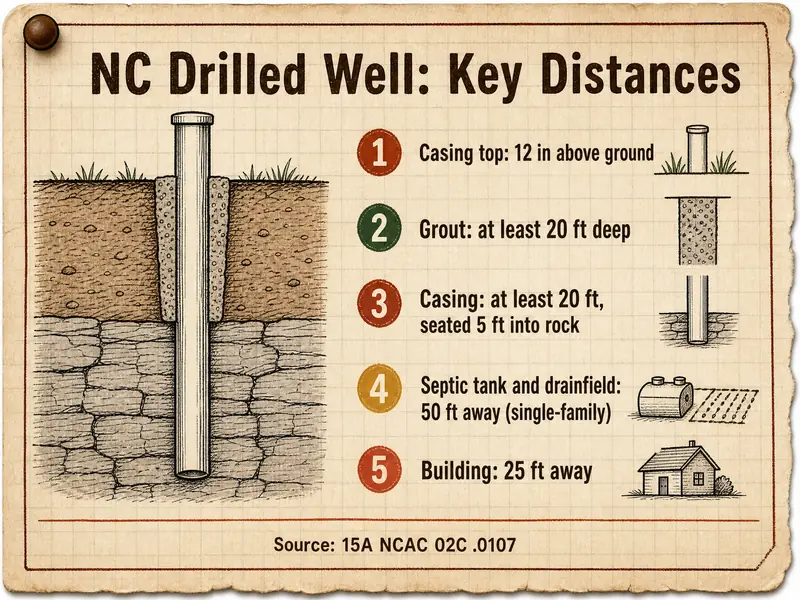
Under current rules, 50 feet from a private well serving one house, and 100 feet from a public or shared well. Older permits may show 100 feet for private wells.
Read next
Filed under Septic notes · Durham-area septic and well notes