Wells
Coliform Bacteria in Well Water and How to Shock
Coliform bacteria in well water mean a pathway exists from the surface into the well; the usual sequence is find the opening, shock chlorinate, retest in 7-14 days, and add UV only if bacteria return.
Compiled by the Red Clay Septic & Well desk · Last revised
Ownership note. Red Clay Septic & Well has the same owners as two water-treatment stores, SoftPro Water Systems and Quality Water Treatment. Links on this page to either store go to equipment that store sells. Treatment advice here follows NC DHHS, NC State Extension and EPA guidance checked in October 2026; what a product listing says is the store's own claim, not a test by this site. More on ownership
In these notes
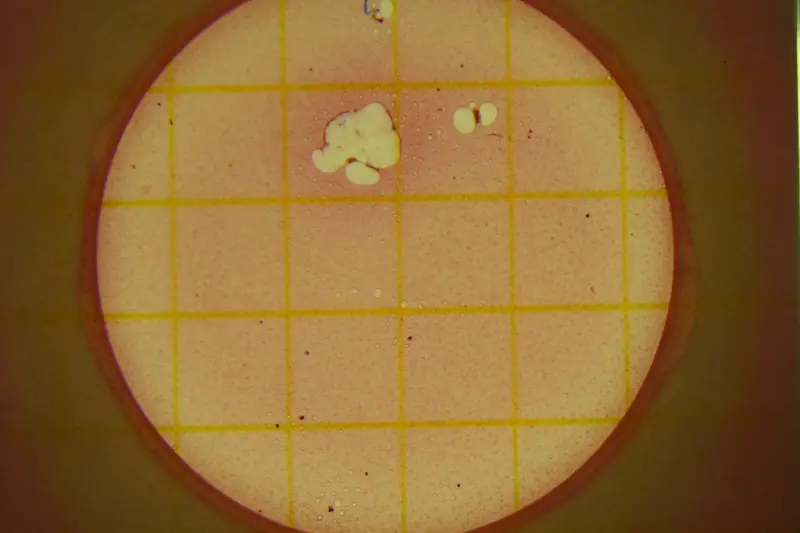
The short version
- About 26% of NC wells sampled from 2011 to 2013 tested positive for coliform bacteria and about 2% for E. coli, per NC DHHS.
- NC DHHS recommends a bacteria test every year, and after well repairs or flooding (NC DHHS).
- NC DHHS homeowner steps use unscented 5.25% bleach and hold chlorinated water in the plumbing at least 8 hours or overnight.
- Well contractors must disinfect at 100 ppm or more for 24 hours or more after any well work, under 15A NCAC 02C .0111.
- Retest after the chlorine is gone: NC State Extension says wait 7-10 days, Penn State 10-14 days.
- UV is not recommended where total coliform exceeds 1,000 colonies per 100 mL, per Penn State Extension (Penn State Extension).
A "present" result for total coliform is the most common bad news on a well test, and usually not a crisis. It says that surface water, soil or something worse has a way in. The fix is mostly mechanical: find how it gets in, close it, disinfect the well, and prove it worked with a second test.
What does coliform bacteria in well water mean?
Coliform bacteria are an indicator: most types do not cause illness, but finding them means a path exists between a source of bacteria and the well. Penn State Extension calls them "indicator organisms" whose presence "indicates that a contamination pathway exists" between surface water, a septic system or animal waste and the water supply (Penn State Extension).
The follow-up result matters more. When total coliform is present, labs test for fecal coliform or E. coli, which come from the intestines of people and warm-blooded animals. NC's new-well rule, 15A NCAC 18A .3803, builds in the same two steps. Penn State says an E. coli result "is much more serious" because it means human or animal waste is reaching the water; until a retest is clean, drink from another source such as bottled water.
NC DEQ's groundwater standard is 1 colony of coliform per 100 mL of water (NC DHHS), and the same NC DHHS sheet reports that about 26% of wells sampled from 2011 to 2013 tested positive for coliform and about 2% for E. coli. So a positive result is common, and fixable.
How do bacteria get into a well?
Most often through the top: a loose cap, a cracked casing, or surface water running along the outside of the casing. Penn State notes that coliform is much more common in springs and shallow wells, and that deep wells over 100 feet can still be contaminated when construction lets surface water flow down the casing.
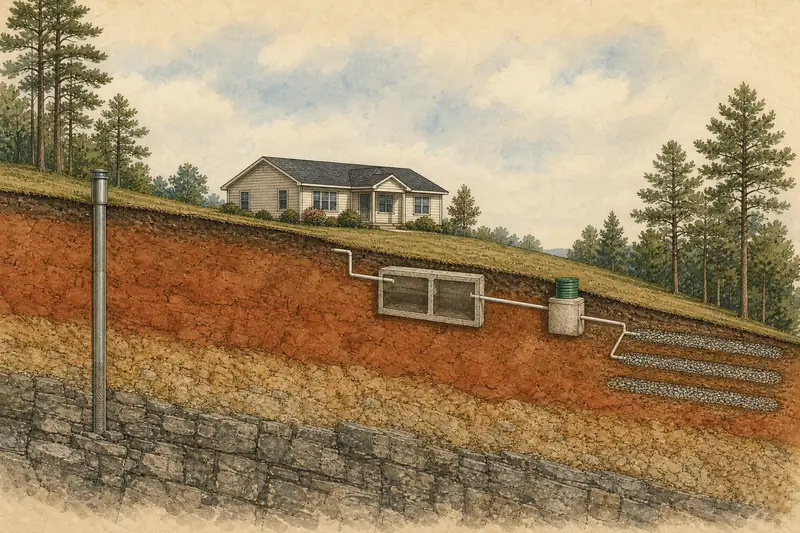
North Carolina's construction rule shows what a sound wellhead looks like. 15A NCAC 02C .0107 requires the casing to end at least 12 inches above land surface, wiring and pipe openings to enter at least 12 inches up unless a pitless adapter is used, and surface water to be diverted away from the well. It also sets 50 feet from a single-family septic tank and drainfield, though older permits may show 100 feet; the well construction page has the full list.
Timing is a clue too. Penn State says bacteria are more likely during warmer, wetter weather when surface water is recharging groundwater, and NC DHHS recommends testing after flooding and after any work on the pump or well. On red clay lots, where puddles can sit for days after a storm, check that no water stands around the casing.
How do you shock chlorinate a well?
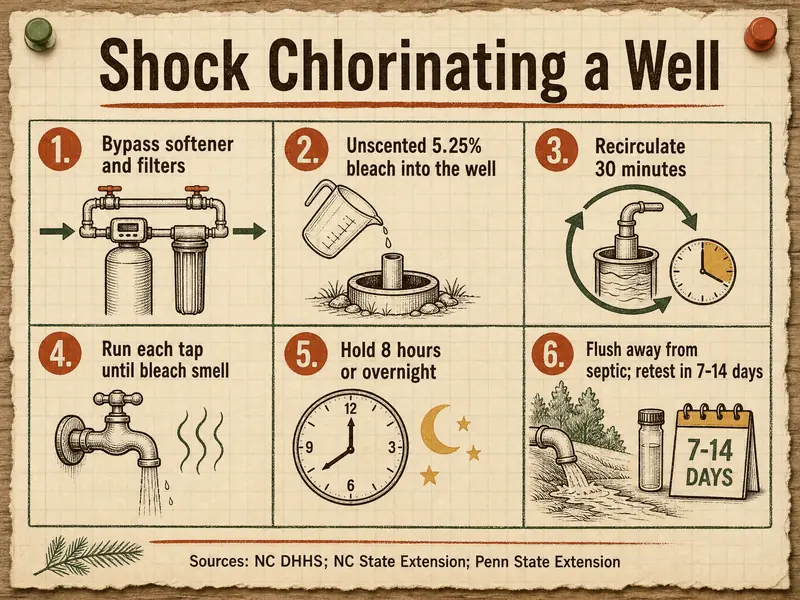
Shock chlorination puts a strong chlorine solution through the well and every pipe, holds it there for hours, then flushes it out. NC DHHS publishes homeowner steps in its flood guide (NC DHHS); in short:
- Put softeners and household filters in bypass mode.
- Pour unscented household bleach, 5.25% chlorine and less than six months old, into the well. The DHHS table for a 6-inch well calls for 7 cups for 10 feet of water, 16 cups for 100 feet, 1.5 gallons for 200 feet and 2.5 gallons for 400 feet (water depth is total depth minus the static water level).
- Run water from a hose back into the well for 30 minutes to circulate it.
- Open each tap until you smell bleach, then shut it off.
- Leave the chlorinated water in the plumbing at least eight hours or overnight. NC State Extension suggests 12-24 hours before turning faucets back on.
- Flush through a hose until the chlorine smell is gone, keeping the water away from the septic system, and don't drink the water until it has been tested.
The professional standard is stronger. Under 15A NCAC 02C .0111, anyone who builds, repairs or installs a pump in a well must disinfect it to at least 100 ppm of chlorine and let it stand 24 hours or more, then pump until no chlorine residual is detectable. NC DHHS strongly recommends calling the local health department or a licensed well driller to shock a well that has been flooded, and Penn State recommends a professional in general. The flush step matters for the drainfield too: NC DHHS says to keep the running water away from the septic system, and the septic care page covers what else the tank should not get.
When should you retest after shock chlorination?
Retest about 7 to 14 days after the chlorine is fully flushed, and again a few months later if that test is clean. NC State Extension says to wait 7-10 days after disinfection before sampling for bacteria (NC State Extension); Penn State suggests 10 to 14 days, then another test two to three months later if the first comes back clean.
The sample has to be free of chlorine, which is why the state rule for new wells allows bacteria samples only after the disinfectant has been flushed. County health departments collect and run these tests. Fees listed on county forms include $135 in Durham (rev 08/2025), $128.90 in Orange, $70 in Chatham (effective July 1, 2024) and $75 through Granville-Vance Public Health; Person County says bacteria results are usually back in 48 hours. Fees change, so confirm first; the well water testing page has the details.
If the bacteria come back, a one-time event was not the cause. Penn State says that is the point to consider continuous disinfection, and notes that in one Penn State study about 15 percent of wells with coliform were fixed by shock chlorination plus a sanitary well cap.
When is UV treatment the answer for coliform bacteria?
UV is the usual answer when bacteria keep returning after the wellhead is repaired and the well has been shocked. NC DHHS lists ultraviolet treatment for persistent coliform and E. coli, and Penn State calls UV a popular option because "it does not add any chemical to the water."
UV has firm limits. Penn State says it is not recommended where total coliform exceeds 1,000 colonies per 100 mL or fecal coliform exceeds 100, the water must be "completely clear" so light reaches every bacterium, and hard water can coat the quartz sleeve with scale. It also kills bacteria only inside the unit and leaves no residual in the pipes. NSF's standard for UV systems, NSF/ANSI 55, separates Class A units meant to disinfect contaminated water from Class B units for non-disease bacteria (NSF).
| Method | How it works | Upkeep and limits |
|---|---|---|
| UV light | Light kills bacteria as water passes a quartz sleeve | Bulb about once a year; needs clear water; no residual |
| Chlorination | Feed pump adds chlorine ahead of a storage tank | Aim for 0.3-0.5 mg/L residual; refill and check often |
| Ozone | Ozone gas oxidizes bacteria | Much more costly than chlorine or UV |
| Iodine | Iodine dosing | EPA now suggests it only for short-term or emergency use |
Two UV systems from the linked stores
If retesting shows coliform keeps returning after the wellhead is fixed, two lamps fit that need. SoftPro Water Systems lists the Pura UV-20 three-stage system (sold by SoftPro Water Systems, which has the same owners as this site), which the store lists with a 5-micron sediment filter, a 10-micron carbon block and a UV lamp, a maximum flow of 8 gallons per minute and a 22-watt lamp replaced yearly. Quality Water Treatment sells the Pura UV-20 two-stage system (sold by Quality Water Treatment, which has the same owners as this site) with a sediment filter and UV lamp at 8-10 GPM; its listing sets feed-water limits of iron under 0.3 mg/L, manganese under 0.05 mg/L, hardness under 120 mg/L and turbidity under 5 NTU.
Those specifications are the stores'. Neither listing names an NSF/ANSI 55 certification, and those feed-water limits mean many wells need iron or hardness treatment ahead of the lamp; see iron and manganese.
How do you keep bacteria out of a well?
Keep the wellhead sealed and high, and keep water and waste moving away from it. Penn State suggests extending a buried casing above ground, sloping soil away from it, and using a tight sanitary cap rather than a loose basic one.
NC DHHS recommends checking the wellhead once a year for cracks or openings, testing for bacteria every year, and testing after any repair or flood. Keep the septic system in good order too, since the well and drainfield share the same lot; the setback rules exist because a failing drainfield is one of the sources Penn State names.
- 26%Share of NC well samples (2011-2013) with coliform presentNC DHHS
- 100 ppmMinimum chlorine for well disinfection by contractors, for 24 hours15A NCAC 02C .0111
- 7-10 daysWait after disinfection before a bacteria sampleNC State Extension
- 1,000/100 mLTotal coliform level above which UV is not recommendedPenn State Extension
Where this comes from
Based on NC DHHS's well FAQ, coliform sheet and flood preparation guide; 15A NCAC 02C .0107 and .0111; 15A NCAC 18A .3802-.3803; NC State Extension's post-flood well guide; Penn State Extension's coliform and shock chlorination guides; NSF's description of its standards; and the bacteria-test forms and pages of five local health departments, read in October 2026. UV details are each store's own listing. Not included: well contractor prices, online forum advice, and any bacteria testing by Red Clay Septic & Well.
Questions worth asking
Can I drink the water while waiting for a retest?
NC DHHS's guidance is not to drink the water until it has been tested after chlorination. Bottled water is the simple stopgap until a clean result comes back.
How much bleach does a 300-foot well need?
It depends on the water depth, not the total depth: subtract the static water level from the total depth. The NC DHHS table then gives the amount by casing diameter; for a 6-inch well it lists 1.5 gallons for 200 feet of water and 2.5 gallons for 400 feet.
Will shock chlorination harm a septic system?
NC DHHS's steps avoid the question by flushing through a hose and keeping that water away from the septic system. Running the whole flush through indoor drains would send it all to the tank.
Why did coliform come back after shocking the well?
A return usually means the pathway is still open, such as a cracked casing, a loose cap or surface water pooling at the wellhead. Penn State says recurring bacteria call for continuous disinfection, but fixing the opening comes first.
Does a UV system need a sediment filter?
Usually. Clear water is a condition for UV to work, per Penn State, and both Pura systems linked here build a sediment cartridge in.
Is a positive coliform test at a home sale a deal-breaker?
Not on its own. It is a common, often fixable finding; ask for a wellhead inspection, shock chlorination and a clean retest before closing, and read the E. coli result closely.
Read next
Filed under Well notes · the front page of these Piedmont field notes