Septic
Septic in Red Clay Soil: Why the Piedmont Is Hard
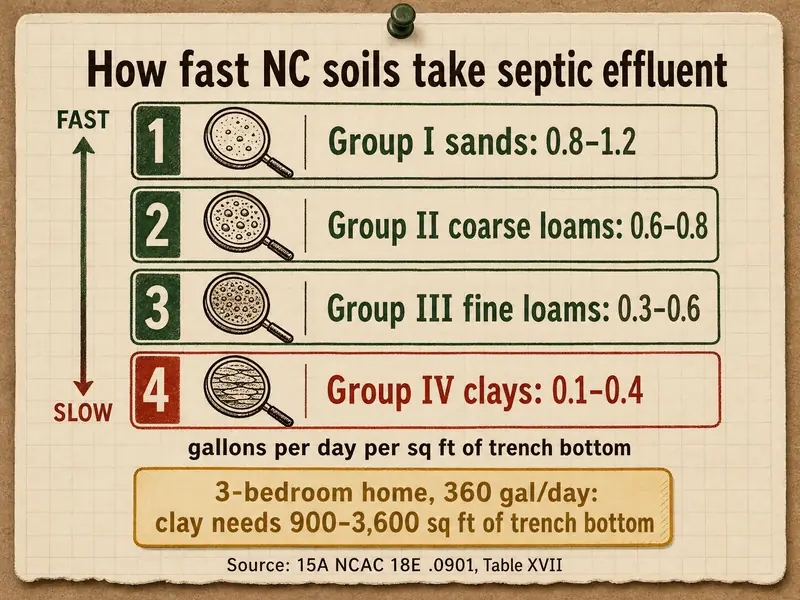
Septic in red clay soil works, but slowly: NC rules let clay accept only 0.1 to 0.4 gallons per day per square foot, so Piedmont drainfields run long or switch to pressure.
Compiled by the Red Clay Septic & Well desk · Last revised
In these notes
The short version
- North Carolina sorts soil into four groups; clay (Group IV) gets the lowest long-term acceptance rate, 0.1-0.4 gal/day per sq ft, under 15A NCAC 18E .0901 Table XVII.
- A 3-bedroom home is designed for 360 gal/day, so a clay lot needs 900-3,600 sq ft of trench bottom against 450-600 sq ft on sandy loam.
- Every trench needs 12 in of natural soil under it before any limiting layer; a soil with gray wetness colors within 12 in of the surface is unsuitable.
- Saprolite, the soft weathered rock under Piedmont clay, can carry a drainfield only with 24 in of separation and pits dug for the county evaluator.
- NC permits are decided by a soil evaluation under 18E .0501-.0509; people call it a perc test, but the evaluator hand-textures each horizon instead.
- NC State Extension says clayey, slowly permeable soils need a larger drainfield than sandy ones.
- 0.1-0.4Gallons per day per sq ft a clay trench may be sized for15A NCAC 18E Table XVII
- 12 inNatural soil required between trench bottom and any limiting condition15A NCAC 18E .0901(a)
- 24 inSeparation needed when the trench sits in saprolite15A NCAC 18E .0506
- 30-70 ftTypical thickness of the weathered clay layer over Piedmont bedrockNC State Extension
Why is red clay soil hard on septic drainfields?
Red clay is hard on drainfields because its tiny particles hold water and pass it along slowly, so effluent soaks in at a fraction of the speed it would in sandy ground. A drainfield works only if the soil keeps up with the daily flow, and clay keeps up only when the trenches are spread over a much larger area.
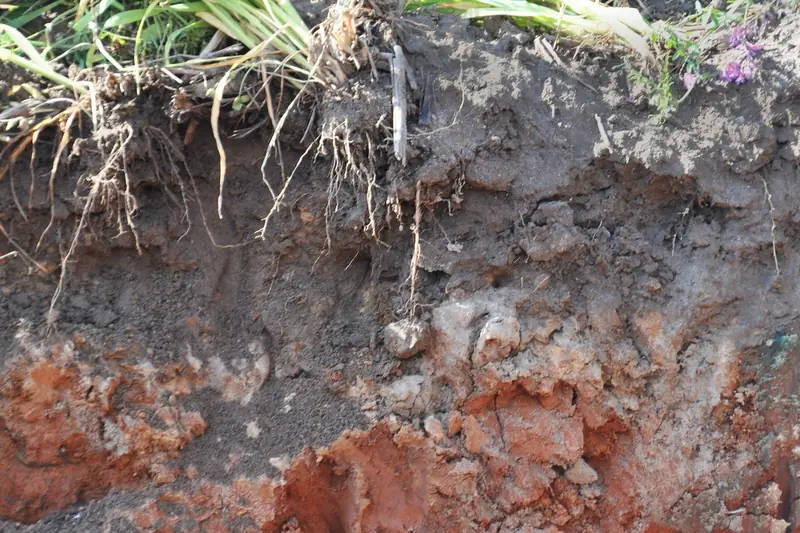
The red itself is not the problem. It comes from oxidized iron and usually marks soil that drains and breathes; NC State Extension describes good drainfield soil as "uniform brown, yellow, or bright red" with no gray spots. The NRCS description of Cecil, the classic Piedmont red clay, shows a subsoil of "red (10R 4/8) clay" from about 8 to 26 in, firm, sticky and plastic, over deep weathered rock. Water moves through it, just slowly.
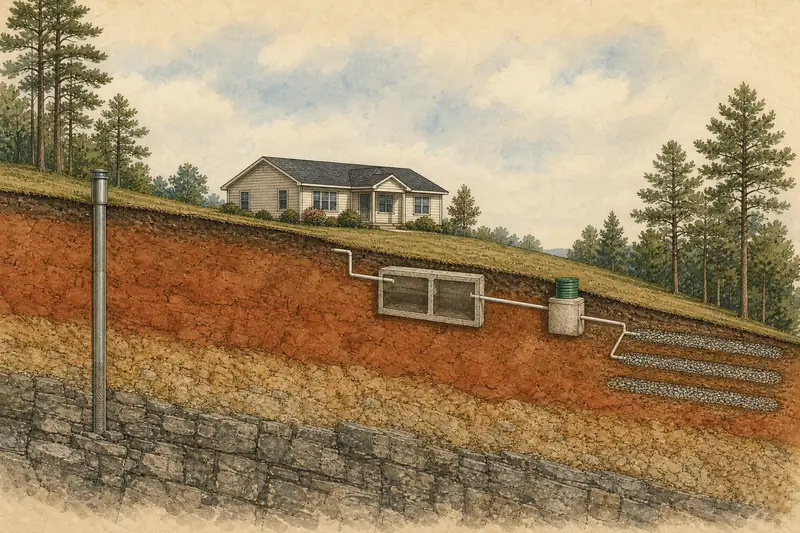
That clay layer sits on a thick blanket of weathered rock. NC State Extension puts the clay-rich layer over Piedmont bedrock at typically 30 to 70 ft, and up to 300 ft in places. North Carolina also has more than 400 kinds of soil, and a single 1-acre lot can hold several, which is why two neighbors on the same road can get very different septic permits.
How slowly does clay take septic effluent under NC rules?
Under 15A NCAC 18E, clay soils (Soil Group IV: sandy clay, silty clay and clay) may be sized for only 0.1 to 0.4 gallons per day per square foot of trench bottom. That figure is the long-term acceptance rate, or LTAR: what the rule lets a designer count on the soil absorbing every day for the life of the system.
The math follows from the house. The rules set design flow at 120 gallons per day per bedroom, so a 3-bedroom home is designed for 360 gal/day. Dividing by the clay range gives 900 to 3,600 sq ft of trench bottom. On a Group II sandy loam at 0.6-0.8, the same house needs 450 to 600 sq ft. Trench length then comes from the rule's formula, TL = (DDF / LTAR) / trench width.
Where in the range a lot lands depends on what the evaluator finds: structure, consistence, clay type and depth. Blocky peds larger than 1 in, platy or massive structure, and expansive clay that feels very firm or very sticky are all rated unsuitable in the 18E soil tables. The shrink-swell clays of the Triassic Basin are the local example; they get their own page on Triassic Basin soils.
What is saprolite and can septic use it?
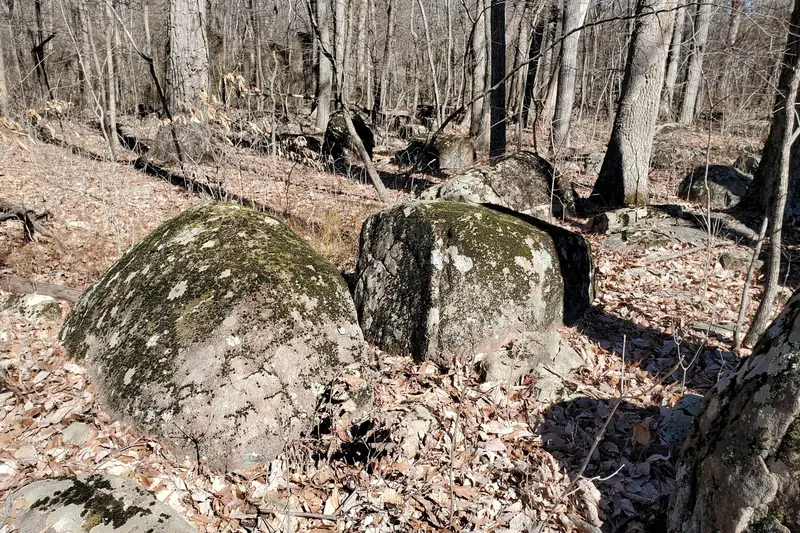
Saprolite is rock that has rotted in place: 18E defines it as porous material that keeps its parent rock's structure in at least half its volume and "can be dug with hand tools." It lies under the red clay on most Piedmont lots, and yes, a drainfield can use it, but under tighter terms than soil.
The trench needs 24 in of saprolite between its bottom and any unsuitable layer, and each inch of suitable soil above counts as two inches of saprolite. The saprolite must be a sand, loamy sand, sandy loam, loam or silt loam texture, with no open joints, quartz veins or relic fractures that would let effluent run straight down. The county evaluates it from pits, so expect a backhoe on the lot.
Acceptance rates in saprolite are set by texture in a separate table: 0.6-0.8 for sand down to 0.1-0.3 gal/day per sq ft for silt loam. Setbacks can also grow. The well-construction rule, 15A NCAC 02C .0107, lists 100 ft between a well and a drainfield in saprolite, so a saprolite permit also shapes where a new well can go.
How does seasonal wetness show up in red clay?
Seasonal wetness shows up as gray color. Under 18E .0504, colors with a chroma of 2 or less, covering at least 2% of the soil as redox depletions or as the matrix of a horizon, mark a soil wetness condition, and a site where it starts within 12 in of the natural surface is unsuitable.
Clay subsoils are where water perches after winter rains. A dense or cemented layer, such as a fragipan, can hold water above it; the rule calls any such layer at least 3 in thick and within 18 in of the surface unsuitable. Gray mottles in an otherwise red profile are the evaluator's clue, even when the hole is dry on the day of the visit. An owner can ask for wetness monitoring or modeling under .0504(c) to reclassify a borderline site.
Homeowners see the same thing from above. The NCDHHS homeowner page lists "Slow drains, especially after rain" and "Soggy, smelly spots in your yard" among trouble signs. On clay, a field that is fine in August can struggle in February.
Which septic designs work in clay soil?
Long conventional gravity trenches still work on many red clay lots that pass the soil evaluation; they simply cover more ground. When gravity is not enough, the usual next steps are a pump, a low-pressure pipe (LPP) field, drip dispersal, fill, or pretreatment before the field.
| Design | What it changes | Clay rate or limit in 18E |
|---|---|---|
| Conventional gravity trenches | Longer trench runs, 2-3 ft wide | 0.1-0.4 gal/day per sq ft |
| Low-pressure pipe (LPP) | Small pressurized laterals dose the whole field | 0.05-0.2 gal/day per sq ft |
| Drip dispersal | Shallow tubing, timed doses | 18 in of suitable soil above a limiting layer |
| Alternating dual fields | Two fields rested in turn | Allowed only in Groups III and IV |
| Fill system | Imported soil over a shallow site | Top 18 in natural soil suitable, slopes under 15% |
| Bed system | One wide excavation | Not allowed in clay (sands, coarse loams and fine loams only) |
NC State Extension notes that on "some clayey soils that have a thick sandy surface," an LPP system provides an alternative, and that pretreatment units can serve soils that are not deep enough. Each option, and the upkeep it brings, is laid out on the septic system types page, and how a field is sized and built is on the drain field page.
How do you protect a drainfield in clay?
Protect a clay drainfield by keeping extra water and weight off it: clay has little spare capacity, so roof runoff, compaction and solids that would be shrugged off in sand can tip it into failure.
- Divert water. 18E .0901 requires runoff, gutter drains and downspouts to be directed away from the system. Don't route softener backwash, sump pumps or condensate lines to the tank, as the NCDHHS factsheet warns.
- No compaction. The rules bar soil disturbance and compaction over the field and repair area. No parking, driving, paving, sheds or patios.
- Keep solids in the tank. Check the effluent filter at least every 2-3 years and when drains slow, and pump when scum and sludge pass one-third of the tank depth. Skip garbage disposals.
- Mind the roots. NC State Extension advises no trees or shrubs within 25 ft of the field.
- Build in dry weather. Extension warns that trenches dug in soil "that is too wet" smear and seal clay walls.
Day-to-day habits are on the septic care page. Before buying a clay lot, ask the county for the permit and layout, which the permits and records page explains how to request.
Where this comes from
Based on 15A NCAC 18E as amended June 1, 2026 (Sections .0500 and .0900), the NRCS Official Series Descriptions for Cecil and other Piedmont series, NC State Extension publications AG-439-13 and "Ground Water in the Piedmont and Blue Ridge Provinces", and NCDHHS homeowner guidance, all checked October 2026. Left out: contractor price quotes, installer opinions on which design is best, and forum stories. Only the county health department, or a licensed soil scientist working under the private option, decides what a given lot can carry.
Questions worth asking
Does red clay always fail a septic soil evaluation?
No. Well-drained red clays such as Cecil often pass, with long trenches sized at the low clay rates. Sites fail on wetness within 12 in, soil shallower than 18 in, expansive clay or bad structure, not on red color.
Why does NC not use a perc test on clay lots?
North Carolina rules call for a soil and site evaluation that looks at texture, structure, consistence, wetness color and depth in each horizon. People still call it a perc test, but 18E has no percolation procedure.
Can topsoil be added to make a clay lot pass?
Only through a permitted fill system, and fill has its own limits: the top 18 in of natural soil must be suitable, with no wetness in the top 12 in and slopes under 15%. Dumping soil on a failing field is something NC State Extension tells owners not to do.
What do gray streaks in a clay road cut mean?
Gray or pale streaks with a chroma of 2 or less are a sign that water sits there part of the year. In a septic evaluation, that color within 12 in of the surface makes the site unsuitable unless monitoring shows otherwise.
How much land does a septic system need on clay?
Orange County says a typical 4-bedroom system and repair area usually need 1/4 to 1/3 of an acre of suitable soil. On slow clay the trench area sits at the high end, and the rules require room for a full repair area too.
Is saprolite better or worse than clay for a drainfield?
It depends on its texture. Sandy or loamy saprolite with no open fractures can take effluent at rates near or above clay, but it needs 24 in of separation and a pit evaluation by the county.
Do clay drainfields fail faster in wet winters?
They show trouble more in wet months, when perched water in the subsoil leaves less room for effluent. Slow drains after rain are an early sign worth noting.
Read next
Filed under Septic notes · septic and well notes for Durham