City water
Durham City Water and Sewer in Brief
Durham city water comes from two lakes, is soft on the USGS scale at about 24-25 mg/L hardness, and is reported on each year by the City of Durham's Department of Water Management, not by this site.
Compiled by the Red Clay Septic & Well desk · Last revised
In these notes
This section is short on purpose. Durham's water system belongs to the City, whose Department of Water Management runs it and writes the annual water quality report; this site is not the city, a utility or a county office. What follows points to the City's own figures, with the report and data year named.
The short version
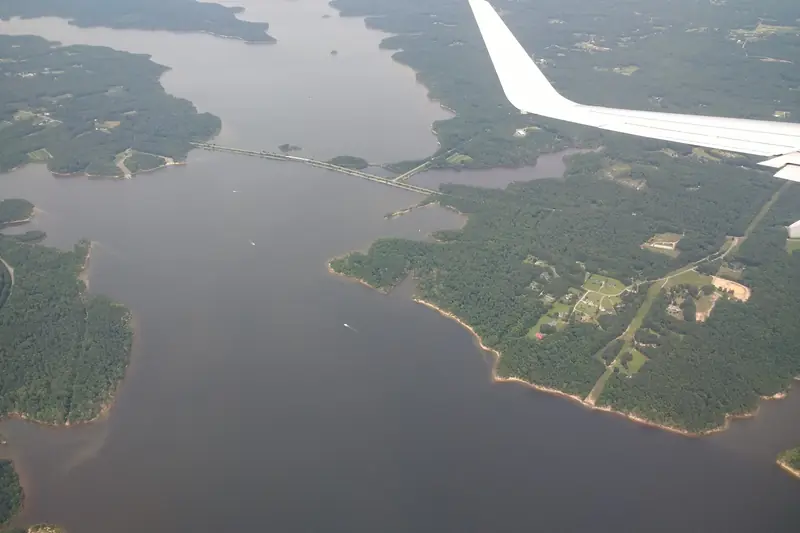
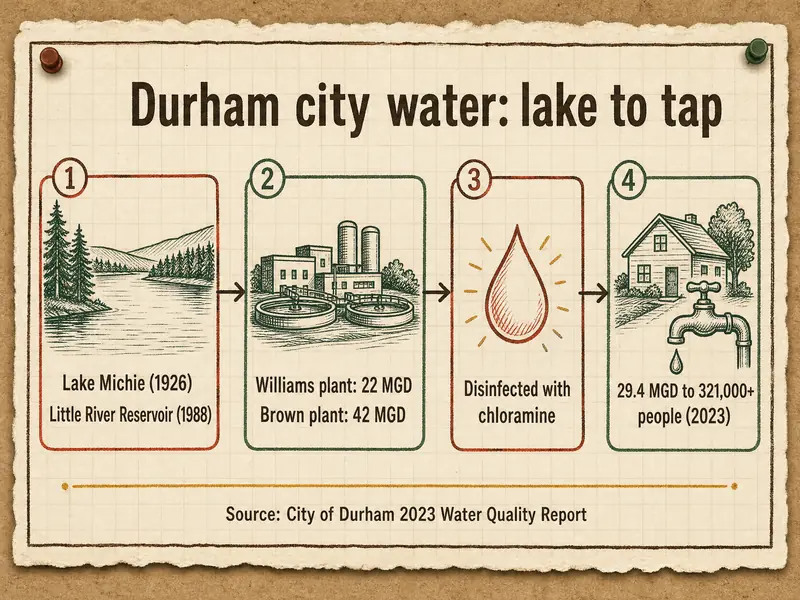
- Two reservoirs, Lake Michie (built 1926) and Little River Reservoir (built 1988), are the main sources, per the City's 2023 Water Quality Report (2023 data).
- City water's hardness is 24-25 mg/L in the 2022 report: soft on USGS's 0-60 mg/L scale, while treatment references, grading 1-3.5 gpg as "slightly hard," put it in that band.
- The City has disinfected with chloramine since 2002, switching to chlorine alone for about six weeks each spring.
- The 90th-percentile lead result from the July-September 2022 sampling was below 3 ppb; the federal action level is 15 ppb.
- PFAS results from 2018 to 2025 (PFOA up to 5.5 ppt, PFOS up to 9.2 ppt) sit near, and sometimes above, EPA's 4.0 ppt limits, which take effect in 2029.
- A septic home outside city limits usually needs voluntary annexation before it can join city sewer, under the City's annexation process.
- 29.4 MGDAverage water delivered by Durham's two plants in 2023City of Durham 2023 Water Quality Report
- 321,000+People in the City's service area in 2023City of Durham 2023 Water Quality Report
- 24-25 mg/LHardness as CaCO3, 2022 data (soft on the USGS scale)City of Durham 2022 Water Quality Report
- 0Known lead service lines in the City's 2024 inventory; 54,372 lines still listed as unknownNC DEQ lead service line inventory
Where does Durham city water come from?
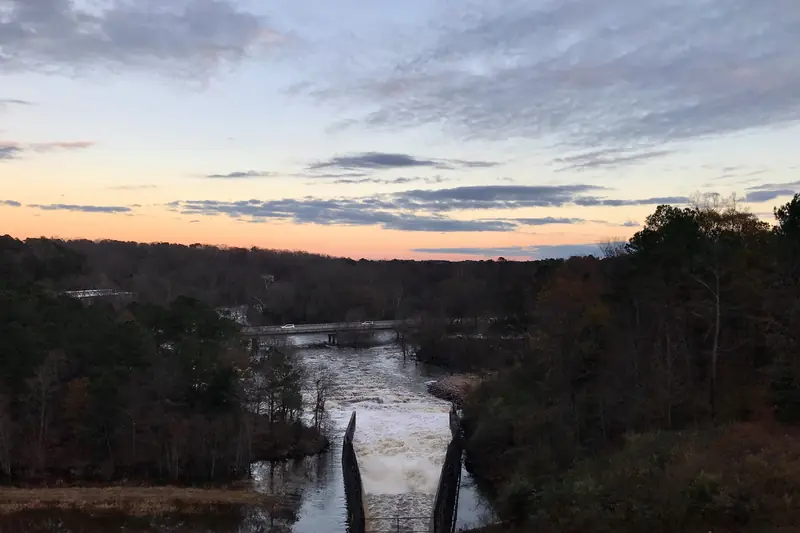
Durham city water comes mainly from Lake Michie and Little River Reservoir, with Jordan Lake and the old Teer Quarry as extra supplies. The 2023 report says the two lakes safely yield 26.9 million gallons a day, while demand averaged about 29.4 MGD in 2023, so the City can draw on a 16.5 MGD allocation from Jordan Lake through the Town of Cary's system. Two plants treat the water: Williams (permitted for 22 MGD) and Brown (42 MGD since a 2021 expansion).
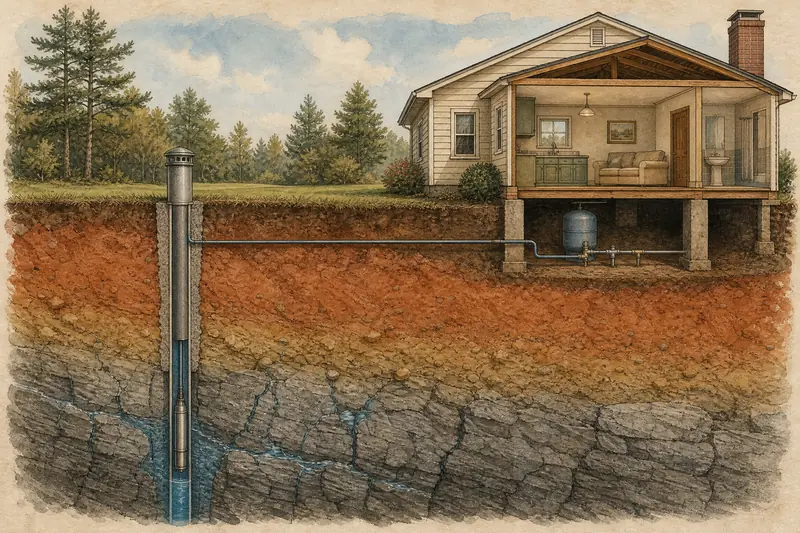
Homes on a private well get none of this; the wells section covers what those households test on their own.
Is Durham city water safe to drink?
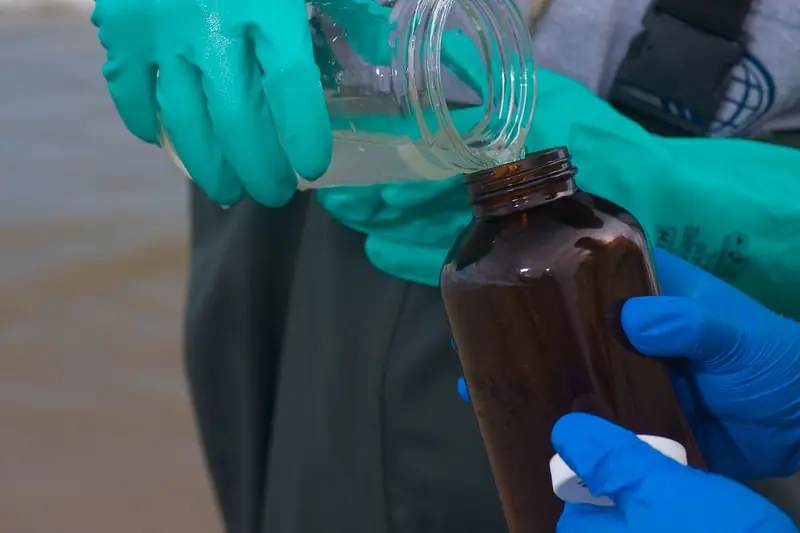
The City's 2023 report lists no health-based violations, only one late-filed set of coliform results that showed no coliform. Nitrate averaged under 0.20 mg/L against a limit of 10, and total coliform was 0% positive. The open question is PFAS, where some results sit above EPA's new 4.0 ppt limits for PFOA and PFOS; the City's PFAS standards page gives the 2018-2025 ranges and the City plans powdered activated carbon treatment by 2029.
The water quality page walks through lead, chloramine, PFAS and filters.
Do septic homes in Durham ever switch to city sewer?
Yes, though it takes a sewer line close enough to serve the lot and, outside city limits, a petition for annexation. The City's annexation page names landowners "with well and septic tank problems" among those who seek to connect, and the process includes a utility extension agreement with its own fee. Once connected, North Carolina's septic rule (15A NCAC 18E .1307) says the old tank must be pumped by a permitted septage firm and removed or collapsed and backfilled.
Before anything else, find out what the house actually has. Durham County Environmental Health holds septic and well permits on file, and the county records page explains how to request them.
Which Durham city water pages are here?
Two pages: one reads the City's water quality report, and one covers moving a house from septic to sewer. The rest of the site deals with septic systems and private wells in five counties.
| Topic | City of Durham water and sewer | Private well and septic |
|---|---|---|
| Who tests the water | City Department of Water Management, results in the annual report | The homeowner, after a first test that state rules require for a new well |
| Hardness | 24-25 mg/L, soft on the USGS scale (2022 report) | Varies by well; only a test shows it |
| Disinfection | Chloramine, chlorine-only each spring | None unless the owner adds treatment |
| Wastewater | City sewer, with system development fees | Septic tank and drainfield under a county permit |
| Who to ask | City of Durham Water Management | Durham County Environmental Health or the local county health department |
Where this comes from
This section is based on the City of Durham's 2022 and 2023 Water Quality Reports (2022 and 2023 data), its pages on PFAS, lead, disinfection and annexation, EPA's PFAS rule page, the NC DEQ lead service line inventory and 15A NCAC 18E, all checked in October 2026. Because the City's site blocked downloads, its pages were read from archived copies (official addresses linked); its newest, 2024 report was not available. Left out: bottled-water or filter sales pitches, news coverage and anyone's home test results.
Questions worth asking
Who publishes the Durham water quality report?
The City's Water Management department puts it out every year as the Annual Water Quality Report. This site only reads it and summarizes it. For questions about a bill, pressure or water color, go to the City, not here.
Does this site test Durham tap water?
No. Red Clay Septic & Well runs no lab and takes no samples; every number here comes from City, EPA or state pages.
Is Durham County water the same as City of Durham water?
Not always. Durham County runs its own small Rougemont water system and the Triangle Wastewater Treatment Plant in the southeast of the county, while most of the urban area is served by the City.
Why does Durham water taste like chlorine in the spring?
Each spring the City stops adding ammonia for about six weeks and disinfects with chlorine alone; in 2025 that ran February 28 to April 13. The taste usually fades if water sits in the refrigerator for a few hours.
How do you find out whether a street has city sewer?
No single City lookup for sewer status turned up in research. County septic permits show whether a septic system was approved for the lot, and the City's Water Management department can answer for its own lines.
Does a home on city water need a softener?
Generally not. At about 1.4-1.5 gpg in the 2022 report, Durham water rates as soft for the USGS (up to 60 mg/L) and only "slightly hard" (1-3.5 gpg) for treatment references, far short of the 7 gpg level Penn State Extension links with heavy scale.
Filed under Durham-area septic and well notes