Septic
Septic Drain Field: How It Works and Why It Fails
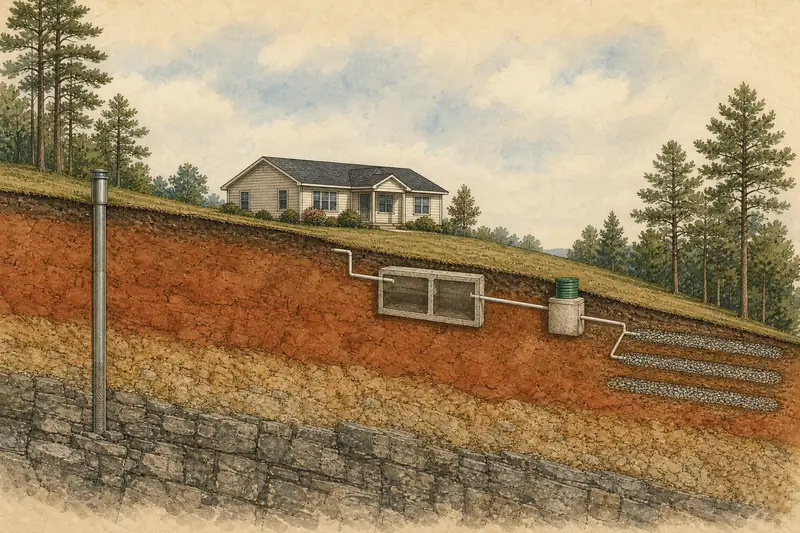
A septic drain field is the set of buried trenches that lets settled wastewater soak into the soil, where microbes finish treating it; on Piedmont clay it must be large and kept dry.
Compiled by the Red Clay Septic & Well desk · Last revised
In these notes
The short version
- North Carolina conventional trenches are 2-3 ft wide, no more than 36 in deep on the downslope side, and spaced at least 6 ft on center under 15A NCAC 18E .0902.
- The field is sized from 120 gallons per day per bedroom divided by the soil's acceptance rate, so a 3-bedroom house on clay needs 900-3,600 sq ft of trench bottom.
- NC law calls a field failing when effluent sits within 3 in of the surface on two checks at least 24 hours apart, more than 24 hours after rain.
- A gravity field longer than 750 ft of trench needs a pump, and every system must keep room for a full repair field.
- NC State Extension says to keep trees and shrubs 25 ft from the field and never pile soil on a wet spot.
- The EPA lists bright green, spongy grass over the field in dry weather as a warning sign.
- 120 galDesign flow per bedroom per day used to size the field15A NCAC 18E .0401
- 6 inMinimum settled soil cover over the dispersal field15A NCAC 18E .0901(g)
- 3 inEffluent this close to the surface over a trench counts as failure15A NCAC 18E .1303
- 25 ftDistance NC State Extension advises between trees and the fieldNC State Extension
How does a septic drain field work?
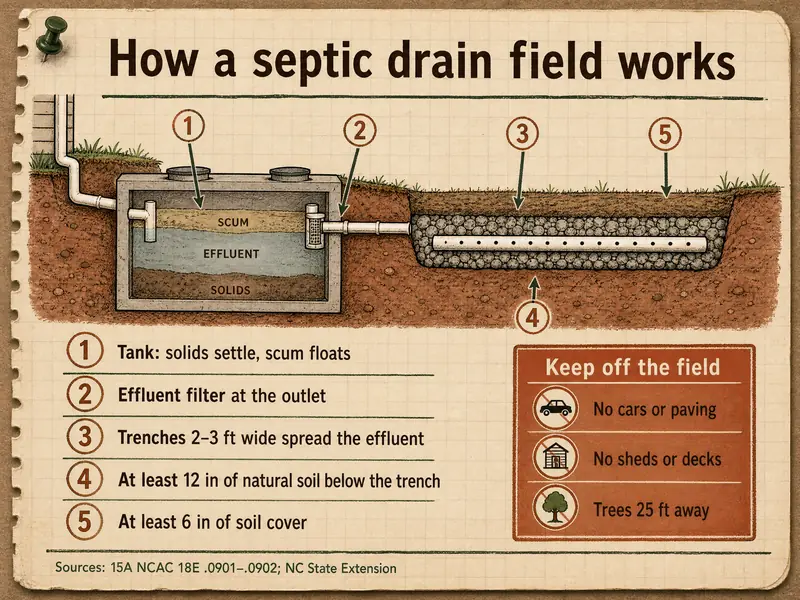
A septic drain field takes the liquid that leaves the septic tank, spreads it along gravel or chamber trenches, and lets it seep into unsaturated soil, where microbes in the soil treat it further. The tank mainly settles solids; the soil finishes the job.
The sequence starts in the tank. Heavy solids sink, grease and scum float, and the clearer middle layer flows out through an effluent filter, which North Carolina requires on the tank outlet under 18E .0801. From there the liquid runs by gravity, or is pumped, into the trenches. In a conventional NC system each trench is 2 to 3 ft wide, holds 12 in of washed gravel around the pipe, and sits no deeper than 36 in on its downslope side, with trenches spaced at least three trench widths apart and never closer than 6 ft on center.
The EPA describes gravelless chambers as a common alternative: open-bottom units, buried in soil, where the wastewater meets the soil directly and microbes treat it. Whatever the media, the rule underneath is the same: 12 in of natural soil between the trench bottom and any rock, wetness or restrictive layer, and at least 6 in of soil on top after settling.
How big is a septic drain field in clay?
On Piedmont clay, a drain field for a 3-bedroom home needs roughly 900 to 3,600 square feet of trench bottom, or about 300 to 1,200 ft of 3-ft-wide trench, before counting the repair area. The size comes from two numbers in the rules: design flow and the soil's long-term acceptance rate (LTAR).
Design flow is 120 gallons per day per bedroom. For clay soils, 18E Table XVII allows 0.1-0.4 gal/day for each square foot of trench bottom. Divide the first by the second and the trench-bottom area follows; the rule's formula then divides by trench width to get length.
| Home size | Design flow (gal/day) | Trench bottom at 0.1-0.4 gal/day/sq ft | Length if trenches are 3 ft wide |
|---|---|---|---|
| 2 bedrooms | 240 | 600-2,400 sq ft | 200-800 ft |
| 3 bedrooms | 360 | 900-3,600 sq ft | 300-1,200 ft |
| 4 bedrooms | 480 | 1,200-4,800 sq ft | 400-1,600 ft |
These are worked ranges, not designs; the county or a licensed soil scientist picks the rate for each lot, and spacing between trenches adds ground on top of the trench area. Two rule thresholds matter here. Once total lateral length passes 750 ft, 18E .1101 requires a pump, and a conventional system stays owner-managed only up to 750 ft of trench. And every permit needs space for a repair field as well as the first one. Orange County's septic page puts a typical 4-bedroom system plus repair area at 1/4 to 1/3 acre of suitable soil. Why clay sits at the slow end is covered on the red clay soil page.
What are the signs of a failing drain field?
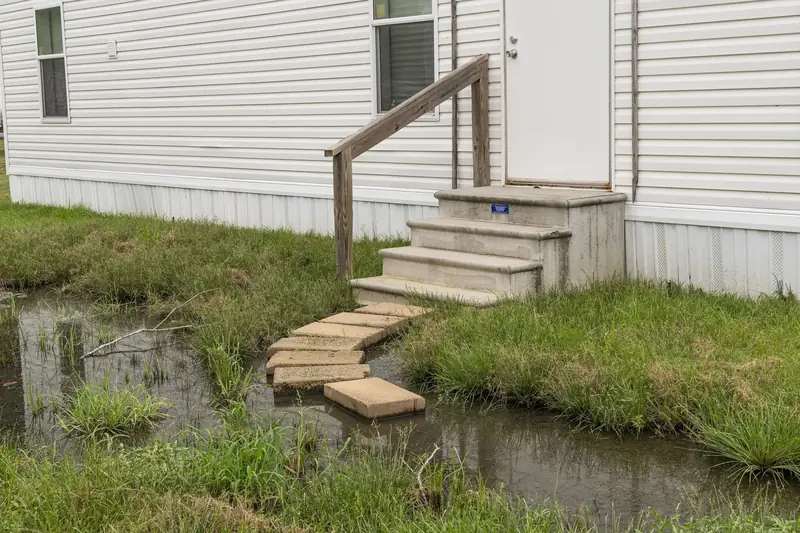
The plainest signs are wet, smelly ground over the trenches and drains that slow down after rain. The EPA adds gurgling plumbing, sewage odors near the field, and grass over the field that stays bright green and spongy even in dry weather.
The NCDHHS septic factsheet describes a pattern common on pumped systems: sewage reaches the surface when the pump turns on and disappears after it shuts off. A high-water alarm on the pump tank is another early warning; see the pump tank alarm page. NC State Extension's checklist asks whether the area is "wet or spongy even when it has not rained for a week or more" and whether the tank needs pumping more than once a year.
The legal line is drawn in 18E .1303. A system is malfunctioning when effluent reaches the ground surface, surface water or groundwater, backs up into the house, or stands within 3 in of finished grade over a trench on two observations at least 24 hours apart and more than 24 hours after rain. Needing the tank pumped more than once a month to hold that off also counts. When any of that happens, the owner must contact the county health department.
What ruins a septic drain field?
Too much water, too many solids and compacted soil are the three things the rules and agency guidance keep returning to. On slow clay, any one of them can push a field past what the soil can take.
Water. The EPA puts indoor use as high as 70 gallons per person per day and says a single leaking toilet can waste up to 200 gallons a day, all of it headed for the field. Downspouts, sump pumps, softener backwash, hot tubs and condensate lines belong away from the system, according to the NCDHHS factsheet.
Solids. Sludge that escapes the tank seals the trench bottom. Pump when scum plus sludge pass one-third of the liquid depth, check the effluent filter at least every 2-3 years and whenever drains slow, and avoid garbage disposals, which NC State Extension says usually double the solids. The EPA leaflet on additives says tank additives are not recommended. Pumping schedules are on the septic tank pumping page.
Compaction and roots. 18E bars any activity that causes soil disturbance or compaction over the field and repair area, and NC State Extension advises keeping trees and shrubs 25 ft away. Fields built when the soil was too wet also start out damaged, since Extension notes that wet installation can seal the trench walls.
Can a failing drain field recover?
Sometimes, if the cause is water or a short-term overload rather than a sealed trench bottom. NC State Extension is clear on one point: "Pumping the septic tank after the soil drainfield has become completely clogged will not rejuvenate the system."
Fixing leaks, cutting laundry loads, diverting roof water and resting the field can bring back a field that was simply flooded. Systems built with alternating dual fields are designed for this; 18E has the owner switch the diversion valve once a year so each side gets a rest. What does not work: piling soil over a wet spot, or piping effluent to a ditch or stream, which Extension calls illegal.
A field that keeps surfacing needs a repair permit. North Carolina requires a repair application to the county before any work, and after a notice of violation the default deadline is 30 days. Repair options range from added trenches in the repair area to pressure or pretreatment systems; the septic repair page covers the process, and septic system types explains the designs.
What can go on top of a drain field?
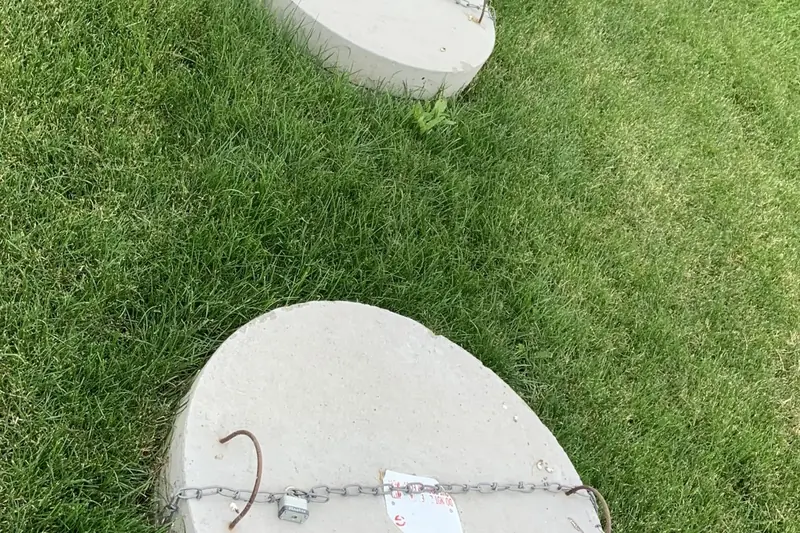
Grass is the right cover. The rules require vegetation over the field and repair area and at least 6 in of settled soil, and they bar anything that disturbs or compacts that ground.
- No driving, parking or paving. 18E .0601(f) keeps fields out from under impervious surfaces and vehicle traffic unless specially approved.
- No decks, patios, sheds or hardened surfaces, per the NCDHHS factsheet, and no grading or additions over the repair area.
- No trees or shrubs within 25 ft, the NC State Extension advice.
- Pools and buildings need distance. Table IX sets 15 ft from an in-ground pool or basement and 5 ft from a building foundation.
Adding a pool, shed or room usually means asking the county, an authorized evaluator or a certified inspector for an existing system approval first, which checks that setbacks still work. The field's location is on the permit layout, and the county permits and records page covers getting a copy.
Where this comes from
Drawn from the June 1, 2026 version of 15A NCAC 18E (sizing, trench construction, setbacks, malfunction and repair rules), NCDHHS's homeowner factsheet, EPA septic pages and its 2024 leaflet on tank additives, NC State Extension's "Why Do Septic Systems Fail?", and Orange County's septic FAQ, checked October 2026. The area table is arithmetic on the rule's numbers, not a design. Left out: repair and replacement prices, product claims for additives or field treatments, and anecdotes.
Questions worth asking
How long does a septic drain field last?
No North Carolina agency publishes a fixed lifespan. NC State Extension compares a well-maintained system's life to that of an asphalt shingle roof, and clay fields last longest when water and solids are kept in check.
Is a drain field the same as a leach field?
Yes. Drain field, drainfield, leach field and absorption field all describe the trenches; North Carolina's rules call it the dispersal field.
How deep are drain field lines in North Carolina?
Conventional trenches may be no deeper than 36 in on the downslope side, and the actual depth is set by how much natural soil sits above rock or wetness, since 12 in must remain beneath the trench.
Why is the grass greener over the drain field?
Effluent carries water and nutrients. A slightly greener strip can be normal, but the EPA flags lush, spongy grass in dry weather as a warning that effluent is too close to the surface.
Can downspouts drain toward the drain field?
No. Under 18E .0901, roof and yard runoff must be routed away from the system, and the NCDHHS factsheet repeats it for sump pumps, pools and hot tubs.
Does a new drain field need a county inspection?
Yes. Under G.S. 130A-337 no system may be covered or used until the county, or an authorized evaluator under the private option, has inspected it against the permit.
Who can find a drain field that nobody has mapped?
When an existing system cannot be found, 18E makes the owner responsible for locating it. Start with the county permit drawing, which often shows where the trenches run from the tank.
Read next
Filed under Septic notes · the front page of these Piedmont field notes