Wells
Arsenic in Well Water in North Carolina
Arsenic in well water around Durham is mostly a bedrock problem, strongest on the Carolina Slate Belt, and since it has no color, taste or smell, a lab result read against 10 µg/L is the only way to know.
Compiled by the Red Clay Septic & Well desk · Last revised
In these notes
The short version
- The drinking water limit for arsenic is 10 µg/L (0.010 mg/L), set by EPA and adopted by NC DEQ in 2001 (NC DHHS arsenic handout).
- 2.26% of NC wells sampled for arsenic in 2018-2019 were over that limit, according to NC DHHS.
- NC DEQ says the Slate Belt, metamorphosed volcanic and sedimentary rock, has more wells with detectable and elevated arsenic than other regions.
- Arsenic is on the required new-well test under 15A NCAC 18A .3803; NC DHHS suggests retesting metals every 2 years.
- NC DHHS suggests pre-oxidation, then adsorptive media, ion exchange, distillation or reverse osmosis.
- Boiling does not remove arsenic, per the Washington State Department of Health.
- 10 µg/LEPA and NC limit for arsenic in drinking waterEPA
- 2.26%NC wells sampled 2018-2019 above the arsenic limitNC DHHS
- 1 in 3Wells over the arsenic limit in some Slate Belt rock unitsUNC Gillings School of Global Public Health
- 5thOrange County's rank of 16 Slate Belt counties for arsenic above 1 µg/LOrange County Health Department
Where does arsenic in NC well water come from?
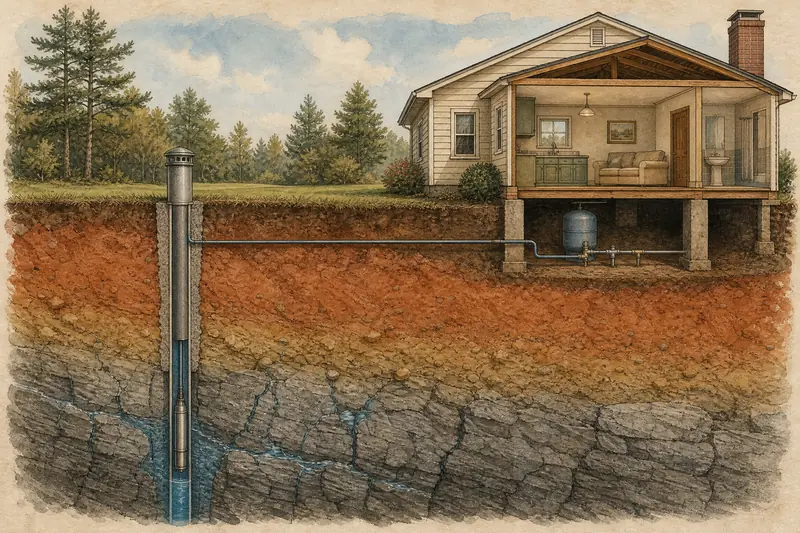
In North Carolina, arsenic in well water mostly comes out of the bedrock itself. The NC DEQ arsenic brochure explains that rock born of ancient volcanic activity is richer in arsenic-bearing minerals, and groundwater moving through fractures in that rock picks the arsenic up. DEQ's own investigations concluded that arsenic in the state's groundwater is "most often naturally occurring."
The amount varies well to well. DEQ notes "there are many instances where one well contains dissolved arsenic and another well nearby is arsenic free." Orange County's review adds that deeper wells tend to have higher arsenic, and UNC researchers found that wells over the limit were more likely to have alkaline, higher-pH water. So a neighbor's clean result says little about yours.
Arsenic can also come from old pesticide use, mining and coal-fired power plants, NC DHHS says, but in the Piedmont the rock is the usual source. Iron-sulfide minerals in fractured bedrock are one of the carriers DEQ pictures on its brochure.
What is the limit for arsenic in well water?
The benchmark is 10 micrograms per liter, shown on lab reports as 0.010 mg/L or 10 parts per billion. EPA adopted that number for public water in 2001 with a 2006 compliance date, and NC DEQ took the same level in 2001 and reaffirmed it in 2011. EPA's health-based goal sits at zero.
The limit is a public-water standard, so nothing forces a private well owner to meet it, but NC DHHS uses it as the benchmark for private well results. Current DHHS guidance uses 10 µg/L, and that is the number to compare against. DHHS also notes that arsenic 3 is more toxic and harder to remove than arsenic 5, and a routine test does not tell them apart.
| Arsenic result | Same value in | What it means |
|---|---|---|
| 0.010 mg/L | 10 µg/L or 10 ppb | At the EPA and NC limit |
| 0.005 mg/L | 5 µg/L | Below the limit; still detectable |
| <0.001 mg/L | Under 1 µg/L | Not detected at the lab's reporting level |
Which counties near Durham sit on the Slate Belt?
Of the five counties this site covers, Orange and Person lie on the Carolina Slate Belt. Orange County's health department says "most of Orange County lies within the former Carolina Slate belt" and places the county 5th of 16 Slate Belt counties for groundwater arsenic above 1 µg/L, while UNC's Superfund Research Program traces the belt "from Union County to Person County."
Rank is not the same as danger. The same Orange County review found "nearly all" of its arsenic results below the 10 µg/L limit. NC DHHS lists Alexander, Anson, Dare, Montgomery, Stanly and Union counties as the places with more frequent detections, and UNC found especially high levels in the younger Albemarle Arc farther southwest.
Parts of Durham, Chatham, Granville and Orange lie instead on Triassic Basin sedimentary rock, which USGS found often carries arsenic above 1 µg/L in its lake-bed layers. County-by-county arsenic rates for Durham, Granville and Person were not found in a primary source, so this page does not give one. The private wells overview and Triassic Basin page describe those rocks.
| Source | Area | Finding |
|---|---|---|
| NC DEQ brochure | NC Slate Belt | More wells with detectable and elevated arsenic than other regions |
| Orange County Health Department | Orange County | 5th of 16 Slate Belt counties for arsenic above 1 µg/L; nearly all below 10 µg/L |
| UNC Superfund Research Program | Slate Belt, Union to Person County | Up to 1 in 3 wells over the limit in some rock units |
| USGS SIR 2013-5072 | Triassic Basin lake-bed rocks | Arsenic above 1 µg/L frequently detected |
| NC DHHS | Statewide, 2018-2019 | 2.26% of sampled wells over 10 µg/L |
Which lab panel picks up arsenic in well water?
Arsenic shows up on a certified lab's inorganic (metals) panel, and in NC that panel includes it without a special request. Every new well must be tested for it under 15A NCAC 18A .3803, and Orange County's published inorganic panel names it as well. As DHHS puts it, "you can't see, smell, or taste arsenic," so the lab number is the whole answer.
For an existing well, the NC DHHS private well FAQ suggests metals every two years. Because arsenic tracks with pH in some Slate Belt rock, read the pH line on the same report. The well water testing page compares county panels and fees.
How is arsenic removed from well water?
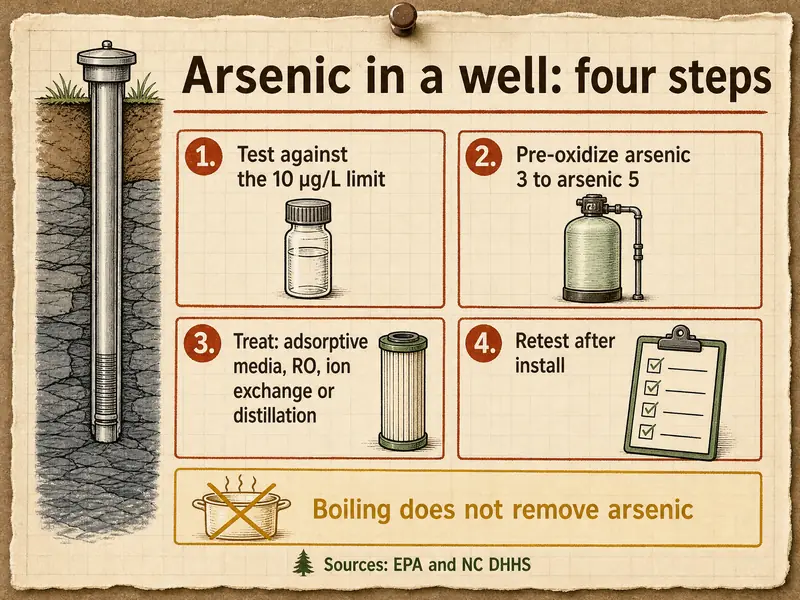
Removal is a two-stage job in NC DHHS's guidance: oxidize the arsenic to the arsenic 5 form, then send the water through adsorptive media, ion exchange, distillation or reverse osmosis. The first stage is there because a routine test cannot say which form is present, so an oxidizing unit such as an iron oxidation or manganese dioxide filter converts any arsenic 3 before the main treatment.
Each method has a trade-off in the DHHS list. Adsorptive media makes little wastewater. Ion exchange works much like a softener. Distillation is point-of-use with low output and high electric use. Reverse osmosis gives a small output and a large amount of wastewater. NC DEQ adds that a point-of-use granular ferric oxide filter "reliably removes most arsenic forms to below detectable levels," and that whole-house versions exist at higher cost.
Other options in the DEQ brochure are bottled water, a public water connection where lines are near, or a new well, with the caveat that a new well may also contain arsenic. NSF cautions that a certification covers only the contaminants a unit was tested for, so look for arsenic by name on the listing. A softener sized for hardness, an iron filter or a sediment filter is not an arsenic treatment on its own. Retest after any system goes in, and keep up the maintenance; DEQ warns that a neglected system can expose you again.
Does boiling remove arsenic from well water?
Boiling leaves the arsenic in the pot; it does not take it out. Washington State's health department settles it in one line: "No. Boiling water does not remove arsenic" (Washington DOH). A rolling boil kills germs, which is why boil-water notices exist, but arsenic is a dissolved element and stays put.
What matters is what you drink and cook with. NC DEQ says the greatest exposure is from drinking and cooking, and that skin contact from bathing is "much less of a risk for most people." That is why a single treated kitchen tap is a common answer for arsenic, unlike radon, which needs whole-house treatment; the radon and uranium page explains the difference.
Where this comes from
This page is based on the NC DHHS arsenic handout and private well FAQ, the NC DEQ "Arsenic in Groundwater" brochure, Orange County's arsenic review, UNC Superfund Research Program reporting on Slate Belt research, USGS SIR 2013-5072, EPA drinking water regulations, 15A NCAC 18A .3803, NSF's standards overview and Washington State Department of Health guidance on boiling, all checked in October 2026. Left out: equipment prices from sellers, contractor claims and anecdotes.
Questions worth asking
Are most Orange County wells over the arsenic limit?
No. Orange County's own review found nearly all of its arsenic results below 10 µg/L, even though the county ranks 5th of 16 Slate Belt counties for arsenic above 1 µg/L. The ranking reflects how often low levels turn up, not how often wells fail. Only a test of your own well settles it.
Can arsenic levels in a well change over time?
DEQ's monitoring of a select set of private wells showed generally stable arsenic levels over several years. DEQ also notes that installing and using a well can cause chemical changes that affect how much arsenic dissolves. Regular retesting covers both cases.
Will a water softener remove arsenic?
Ion exchange is one of the DHHS arsenic treatments and works like a softener, but a softener set up for hardness is not an arsenic treatment by default. Use equipment whose listing names arsenic, and test after installation.
Should you drill a new well to get away from arsenic?
It can work, since one well may have arsenic while a neighbor's does not. NC DEQ warns there is a risk the new well could also contain arsenic, and Orange County notes deeper wells tend to run higher. A new well also needs its own permit and tests.
What is the difference between arsenic 3 and arsenic 5?
They are two forms of dissolved arsenic. NC DHHS says arsenic 3 is more toxic and harder to remove, and routine tests do not separate them, which is why pre-oxidation to arsenic 5 comes first.
Does arsenic affect animals and gardens on a well?
This page covers household drinking water only. NC DEQ notes some foods raised with arsenic-rich water or feed can carry arsenic, so ask NC State Extension about livestock or garden use.
Read next
Filed under Well notes · septic and well notes for Durham