Wells
Reverse Osmosis for Well Water at the Kitchen Tap
Reverse osmosis for well water makes sense when a test finds arsenic, nitrate, uranium, lead or copper in water you drink; it treats one tap, so it does not fix bacteria, radon or whole-house problems.
Compiled by the Red Clay Septic & Well desk · Last revised
Ownership note. Red Clay Septic & Well has the same owners as two water-treatment stores, SoftPro Water Systems and Quality Water Treatment. Links on this page to either store go to equipment that store sells. Treatment advice here follows NC DHHS, NC State Extension and EPA guidance checked in October 2026; what a product listing says is the store's own claim, not a test by this site. More on ownership
In these notes
- Is reverse osmosis for well water worth it?
- What does reverse osmosis remove from well water?
- Which certifications should a reverse osmosis unit have?
- Does a well need pretreatment before reverse osmosis?
- What does reverse osmosis not fix?
- How do you maintain reverse osmosis on well water?
- Questions worth asking
The short version
- NC DHHS lists reverse osmosis among its treatment options for arsenic, uranium and nitrate in private wells.
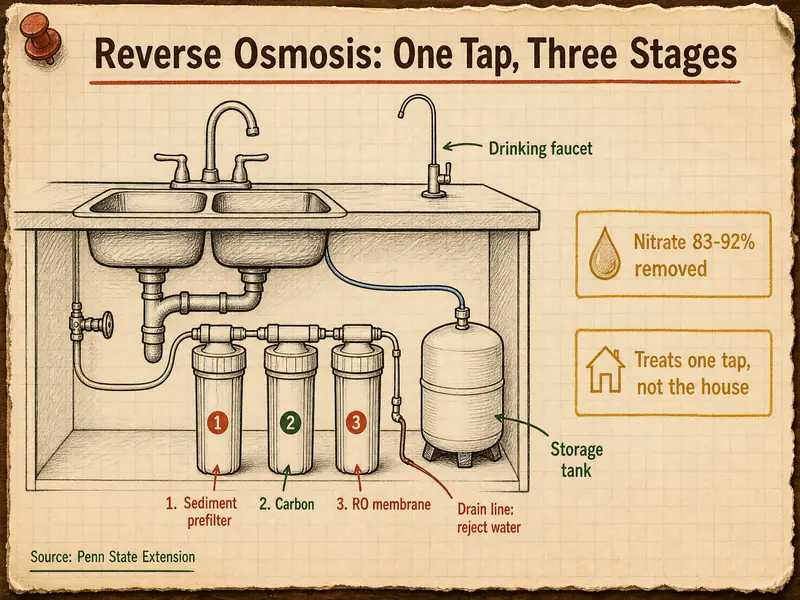
- Penn State Extension estimates RO removes about 83 to 92 percent of incoming nitrate (Penn State Extension).
- Some RO units waste up to 90 percent of the incoming water, Penn State says; newer designs claim much less.
- NSF/ANSI 58 is the standard for reverse osmosis systems; certification covers only the contaminants listed for that model (NSF).
- EPA's arsenic limit is 10 µg/L and its uranium limit is 30 µg/L; neither is enforced on private wells.
- Radon in water is mainly an indoor-air risk and calls for whole-house carbon or aeration, per EPA, not an RO unit.
An under-sink reverse osmosis unit is one of the most common answers when a well test comes back with a health-related result at a level that is not dramatic but not comfortable either. It is also one of the most oversold. What it does well, it does at one faucet, and it depends on the water reaching it being reasonably clean already.
Is reverse osmosis for well water worth it?
It is worth it when a lab test shows a dissolved contaminant you want out of drinking and cooking water, and the rest of the house's water is acceptable. For a well with arsenic slightly over the limit, nitrate near 10 mg/L, or copper from corroding pipes, a single RO tap is often the simplest fix.
It is not worth it as a first purchase. NC DHHS recommends knowing hardness, pH, iron and turbidity before installing any treatment and retesting after it goes in (NC DHHS). The same guide puts costs at around $500 for a single point-of-use system and up to $3,000 for point-of-entry treatment. If the test shows nothing above health levels, an RO unit is a taste preference, not a fix.
Around Durham the contaminants that most often send people to RO are arsenic and, less often, uranium. NC DHHS reports that 2.26% of wells sampled for arsenic from 2018 to 2019 exceeded the 0.01 mg/L standard (NC DHHS), and NC DEQ notes the slate belt has more wells with elevated arsenic than other regions. USGS found uranium above 30 µg/L in 0.6% of 310 Piedmont samples. Both are on the arsenic and radon and uranium pages.
What does reverse osmosis remove from well water?
Reverse osmosis forces water through a semi-permeable membrane that holds back most dissolved substances, the description NSF uses for its NSF/ANSI 58 standard. Penn State's buying guide says RO "removes any dissolved pollutants from water." Real-world numbers are lower than that phrasing suggests: for nitrate, Penn State estimates 83 to 92 percent removal.
NC agencies name RO for several well contaminants. NC DHHS lists it for uranium and for nitrate, and lists it for arsenic after pre-oxidation, while warning of "small water output, large amount of wastewater." NC DEQ calls RO "a membrane filtration process commonly used by households to remove arsenic" (NC DEQ). Penn State Extension also lists RO, distillation and activated alumina as acceptable point-of-use methods for lead and copper.
| Contaminant | Limit for comparison | RO named? | Other options named |
|---|---|---|---|
| Arsenic | 10 µg/L (EPA MCL) | Yes, after pre-oxidation | Adsorptive media, ion exchange, distillation, ferric oxide filter |
| Nitrate | 10 mg/L as N (EPA MCL) | Yes | Anion exchange, distillation |
| Uranium | 30 µg/L (EPA MCL) | Yes | Ion exchange |
| Lead and copper | 0.015 / 1.3 mg/L (public-system action levels) | Yes, at the tap | Distillation, activated alumina |
| Radon in water | No enforceable standard | No | Whole-house carbon or aeration |
| Coliform bacteria | None present | No | Shock chlorination, then UV |
Which certifications should a reverse osmosis unit have?
Look for NSF/ANSI 58, the standard for reverse osmosis systems, with the specific contaminants you need listed on that model's performance data sheet. NSF warns that certification to a standard "does not mean" a unit reduces every contaminant, so a 58 listing for total dissolved solids alone says nothing about arsenic.
Arsenic is the case to read closely. NC DHHS recommends pre-oxidation to convert well-water arsenic to arsenic 5, the form treatment removes best, so look for an arsenic claim on the data sheet and ask how the unit handles the other form. Penn State suggests asking sellers for written proof of NSF or WQA certification for the equipment.
Certifications can be checked in the certifier's online listings by model number, which settles claims a product page may state loosely.
Does a well need pretreatment before reverse osmosis?
Usually yes, at least a sediment stage, and sometimes more. Penn State notes that an RO system "requires a sediment filter, storage tanks, a membrane, and an activated carbon filter," and most under-sink units include a sediment and carbon stage ahead of the membrane.
Well water adds its own demands. NC DHHS lists hardness, pH, iron and turbidity as the "interference" values to know before buying treatment, and the maker of one popular unit advises in its FAQ that well water pass through pre-filtration first. If the well has iron, manganese or heavy sediment, fix those at the whole-house level first; the iron and manganese and whole house filter pages cover that.
Check pressure too. Membranes need enough pressure to work, and makers state a range; well pressure switches cycle between a low and high setting, so read the low number on your pressure gauge.
What does reverse osmosis not fix?
It does not disinfect, does not treat the whole house, and does not address radon. For coliform bacteria NC DHHS names shock chlorination and then UV treatment when contamination persists; the steps are on the coliform bacteria page.
Radon is the clearest mismatch. EPA estimates most of the harm from radon in water comes from breathing radon released into indoor air from showers and taps, and names point-of-entry granular activated carbon or aeration to remove it (EPA). An RO tap in the kitchen leaves every shower untreated.
It also leaves corrosive water corroding pipes elsewhere in the house, and hard water scaling the water heater. And it uses water: Penn State notes some units produce only a few gallons a day while "wasting up to 90 percent of the incoming water." On a septic system, that reject water goes down the drain like any other wastewater.
How do you maintain reverse osmosis on well water?
Change the prefilters and membrane on the maker's schedule and retest the treated water. Penn State lists membrane replacement as the main maintenance item for RO.
Testing after installation is the step people skip. NC DHHS recommends retesting after any treatment system is installed. Orange County's health department makes the point plainly: if you have treatment, test "from a faucet after the filter," because the goal is to "test the water where you actually drink it" (Orange County). A yearly or every-other-year check of the RO tap for the contaminant you bought it for confirms the membrane is still doing its job; the well water testing page lists county tests.
Two under-sink RO units from the linked stores
If a test turns up a contaminant RO is named for, two units fit the job. SoftPro Water Systems carries the Waterdrop G3P600 (sold by SoftPro Water Systems, which has the same owners as this site), a tankless under-sink unit. Its maker, Waterdrop, rates it at 600 gallons per day with a 2:1 pure-to-drain ratio, says it needs an electrical outlet and 14.5 to 87 psi of water pressure, gives filter lives of 6, 12 and 24 months for the three cartridges, and states that IAPMO R&T tested it against NSF/ANSI 58 for the claims on its performance data sheet (Waterdrop). The maker's pages list other standards inconsistently, so check the listing for the contaminant you care about. Quality Water Treatment sells the SoftPro Green Reverse Osmosis System (sold by Quality Water Treatment, which has the same owners as this site), which the store describes as a high-efficiency 50 GPD unit with a choice of post carbon filter or alkalizing filter and several faucet finishes; its listing showed every option as unavailable when checked in October 2026.
These are the stores' and maker's own claims. Neither unit disinfects water or treats radon, and both serve one faucet.
- 83-92%Share of incoming nitrate RO removes (estimate)Penn State Extension
- Up to 90%Incoming water some RO units send to the drainPenn State Extension
- 10 µg/LEPA arsenic limit (MCL)EPA
- 2.26%NC wells over the arsenic standard, 2018-2019 samplesNC DHHS
Where this comes from
Written from NC DHHS guidance on arsenic, uranium, nitrate and choosing treatment; NC DEQ's arsenic brochure; EPA's drinking water standards and radon pages; USGS SIR 2013-5072; NSF's description of its standards; Penn State Extension's nitrate, buying and corrosive water guides; Orange County's water sample page; and the Waterdrop G3P600 product page, all opened in October 2026. Store and maker details are their own claims. Not included: installer quotes, brand rankings, forum reports, and any testing of these units by Red Clay Septic & Well.
Questions worth asking
Does reverse osmosis remove fluoride from well water?
Some makers claim it; Waterdrop lists fluoride among the G3P600's reductions, for example. Check the NSF/ANSI 58 listing for that model, since certification covers only the contaminants listed.
Is RO water too low in minerals to drink?
RO holds back most dissolved substances, minerals included. Some units add a remineralizing or alkalizing cartridge after the membrane, as one of the store options here does, mainly for taste.
Is boiling an alternative to RO for nitrate?
No. NC DHHS says plainly that boiling water does not remove nitrates. Its listed treatments are anion exchange, distillation and reverse osmosis.
Where should the RO reject water go on a septic system?
It drains to the sink drain and into the septic tank like other household water. A high-waste unit adds to the daily flow, which is one reason low-waste designs suit septic homes.
Will RO remove the rotten-egg smell from well water?
The carbon stage may reduce a mild odor at that one tap, but the smell will remain at every other faucet. Hydrogen sulfide is usually treated at the whole-house level by oxidation, according to Penn State Extension.
How can you tell when an RO membrane needs changing?
Follow the maker's schedule, which for the G3P600 is 24 months or 2,200 gallons, and retest the RO tap for the contaminant you bought it for. A result creeping back up is the clearest sign.
Read next


Filed under Well notes · the front page of these Piedmont field notes