Septic
Septic Tank Pumping in Durham: How Often and Why
Septic tank pumping in Durham, NC is due when scum and sludge fill more than one-third of the tank's liquid depth, which for a family on a 1,000-gallon tank usually means every 3 to 5 years.
Compiled by the Red Clay Septic & Well desk · Last revised
In these notes
- How often should a septic tank in Durham NC be pumped?
- What does NC law say about when a tank needs pumping?
- What happens during septic tank pumping?
- How do you find the septic tank on a Durham lot?
- What does septic tank pumping cost?
- What shortens the time between pumpings?
- What records should you keep?
- Questions worth asking
The short version
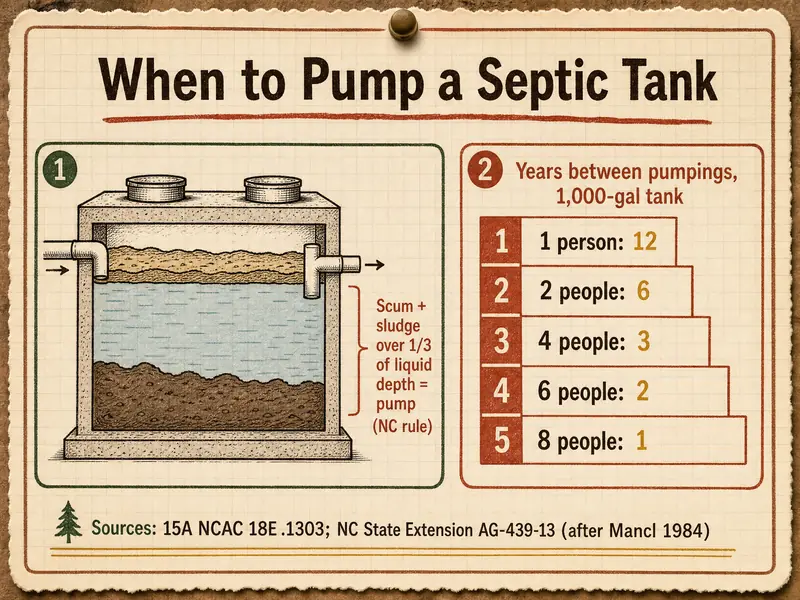
- North Carolina's legal trigger is in 15A NCAC 18E .1303: empty every compartment once scum plus sludge pass one-third of the liquid depth.
- NCDHHS, EPA and NC State Extension all put a typical household interval at 3 to 5 years; have the tank checked every 1 to 3 years to find your own number.
- NC State Extension's table runs from 12 years (one person, 1,000 gallons) down to 1 year (eight people, same tank).
- Pumpers in NC work under a septage firm permit from the NC Department of Environmental Quality, not under the septic installer and inspector board.
- Tanks permitted since January 1, 1999 must carry an effluent filter; check it at least every 2 to 3 years and whenever drains slow.
- Durham County, Granville-Vance Public Health, Orange, Chatham and Person all keep septic permits that show where the tank sits and how big it is.
- 1/3Scum plus sludge depth that requires a full pump-out in North Carolina15A NCAC 18E .1303(a)(3)
- 3-5 yearsTypical pumping interval for a household tankNCDHHS On-Site Water Protection
- 2xSolids added to the tank when a home runs a garbage disposalNC State Extension AG-439-13
- 1,000 galMinimum tank for a home of up to four bedrooms15A NCAC 18E .0801 Table XIV
How often should a septic tank in Durham NC be pumped?
A family of four on a standard 1,000-gallon tank around Durham needs pumping about every 3 years by NC State Extension's table below, while 3 to 5 years is the general guidance for household tanks; the real answer comes from measuring the tank. NCDHHS says most tanks should be pumped every three to five years, and EPA gives the same range for household tanks.
The interval stretches or shrinks with two things: how many people live in the house and how big the tank is. NC State Extension's Table 1 in Septic Systems and Their Maintenance (AG-439-13) shows a single person on a 1,000-gallon tank going about 12 years between pump-outs, while eight people on the same tank need it yearly.
So the better habit is a check, not a calendar: have the sludge and scum measured every 1 to 3 years, write the numbers down, and let the rate of buildup set the next date. Orange County's health department goes further and suggests a look at the tank once a year.
| Tank size | 1 person | 2 people | 4 people | 6 people | 8 people |
|---|---|---|---|---|---|
| 900 gal | 11 | 5 | 2 | 1 | under 1 |
| 1,000 gal | 12 | 6 | 3 | 2 | 1 |
| 1,250 gal | 16 | 8 | 3 | 2 | 1 |
| 1,500 gal | 19 | 9 | 4 | 3 | 2 |
What does NC law say about when a tank needs pumping?
State rule sets a depth trigger, not a date: under 15A NCAC 18E .1303(a)(3), the entire contents of every compartment come out once scum and sludge together exceed one-third of the liquid depth in any compartment. The same paragraph says the effluent filter is to be rinsed or replaced as needed.
Other agencies publish earlier planning points. EPA's septic care page suggests pumping when sludge and scum reach 25 percent of the liquid depth, when the bottom of the scum sits within 6 inches of the outlet, or when sludge rises within 12 inches of it. Extension gives a worked number: a 1,000-gallon tank with about 4 feet of liquid should be pumped once the solids are roughly a foot thick.
The rule also defines the far end. A tank that has to be pumped more often than once a month to keep sewage off the ground or out of the house counts as a malfunctioning system under 18E .1303(a)(2), and the owner must report it to the county. That situation is a repair problem, covered on the septic repair page, not a pumping schedule.
What happens during septic tank pumping?
A permitted pumper uncovers the tank access ports, measures the scum and sludge, pumps out every compartment and looks over the tank while it is empty. NCDHHS tells owners to ask the pumper to check both sides of the tank, because most NC tanks have two compartments and the second is easy to skip.
A careful visit usually covers:
In a nutshell
- Measuring scum and sludge before pumping, so you know the buildup rate
- Pumping both compartments, and a separate pump tank if the system has one
- Pulling and rinsing the effluent filter at the outlet
- Looking at the inlet and outlet baffles or tees for cracks or missing pieces
- Noting roots, cracks, or water running back from the drainfield
Pumping is regulated differently from installing. The NC certification board's FAQ says it does not regulate pumpers; they hold a septage firm permit issued through the NC Division of Waste Management. DEQ posts its current septage firm list on its solid waste facility lists page, which Orange County's septic page points to for finding a pumper by county.
On pumping day, nobody should ever enter the tank, and the truck should stay off the drainfield; the NCDHHS factsheet says not to drive or park over the system, and ruts in wet clay compact the soil the trenches depend on.
How do you find the septic tank on a Durham lot?
Start with the county permit, which shows the tank's approximate spot and size. NC State Extension's Septic System Owner's Guide says the permit and soil evaluation sheet from the local health department mark each component and the tank capacity, and that the tank and drainfield may not even sit on the same lot.
In Durham County, the Environmental Health division sends copies of septic and well records to anyone who asks; the records page asks for your name, phone, site address and the parcel number or PIN. Granville-Vance Public Health lists a "Detailed Septic System Search" at $100 on its fee schedule checked October 2026, and Orange, Chatham and Person counties have their own routes, compared on the county permits and records page.
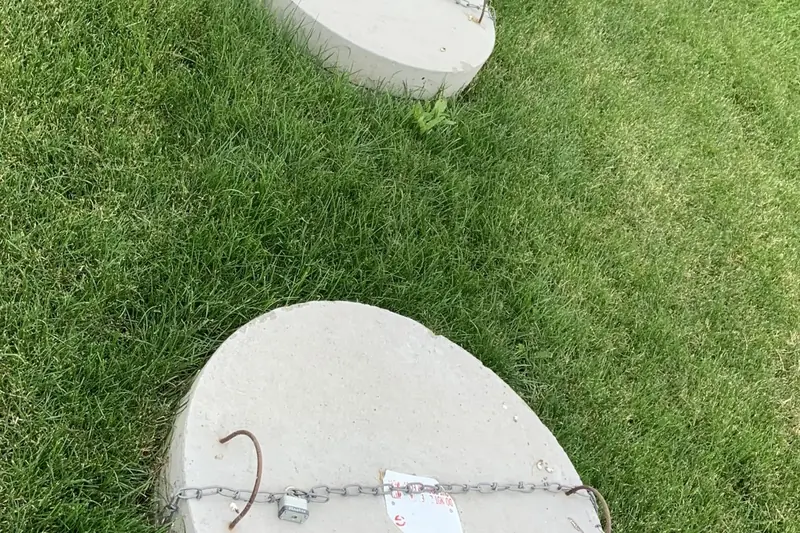
On the ground, EPA's FAQ suggests following the main sewer line out of the house; the access riser, often a black or green disc, is usually about 10 feet from the building. Older tanks without risers may be buried well below the lawn. Extension recommends adding a riser to any tank buried 6 inches or deeper, secured with a lock or heavy lid. Newer tanks already have one, since state law requires the access device to reach within 6 inches of finished grade.
What does septic tank pumping cost?
No county or state agency publishes a price for pumping, so this site does not quote one. Contractors set the price, and a few things drive it:
- Tank volume and the number of compartments or tanks to empty
- Whether a pump tank also needs pumping
- Digging needed to reach lids that have no riser
- Effluent filter cleaning, and any repairs found while the tank is open
- Distance to the lot and how close the truck can park without crossing the drainfield
Ask two or three permitted firms what their quote includes, especially whether both compartments and the filter are covered.
What shortens the time between pumpings?
More solids in, or more people in the house, shortens the interval. NC State Extension says garbage disposals usually double the solids reaching the tank, and NCDHHS tells owners not to install them at all; some permits prohibit them outright.
Grease, wipes, paper towels, coffee grounds and cat litter add solids the tank cannot digest well. Extra water matters too, even though it is not solids: EPA notes one running toilet can waste as much as 200 gallons a day, and heavy flows can push solids out of the tank toward the drainfield before they settle.
Additives do not buy time. EPA's 2024 additives guidance does not recommend septic additives for household systems, and Extension research found no slowdown in solids buildup from bacterial products. The septic care page covers the daily habits in more detail.
What records should you keep?
Keep the county permit, the date of every pump-out, the measured scum and sludge levels, and notes on the filter and baffles. EPA advises writing down the sludge and scum levels the pumper finds; after two or three visits those numbers show your household's own interval better than any chart.
The Operation Permit for a system under 18E lists the tank location, capacity and ID numbers, along with the field layout and number of bedrooms, so it is the first page to file. Add the pumper's name and permit, the gallons removed and anything they flagged. Extension's owner's guide also suggests measuring the distance from the house to the tank access port each time, so the next visit starts with a tape measure rather than a probe.
Records pay off at sale time. A buyer's septic inspection will ask when the tank was last pumped, and a log that shows steady intervals is easier to trust than a guess. Systems with a pump and alarm need those service dates too; see the pump tank alarm page.
Where this comes from
Pumping intervals and triggers here come from the state septic rules (15A NCAC 18E, with its June 2026 amendments), the NCDHHS homeowner page and factsheet, EPA's care pages and 2024 additives guidance, AG-439-13 and the owner's guide from NC State Extension, the certification board's FAQ, DEQ's septage firm list, and the Durham, Orange and Granville-Vance health department pages, read in October 2026. Left out: contractor prices, forum stories and additive makers' claims.
Questions worth asking
Does a septic tank need pumping if nothing seems wrong?
Yes, on a schedule set by measurement. Solids build up whether or not drains slow, and by the time a backup shows, solids may already have reached the drainfield. A check every 1 to 3 years catches the tank before that point.
Should the tank be pumped before a house is sold?
No North Carolina rule requires it. A certified inspector working for a buyer may ask for the tank to be pumped so it can be seen fully, and under the board's rules a client who declines must sign a form saying the inspection was incomplete without it.
Can pumping fix a soggy drainfield?
Rarely. NC State Extension says pumping a tank after the drainfield has fully clogged will not bring the field back. A field with effluent surfacing needs a county repair permit, not just a pump-out.
Is it a problem to pump during a wet Piedmont spring?
The tank itself can be pumped in any season. The risk is to the yard: trucks and foot traffic on saturated clay over the trenches compact the soil, so ask the crew to stay on the driveway side and run the hose rather than drive closer.
Who is allowed to pump a septic tank in North Carolina?
A firm holding a septage permit through NC DEQ's Division of Waste Management. The septic installer and inspector board does not license pumpers, so ask for the firm's septage permit rather than a contractor certificate, or look it up on DEQ's septage firm list.
Does a pump tank need pumping too?
Sometimes. The state homeowner page says a pump tank can need a pump-out of its own, especially if solids have slipped past the septic tank. A pump tank must be at least as large as the septic tank, so treat it as a second tank to check.
Is there a county pumping requirement in Durham or Granville?
Not for a standard gravity system. Durham County Environmental Health and Granville-Vance Public Health permit and inspect systems, while pumping timing follows the state one-third rule. Systems with pumps or pretreatment carry operator and county inspection schedules set by their permit type.
Read next
Filed under Septic notes · the front page of these Piedmont field notes