Septic
Septic Tank Size in NC by Bedrooms
Septic tank size in North Carolina follows bedrooms, not people: 1,000 gallons for up to four bedrooms, 1,250 gallons for five, and a formula above that.
Compiled by the Red Clay Septic & Well desk · Last revised
In these notes
The short version
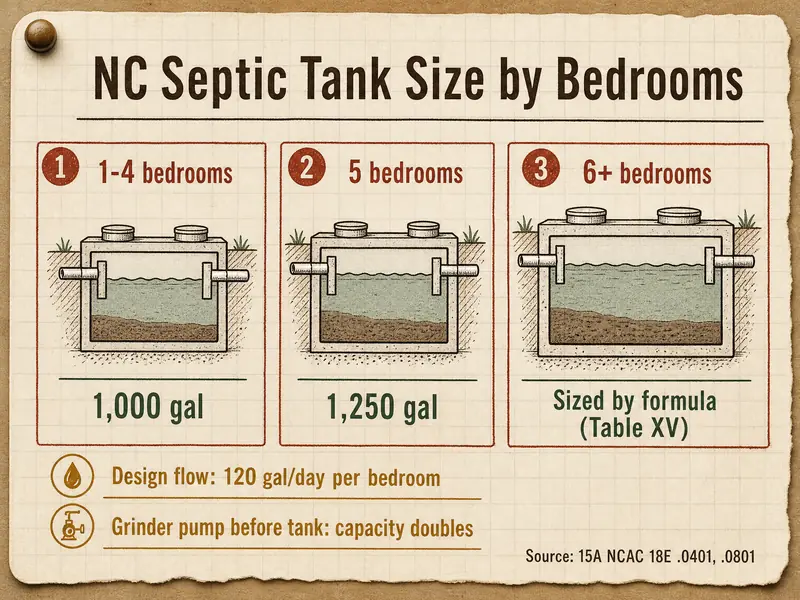
- 15A NCAC 18E .0401 sets design flow at 120 gallons per day per bedroom, or 60 gallons per person when more than two people share each bedroom, whichever is greater.
- Table XIV in 18E .0801 sets a 1,000-gallon minimum tank for four bedrooms or fewer and 1,250 gallons for five.
- Above five bedrooms, Table XV sizes the tank from design flow; a 6-bedroom home at 720 gallons a day works out to about 1,342 gallons.
- A grinder or lift pump ahead of the tank doubles the required capacity under 18E .0801(c).
- 18E defines a bedroom as any room the NC Building Code treats as a sleeping room, and Orange County counts any room that "could reasonably be used as a bedroom."
- The state's real estate licensing board, NCREC, says a home may be advertised only with the number of bedrooms its septic permit allows.
What septic tank size does NC require?
North Carolina requires a septic tank of at least 1,000 gallons for any home of four bedrooms or fewer, and 1,250 gallons for a 5-bedroom home. Both figures come from Table XIV in 15A NCAC 18E .0801, the state wastewater rule in force since January 1, 2024 and amended June 1, 2026. The rule also says no septic tank of any kind may be smaller than 1,000 gallons.
The rule then sets how the volume is built. The required capacity is met with a single two-compartment tank or with two tanks in series, and each tank must hold at least 1,000 gallons. An approved effluent filter sits in the outlet of the last compartment. In the field, the typical tank NC State Extension describes is precast concrete, "about 9 feet long and 5 feet tall."
How does NC count design flow per bedroom?
NC counts design flow at 120 gallons per day for each bedroom, or 60 gallons per day for each person when occupancy runs more than two people per bedroom, whichever number is larger. That is 18E .0401(a). NC State Extension explains the logic in Why Do Septic Systems Fail?: two people per bedroom, each producing about 60 gallons of wastewater a day.
Design flow is a ceiling, not a forecast. Extension puts typical use near 50 gallons per person per day, so a family of four sends roughly 200 to 250 gallons a day into a system permitted for 360 or 480. The margin is there for guests, laundry days and wet weeks, and the Septic System Owner's Guide warns that the drainfield's design capacity of 120 gallons per bedroom holds "even for short periods of time."
What counts as a bedroom matters as much as the arithmetic. 18E .0105 defines a bedroom as "any room defined as a sleeping room in the North Carolina Building Code." Orange County's septic page puts it more plainly: any room that "could reasonably be used as a bedroom, even if it is currently used for something else." A finished bonus room with a closet can count, whatever the listing calls it.
What size septic tank for a 3 bedroom house?
A 3-bedroom house in North Carolina needs a septic tank of at least 1,000 gallons, sized for a design flow of 360 gallons per day. The same 1,000-gallon minimum covers 2- and 4-bedroom homes, so the tank itself rarely changes between them. What does change is the drainfield.
The field is sized by dividing design flow by the soil's long-term acceptance rate (LTAR). In Group IV clay, 18E Table XVII allows 0.1 to 0.4 gallons per square foot per day. For 360 gallons a day, that means roughly 900 to 3,600 square feet of trench bottom. On a Group II sandy loam at 0.6 to 0.8, the same house needs about 450 to 600 square feet. That gap explains why a 3-bedroom lot on red clay can need a far larger field, or a pump system, than the same house on sandier ground. The drainfield page covers trench layout.
| Home | Design daily flow | Minimum septic tank |
|---|---|---|
| 2 bedrooms | 240 gallons/day | 1,000 gallons |
| 3 bedrooms | 360 gallons/day | 1,000 gallons |
| 4 bedrooms | 480 gallons/day | 1,000 gallons |
| 5 bedrooms | 600 gallons/day | 1,250 gallons |
| 6 bedrooms | 720 gallons/day | About 1,342 gallons (1.17 × 720 + 500) |
| 7 bedrooms | 840 gallons/day | About 1,483 gallons (1.17 × 840 + 500) |
When does a bigger septic tank make sense?
A bigger septic tank is required in three cases and optional in most others. The rule requires more capacity for a 5-bedroom home, for homes above five bedrooms or serving two or more dwellings (Table XV), and wherever a grinder pump or sewage lift pump feeds the tank. In that last case 18E .0801(c) doubles the required volume, unless the pump discharges into 10 feet of 4-inch pipe as the NC Plumbing Code specifies.
Choosing a larger tank than required mostly buys time between pumpings. NC State Extension's Table 1, adapted from a 1984 study, shows a family of two on a 1,000-gallon tank reaching the pumping point in about 6 years, against about 8 on a 1,250-gallon tank and 9 on a 1,500-gallon tank. For a family of four the spread narrows to about 3, 3 and 4 years.
A bigger tank does not add bedrooms. The permit's design flow, and the field built for it, set the home's capacity. A 1,500-gallon tank on a field permitted for three bedrooms is still a 3-bedroom system. Pump tanks follow the same floor: 18E .0802 requires a pump tank at least as large as the required septic tank (see pump tank alarms).
Does adding a bedroom change the septic tank size?
Adding a bedroom raises design flow by 120 gallons a day, so it can change the required tank and field, and it needs county review before the building permit. 18E .0202 requires an application "when an increase in DDF or wastewater strength is proposed." Going from four bedrooms to five moves the minimum tank from 1,000 to 1,250 gallons and adds field area.
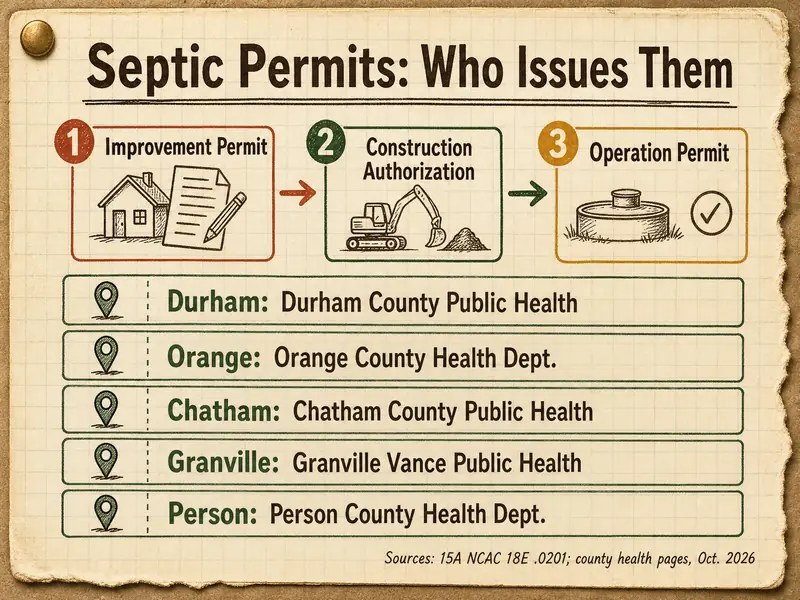
Orange County's septic page lays out the two paths. An addition that adds no bedrooms and does not affect the system gets an Existing System Authorization. One that adds bedrooms, or moves the system, "will likely need a new Improvement Permit and Construction Authorization." The other counties follow the same state rule, though forms and fees differ; see county septic permits and records.
Real estate makes the same point from the other side. NCREC's 2016 bulletin for brokers tells brokers that when a permit shows three bedrooms, the home "may only" be advertised as a 3-bedroom home, and that some permits also prohibit a dishwasher or garbage disposal.
How do you find your tank's size?
The surest way to find your tank's size is the septic permit on file with the county health department. NCDHHS tells owners to "ask your local health department for a copy of your septic permit and system layout," and NC State Extension notes the permit and soil evaluation sheet show the approximate location of each part and the size of the tank.
Other clues help when the permit is thin or missing:
- The pumping record. A pumper reports gallons removed and can see both compartments. Ask for the number in writing.
- An inspection report. A certified inspector at sale records the designed system size, in gallons per day or bedrooms, from county records under 21 NCAC 39 .1006.
- The permit date. Systems permitted after January 1, 1999 must have an effluent filter, which helps date the tank.
- The bedroom count. Under current rules, a 4-bedroom-or-smaller home should have at least 1,000 gallons; an older home may not.
Some counties did not keep early records, and NCREC notes that a missing permit should be disclosed as missing. For pumping intervals by tank size, see septic tank pumping.
- 120 gal/dayDesign flow each bedroom adds to a home's permit15A NCAC 18E .0401(a)
- 1,000 galMinimum septic tank for four bedrooms or fewer15A NCAC 18E .0801, Table XIV
- 1,250 galMinimum septic tank for five bedrooms15A NCAC 18E .0801, Table XIV
- 2xRequired capacity when a grinder or lift pump feeds the tank15A NCAC 18E .0801(c)
Where this comes from
This page is based on 15A NCAC 18E Sections .0105, .0202, .0401, .0801, .0802 and .0901 (rules as amended June 1, 2026), 21 NCAC 39 .1006, NC State Extension publications AG-439-13, the Septic System Owner's Guide and Why Do Septic Systems Fail?, the NCDHHS homeowner page, Orange County's septic page and NCREC's 2016 broker bulletin, all checked in October 2026. The 6- and 7-bedroom tank sizes are calculated from Table XV. Left out: tank prices, brand capacities and older rules that applied before 2024.
Questions worth asking
Is a 1,000 gallon septic tank big enough for 4 bedrooms?
Yes, under current NC rules. Table XIV in 18E .0801 sets 1,000 gallons as the minimum for four bedrooms or fewer. A grinder pump ahead of the tank would double that requirement.
Does a home office count as a bedroom for septic sizing?
It can. 18E uses the NC Building Code definition of a sleeping room, and Orange County counts any room that could reasonably be used as a bedroom. The county health department makes the call when it reviews plans.
Can two houses share one septic tank?
Only under a permit sized for both. Two or more dwelling units are sized with Table XV from their combined design flow, not with the bedroom table, and the county must permit that arrangement.
Is a two-compartment tank required?
The capacity must come from a single two-compartment tank or two tanks in series, each of at least 1,000 gallons. Pumpers should empty both compartments, as NCDHHS reminds owners.
What if the tank is smaller than current rules require?
Tanks built under earlier rules were permitted to those rules, so ask the county health department before assuming a problem. The size comes up when the home adds bedrooms or the system is repaired or replaced, since that work is permitted under 18E.
Does a larger tank mean less frequent pumping?
Usually. In NC State Extension's Table 1, a household of two reaches the pumping point in about 6 years on 1,000 gallons and about 9 on 1,500 gallons. Actual rates vary, so have solids measured.
Is the 6-bedroom size exactly 1,342 gallons?
That is the Table XV result for 720 gallons a day. The designer and the county settle the actual tank, which also has to satisfy the two-compartment or two-tank rule.
Read next

Filed under Septic notes · septic and well notes for Durham