City water
Durham Water Quality: What the City Report Shows
Durham water quality, by the City's own 2023 report, meets every federal limit in force, is soft on the USGS scale, and carries PFAS at times above EPA's 4.0 ppt limits that apply from 2029.
Compiled by the Red Clay Septic & Well desk · Last revised
In these notes
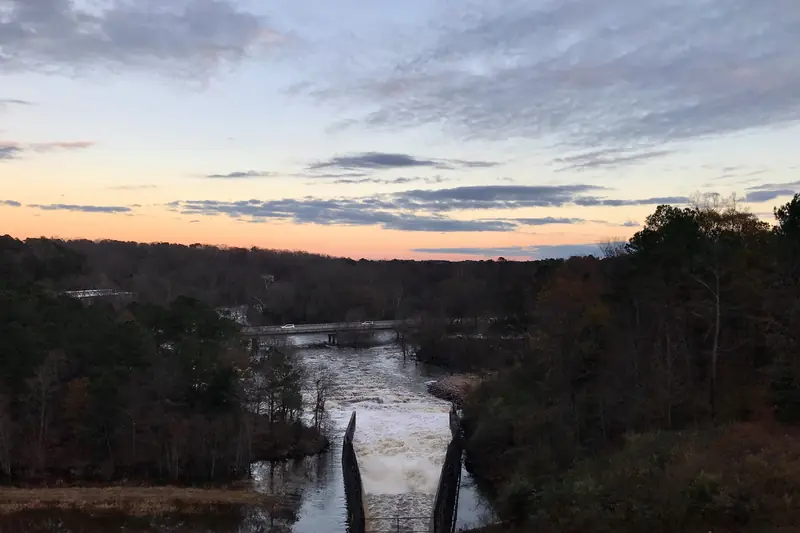
The City of Durham's Department of Water Management publishes the Annual Water Quality Report; Red Clay Septic & Well is not the city and does not test anyone's water. This page reads the newest report that could be opened (the 2023 report, 2023 data, updated October 18, 2024) and the City's lead and PFAS pages, and names the year beside every number. A 2024 report is listed on the City's water quality report page; check it for newer figures.
The short version
- The 2023 report (2023 data) shows no health-based violations; the only notice was coliform paperwork filed three days late, with results showing no coliform.
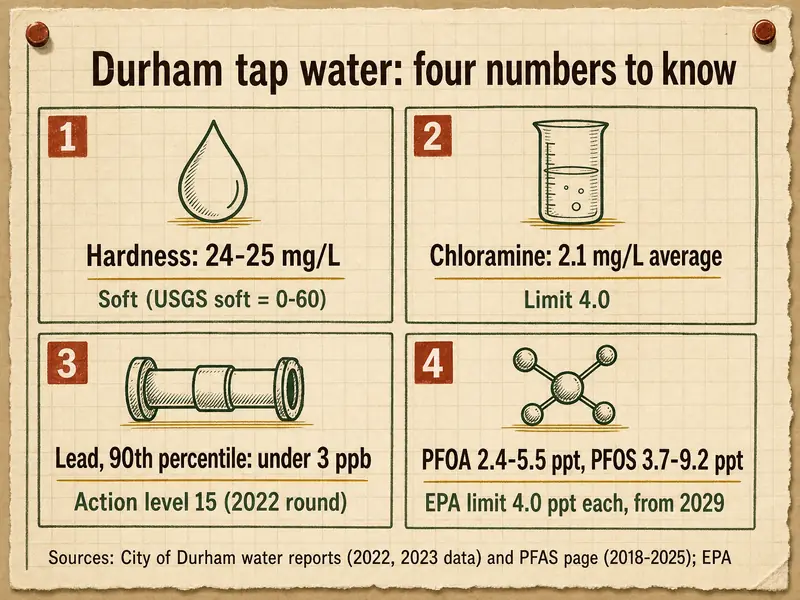
- Hardness was 24-25 mg/L as calcium carbonate in the 2022 report (2022 data), about 1.4-1.5 grains per gallon: soft on the USGS scale (0-60 mg/L), "slightly hard" on the 1-3.5 gpg scale water-treatment sources use.
- Chloramine averaged 2.1 mg/L in 2023 against a maximum residual level of 4.0 mg/L; Durham has used it since 2002.
- Lead at the 90th percentile was under 3 ppb in the July-September 2022 round, against an action level of 15 ppb.
- PFOA ranged 2.4-5.5 ppt and PFOS 3.7-9.2 ppt in tests from February 2018 to February 2025; EPA's limit for each is 4.0 ppt from 2029.
- The City's own PFAS fix, powdered activated carbon, is planned by 2029.
- 2.1 mg/LAverage chloramine in 2023 (limit 4.0)City of Durham 2023 Water Quality Report
- <3 ppbLead, 90th percentile, 2022 sampling roundCity of Durham 2023 Water Quality Report
- 0.137 mg/LCopper, 90th percentile, 2022 round (action level 1.3)City of Durham 2023 Water Quality Report
- 4.0 pptEPA limit each for PFOA and PFOS, compliance by 2029US EPA PFAS drinking water rule
What does the Durham water quality report show?
The Durham water quality report for 2023 shows the City met every federal and state limit that applied that year. The regulated-contaminants table marks each row "No" for violations: fluoride averaged 0.72 mg/L (limit 4.0), nitrate under 0.20 mg/L as nitrogen (limit 10), turbidity peaked at 0.08 NTU, and total coliform was 0% positive. Disinfection byproducts stayed below their limits at every sampling site; the highest running averages were 44.0 ppb for total trihalomethanes (limit 80) and 38.8 ppb for haloacetic acids (limit 60).
One reporting notice appears. In February 2023 staff submitted coliform results three days after the deadline; those results showed no coliform. EPA's federal database lists four violations for the system between 2018 and 2023, and each is flagged as not health-based.
The report is also candid about the lakes. A 2020 state source-water assessment rated both Lake Michie and Little River Reservoir "Higher" for susceptibility to contamination, which is a rating of the watershed, not of the treated water.
Where does Durham's water come from?
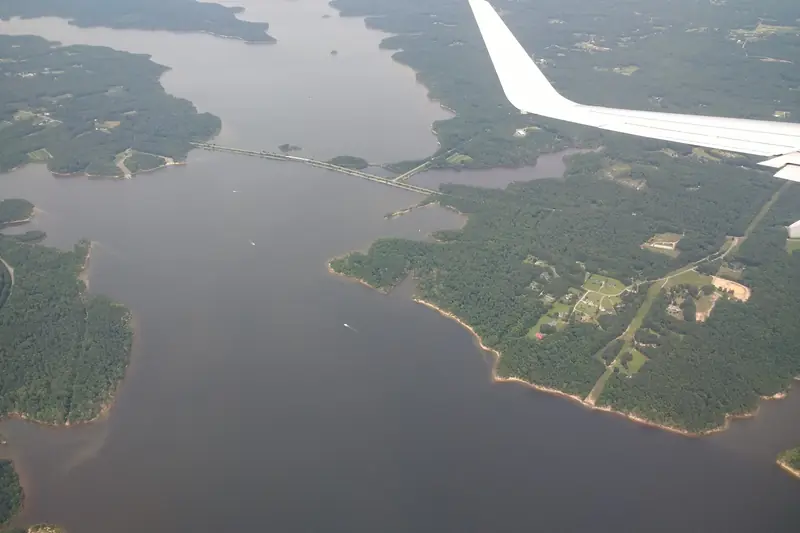
Durham's water comes from Lake Michie, built in 1926, and Little River Reservoir, built in 1988, with Jordan Lake and the former Teer Quarry as backups. The 2023 report puts the two lakes' safe yield at 26.9 million gallons a day, below the 29.4 MGD the City delivered in 2023 to more than 321,000 people. Jordan Lake water arrives through the Town of Cary under an allocation that rose to 16.5 MGD in 2017.
Two plants treat it: the Williams plant on Hillandale Road (1917, permitted for 22 MGD) and the Brown plant (42 MGD after a 2021 expansion). Treatment adds chloramine for disinfection, orthophosphate against pipe corrosion, sodium hydroxide for pH and fluoride. Since these are surface lakes, the City's reports do not flag the iron, manganese, radon or uranium questions that come with a private well; those are covered under well water testing.
Is Durham water hard or soft?
It depends on whose scale: soft for the USGS, "slightly hard" for the grain-based ladder that softener guides use, where 1 to 3.5 gpg earns that label. The 2022 report (2022 data), the newest one opened that still lists minerals, gives hardness of 24 mg/L calculated and 25 mg/L by EDTA titration, roughly 1.4-1.5 grains per gallon. The USGS scale calls 0-60 mg/L soft, 61-120 moderately hard, 121-180 hard and anything above 180 very hard.
The same table lists pH of 7.4-7.5, alkalinity of 25 mg/L, calcium of 5.7 mg/L and sodium of 26.6 mg/L. The well water softener page covers when hardness does matter, which is mostly on private wells.
Why does Durham use chloramine?
Durham uses chloramine, chlorine combined with ammonia, because it keeps disinfecting through 1,400 miles of pipe while forming fewer disinfection byproducts than chlorine alone. The City's disinfection changeover page says the method has been in place since 2002. The 2023 average was 2.1 mg/L, about half the 4.0 mg/L maximum.
Each spring, federal and state rules require a switch to chlorine alone for about six weeks while crews flush hydrants. In 2025 the City stopped adding ammonia on February 28 and resumed on April 14. Neighboring Triangle utilities, including Raleigh, Cary and OWASA, make the same switch at the same time.
Two groups need to act on chloramine year-round. The City tells dialysis patients and aquarium or pond owners to remove ammonia and chlorine before using the water. For everyone else, a stronger taste in spring usually fades if water sits in the refrigerator for a few hours.
What do Durham's lead and PFAS results show?
Durham's lead results are low and its PFAS results are close to the new federal limits. Lead at the 90th percentile was under 3 ppb in the July-September 2022 round, and the City's Lead Safe Durham page says the 2025 round was "well under action levels," with no lead detected in most samples. The City samples a pool of more than 200 homes built from 1983 to 1985 every three years and has added zinc orthophosphate for corrosion control since the 1970s.
The service lines themselves look clean so far. The state's lead service line inventory, with City data reported October 10, 2024, lists 0 lead lines, 37 galvanized lines needing replacement, 55,106 non-lead lines and 54,372 still unknown. Houses built after 1987 count as "known not lead," since North Carolina banned lead service lines in 1986.
PFAS is the harder number. The City's PFAS standards page gives PFOA at 2.4-5.5 ppt and PFOS at 3.7-9.2 ppt across tests from February 2018 to February 2025, with no GenX or PFNA detected. EPA set limits of 4.0 ppt for each in April 2024, with compliance due by 2029, so some Durham results sit above the line. In May 2026 EPA proposed letting systems request two more years, to 2031, and rescinding the limits for four other PFAS; neither proposal is final. The City plans powdered activated carbon treatment by 2029, sooner if possible.
| Measure | Durham result | Federal limit or level |
|---|---|---|
| Nitrate (as N) | Under 0.20 mg/L average | 10 mg/L |
| Fluoride | 0.72 mg/L | 4.0 mg/L |
| Lead, 90th percentile | Under 3 ppb (2022 round) | 15 ppb action level (10 ppb from November 2027) |
| Copper, 90th percentile | 0.137 mg/L (2022 round) | 1.3 mg/L action level |
| Total trihalomethanes | Highest site average 44.0 ppb | 80 ppb |
| PFOA / PFOS | 2.4-5.5 / 3.7-9.2 ppt (2018-2025) | 4.0 ppt each, from 2029 |
Do you need a filter or softener on Durham water?
A softener is not needed on Durham city water: at 24-25 mg/L the water sits inside the USGS soft class and at the low end of the grain-based "slightly hard" band. A filter is a personal choice that turns on PFAS and, in older houses, plumbing. EPA's guide to home filters, which the City points customers to, says to look for certification to NSF/ANSI 53 or 58 for PFAS reduction, and notes that as of April 2024 those certifications did not yet show removal down to the new 4.0 ppt limits.
Activated carbon, reverse osmosis and ion exchange resins are the filter types EPA lists for PFAS, and every one of them works only if cartridges are changed on the maker's schedule. For lead, the City's page suggests a filter certified to NSF 53. None of this applies to a private well, where the questions and the tests are different; the whole-house well filter page and the wells section cover those.
Where this comes from
This page is based on the City of Durham's 2023 Water Quality Report (2023 data) and 2022 report (2022 data, for hardness and minerals), the City's pages on PFAS, lead and the annual disinfection changeover, EPA's PFAS rule page and its home filter guidance, the USGS hardness scale, EPA's federal water system database and the NC DEQ lead service line inventory, all checked in October 2026. City pages were read from archived copies because the City's site blocked research downloads; the official addresses are linked. The 2024 report could not be opened. Left out: third-party tap-water databases, news coverage and filter makers' marketing.
Questions worth asking
Is Durham tap water safe for baby formula?
The 2023 report shows nitrate under 0.20 mg/L, far below the 10 mg/L limit, and fluoride at 0.72 mg/L. Parents with questions about fluoride or PFAS should ask their pediatrician; this page is not medical advice.
Why does Durham water sometimes look cloudy or brown?
The City says hydrant flushing, which runs alongside the spring changeover, can cause slight discoloration. It advises checking the tap before washing white clothes and running it until the water is clear.
Does Durham water contain fluoride?
Yes. The City adds fluoride, and the 2023 report lists an average of 0.72 mg/L against a federal limit of 4.0 mg/L.
Does Durham test for Cryptosporidium?
Yes, monthly since fall 2006, and the 2023 report says the parasite has never been found in any monitoring event.
Has Durham found any lead service lines?
None so far. The City said in November 2024 that no lead service lines had been identified, though more than 54,000 lines were still listed as unknown and about 54,300 customers were due to get a notice asking them to help verify their line.
Will a refrigerator filter remove PFAS from Durham water?
Only if it is certified for PFAS reduction under NSF/ANSI 53 or 58; check the certification body's listing for that model.
Does Durham water have radon or uranium?
The 2023 report lists gross alpha and beta radiation as not detected in samples from February 2017. Radon and uranium are mainly private-well concerns in this area.
Read next
Filed under City water · the front page of these Piedmont field notes