Septic
Septic System Types in NC and Where Each Fits
Septic system types in NC run from plain gravity trenches to pumped low-pressure pipe, drip and pretreatment systems; the soil evaluation picks the type, and the type sets the upkeep.
Compiled by the Red Clay Septic & Well desk · Last revised
In these notes
The short version
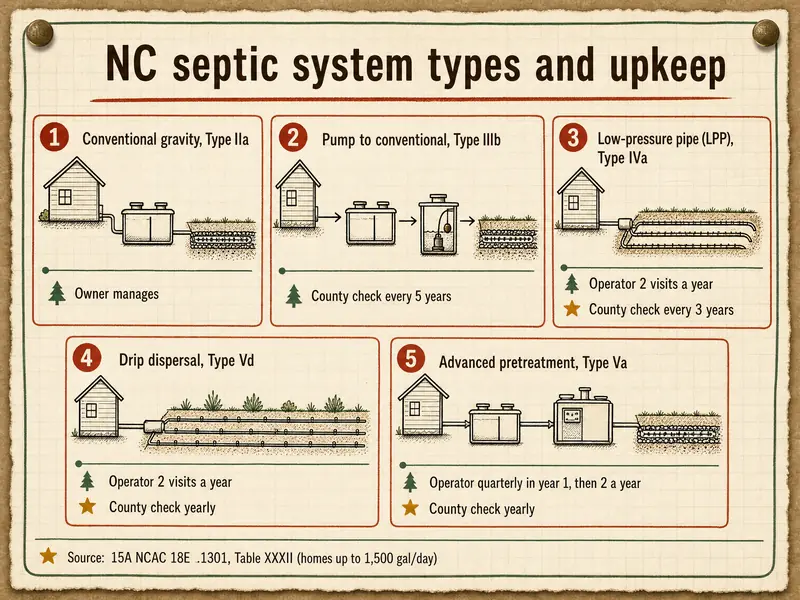
- 15A NCAC 18E .1301 Table XXXII sorts systems into six classes, from privies to large Type VI systems; a conventional gravity field up to 750 ft of trench is Type IIa and owner-managed.
- One pump makes it Type IIIb, with a county compliance inspection every 5 years.
- Low-pressure pipe (Type IVa) needs a certified operator twice a year and a county inspection every 3 years.
- Drip dispersal (Type Vd) and advanced pretreatment (Type Va) get a county inspection every year and, for homes, two operator visits a year; only Type Va adds quarterly visits in year one.
- NC State Extension warns that about 40-50% of advanced systems fail within 6 years without maintenance.
- In Durham County, a Construction Authorization costs $200 for gravity systems (Type II and below), $350 for Type III and $525 for Types IV, V and VI (fee schedule checked October 2026; fees change).
- 750 ftTrench length above which a gravity field must be pumped15A NCAC 18E .1101
- 3-6 ftPressure head that spreads effluent in a low-pressure pipe field15A NCAC 18E .0907
- 2/yearCertified operator visits required for an LPP system15A NCAC 18E Table XXXII
- 40-50%Advanced systems that fail within 6 years without upkeepNC State Extension AG-439-13
What septic system types does NC allow?
North Carolina allows conventional gravity systems, pumped systems, low-pressure pipe, drip dispersal, fill systems, sand-lined trenches, advanced pretreatment and several accepted proprietary designs, and it groups them into six numbered classes by how much oversight they need. The type is not a buyer's choice from a menu; it follows from what the soil and site evaluation finds.
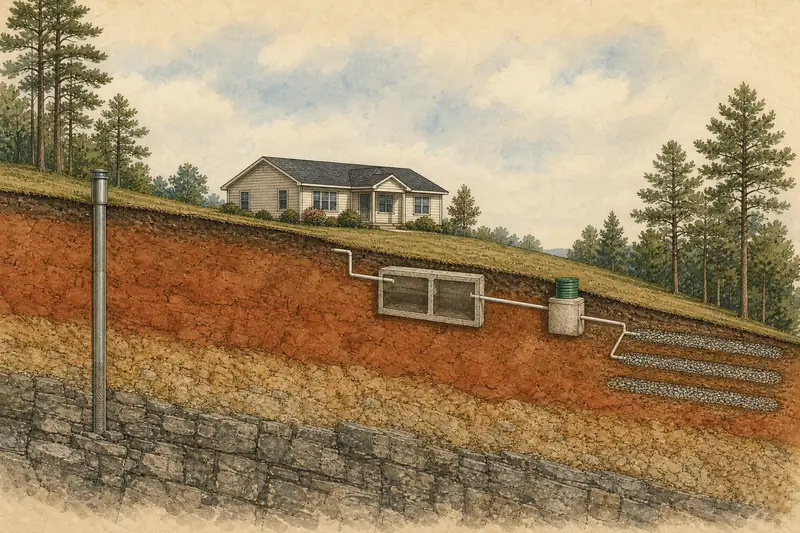
A conventional system, in 18E's words, is "a septic tank and a gravity distribution dispersal field." When the soil is deep and drains well enough, that is what the county permits. As problems stack up, such as a field uphill from the house, shallow wetness or slow clay, the design moves up the table: a pump, then pressure distribution, then pretreatment. Systems with several parts are classed by their most complex component.
Proprietary products come in through the provisional, innovative and accepted (PIA) program in Section .1700. To reach accepted status, a product needs at least 300 systems installed statewide and in use for more than five years. Bed systems, one wide excavation instead of trenches, are limited to sand and loam soils and 600 gallons per day, so they rarely fit Piedmont clay; the red clay soil page explains why.
What is a low-pressure pipe septic system?
A low-pressure pipe (LPP) system pumps settled effluent through a network of small pipes under 3 to 6 ft of pressure head so that it reaches the entire field at once, instead of trickling down the first few feet of each trench. That even dosing is why LPP is a standard answer on shallow or clayey Piedmont lots.
Under 18E .0907, laterals are 1 to 2 in Schedule 40 PVC in trenches 1 to 2 ft wide, at least 5 ft on center. Trench length uses TL = (DDF / LTAR) / 5. The LPP loading rates are lower than for gravity trenches: 0.05 to 0.2 gallons per day per square foot in clay, 0.15 to 0.3 in fine loams. NC State Extension says LPP gives an alternative on "some clayey soils that have a thick sandy surface."
LPP is Type IVa. The owner must sign a contract with a certified operator before the county issues the Operation Permit, keep it for as long as the system is used, and expect operator visits twice a year plus a county compliance inspection every 3 years.
How does drip dispersal work?
Drip dispersal doses effluent in timed, small amounts through flexible tubing with emitters, laid shallow and close together, so the soil gets a little at a time over a wide area. The EPA notes the laterals go into the top 6 to 12 in of soil, and that the system needs a large dose tank, electrical power and more maintenance.
18E .0908 sets the site floor for drip receiving ordinary septic tank effluent: 18 in of naturally occurring suitable soil above a limiting condition, 13 in above a soil wetness condition, and at least 12 in of separation to any limiting layer. In clay the loading rate is 0.05 to 0.2 gal/day per sq ft. Field area is design flow divided by that rate, and dripline length is the area divided by the 2 ft maximum line spacing.
Anaerobic drip is Type Vd. For a home under 1,500 gallons per day, Table XXXII calls for a county inspection every year and two certified operator visits a year; the quarterly first-year schedule applies to Type Va pretreatment, not to Vd. Drip that follows advanced pretreatment falls under the pretreatment rules as well.
When does a site need a pump-to septic system?
A site needs a pump when gravity cannot carry effluent from the tank to the field, when the trenches total more than 750 ft, or when the design uses pressure distribution. Those are the three triggers in 18E .1101. On rolling Piedmont lots, the usable soil is often uphill or across a slope from the house.
The pump sits in its own tank after the septic tank. Under 18E .0802 that pump tank must hold at least as much as the septic tank, and it keeps an emergency reserve: 24 hours of flow for homes in water-supply watersheds (classes up to WS-III) and SA, SB or B waters, and 12 hours elsewhere. A NEMA 4X control panel mounted at least 24 in above grade, within 50 ft and in sight of the tank, runs the pump, and a separate float sets off a high-water alarm that must be audible and visible.
A single-pump system is Type IIIb: the owner or a certified operator manages it, and the county does a compliance inspection every 5 years. Some counties charge for that program; Chatham County lists $25 a year or $110 for 5 years for Type III monitoring (fee schedule checked October 2026; fees change). What the alarm means and what to do when it sounds is on the pump tank alarm page.
What is pretreatment and who maintains it?
Pretreatment is a unit between the septic tank and the field that cleans the effluent further, so the soil receives cleaner water and the design can use thinner soil or a smaller field. NC State Extension lists sand, peat, textile and foam biofilters and aerobic units, installed "between the septic tank and drainfield" where soils are not deep enough.
To be used in North Carolina, a unit for up to 3,000 gallons per day must hold state approval and meet NSF/ANSI 40 or one of the state's two stricter TS tiers, with carbonaceous BOD limits of 25 mg/L for NSF/ANSI 40 and 15 or 10 mg/L for the TS tiers. The EPA describes aerobic treatment units as injecting oxygen to boost bacterial activity, much like a small sewage plant, and says regular lifetime maintenance should be expected.
Maintenance is not optional. Type Va pretreatment needs a management entity holding a state water pollution control system operator certificate, quarterly visits in year one and twice a year after that for homes under 1,500 gal/day, plus a county inspection every year. Extension's warning is blunt: about 40 to 50% of advanced systems fail within 6 years when that maintenance is not provided.
How do NC septic system types affect upkeep?
The higher the type number, the more people visit and the more contracts the owner keeps. A conventional system needs only the owner's attention and a pumper every few years; a pretreatment or drip system adds a paid operator and yearly county inspections.
| System | Type | County compliance inspection | Operator visits | Durham Construction Authorization fee |
|---|---|---|---|---|
| Conventional gravity, up to 750 ft | IIa | None | Owner-managed | $200 |
| Single pump or siphon | IIIb | Every 5 years | Owner or certified operator, every 5 years | $350 |
| Low-pressure pipe | IVa | Every 3 years | 2 per year | $525 |
| Anaerobic drip | Vd | Every year | 2 per year | $525 |
| Advanced pretreatment | Va | Every year | Quarterly in year one, then 2 per year | $525 |
Installers are tiered too. The NC On-Site Wastewater Contractors and Inspectors Certification Board's FAQ says a Grade II installer covers conventional, single-pump and fill systems up to 1,499 gallons per day, while Grade IV adds low-pressure, drip and any pretreatment component. Every type still needs regular pumping; see septic tank pumping, and for how the field itself works, the drain field page. Lots in the Triassic Basin are where the pumped and pretreatment designs turn up most.
Where this comes from
Sourced from 15A NCAC 18E as amended June 1, 2026 (Sections .0900, .1100, .1200, .1300 and .1700), NC State Extension AG-439-13, EPA's septic system types page, the NCOWCICB FAQ, and the Durham and Chatham County environmental health fee schedules, checked October 2026. Excluded: installation and operator contract prices, brand recommendations for pretreatment units, and any ranking of designs. Which type a lot gets is a county or licensed-professional decision.
Questions worth asking
What is the most common septic system type in North Carolina?
The rules start from the conventional gravity system, a tank and gravity trenches, and use it wherever the soil allows. No state source found gives a statewide count by type.
Is a mound system used in NC?
North Carolina's rules use fill systems rather than the "mound" label: imported soil over a site whose top 18 in of natural soil is suitable, on slopes under 15%. Gravity fill is Type IIIc and owner-managed.
Does a pump system need an operator contract?
A single-pump Type IIIb system may be managed by the owner or a certified operator. LPP, multi-pump, drip and pretreatment systems require a contract with a certified operator before the Operation Permit is issued.
Can an older conventional system be switched to LPP?
Usually through a repair permit. 18E requires an application to the county before any repair, and the new system must be inspected before it is covered or used.
Do operation permits expire for advanced systems?
Yes. Type V and VI Operation Permits expire five years after issue, and Durham County lists a $50 renewal fee (fee schedule checked October 2026).
Why does a drip or LPP system need power during an outage?
Both depend on a pump. The pump tank's reserve, 12 or 24 hours of flow under the rules, buys time, so cutting water use during an outage protects the field.
Are chamber systems allowed in NC?
The EPA calls chambers a widely used gravelless design. In North Carolina, products the rules do not otherwise describe come through the PIA program in Section .1700, and an accepted gravity system is Type IIb, owner-managed like a conventional field.
Read next
Filed under Septic notes · septic and well notes for Durham