Septic
Septic Inspection in Durham: What It Covers
A septic inspection in Durham, NC is done by a state-certified inspector who opens the tanks, checks baffles, filter, pump and alarm, walks the drainfield and sends a written report within 10 business days.
Compiled by the Red Clay Septic & Well desk · Last revised
In these notes
- What does a septic inspection in Durham NC cover?
- Who is allowed to inspect a septic system in NC?
- Is a septic inspection required when you sell a house in NC?
- How do you get the county's septic records first?
- What does a septic inspection find on clay lots?
- What happens after a failed septic inspection?
- Questions worth asking
The short version
- Only inspectors holding a certificate from the state's septic certification board, NCOWCICB, may inspect a septic system for a home sale; Durham County's health department links the board's list by county.
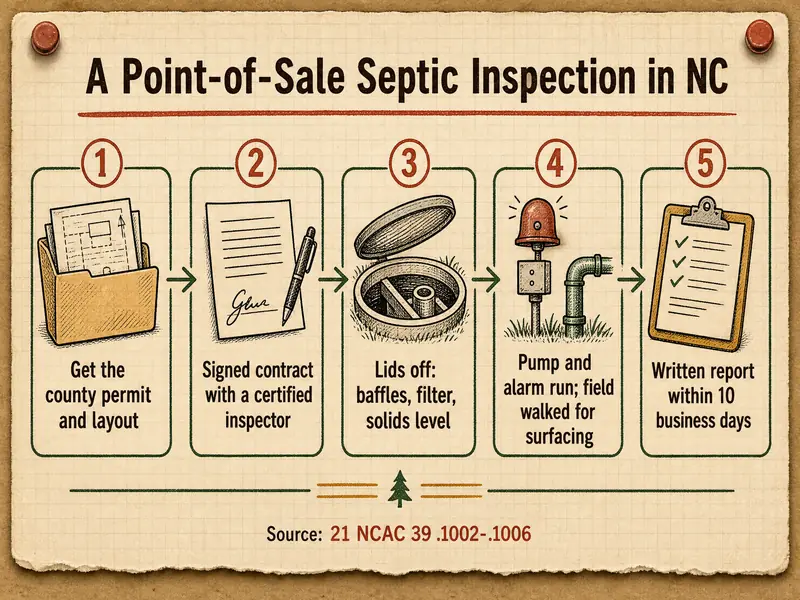
- The inspection standard is 21 NCAC 39 .1002-.1006: a signed contract first, lids uncovered, components probed, and a written report within 10 business days.
- No North Carolina rule requires a septic inspection at sale; G.S. 90A-71 describes it as one requested by a buyer, lender, realtor or other party.
- Get the county permit before the inspector arrives: it shows the permitted bedrooms, tank size and drainfield layout the inspector compares against.
- Granville-Vance Public Health lists a $100 "Detailed Septic System Search" (fee schedule checked October 2026); Durham County sends copies of permits on request.
- Inspectors do not judge remaining life, repair cost or whether to buy; defects are referred to the county or a certified contractor.
- 10 business daysDeadline for the inspector's written report21 NCAC 39 .1002(a)(4)
- 7 yearsHow long inspectors must keep inspection records21 NCAC 39 .1002(a)(5)
- 6 hoursYearly continuing education for a point-of-sale inspectorNCOWCICB FAQ
- 3 yearsEPA's suggested inspection interval for a household systemEPA septic care page
What does a septic inspection in Durham NC cover?
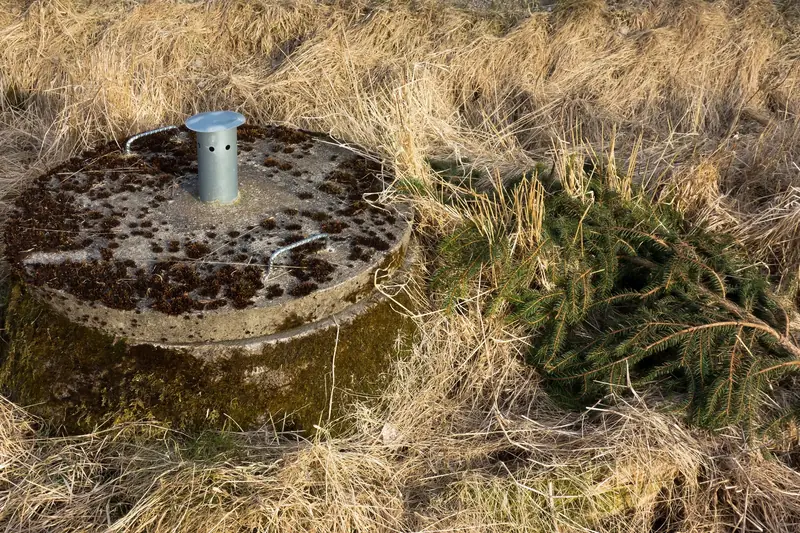
A certified septic inspection in Durham covers every permitted part of the system: the septic tank, any pump tank, distribution devices, the drainfield, treatment units and control panels, plus grading and plants where they affect the system. That list comes from 21 NCAC 39 .1005(a), the board rule that sets the minimum for every point-of-sale inspection in the state.
The method is physical. The rule tells the inspector to uncover tank lids and distribution devices, probe components where deterioration is suspected, and report any sign that water is getting in where it should not. At the tank, .1006(b)(3) lists what gets recorded:
In a nutshell
- Distances from the tank to the house, well, water line and property line
- Risers, lids, baffles and the outlet tee, and the liquid level compared with the outlet
- Whether an effluent filter is present and its condition
- Roots, leaks and non-permitted connections such as downspouts or sump pumps
- The percentage of the tank taken up by sludge and scum
For systems with a pump, the inspector checks that the alarms work and that the pump turns on and moves effluent to the next part of the system. In the field, the report notes the type of dispersal, the number and length of lines, any past or current surfacing, signs of vehicle traffic, and whether effluent is actually reaching the drainfield.
The inspector also compares the house with its paperwork. Under .1006(a), the report records how many bedrooms are advertised and the design size stated in the county health department's records, so a three-bedroom permit under a house listed as four bedrooms shows up in writing.
Who is allowed to inspect a septic system in NC?
Only a person certified as an inspector by the state board may inspect a septic system, or even offer to, for a sale or refinance. G.S. 90A-72 makes that certification a requirement, and the board's FAQ says the inspector certificate is the one used when a real estate transaction is involved. NCDHHS's own 18E guidance tells county staff to refer real estate clients to a certified inspector.
The same FAQ notes the inspector certificate does not cover newly installed systems; those are inspected by the county or, under the private permitting options, by an Authorized On-Site Wastewater Evaluator. Pumpers are a separate trade again, permitted for septage handling rather than certified as inspectors.
To find one, the board publishes a certification list that can be sorted by county. Durham County's On-Site Water Protection page and Granville-Vance Public Health both link to the board for this reason. Before work starts, the inspector must give you a signed written contract that names the rules followed, the services included and their cost.
Is a septic inspection required when you sell a house in NC?
No state rule requires a septic inspection when a North Carolina house changes hands. The statute defines a point-of-sale inspection as one requested by a lending institution, realtor, prospective buyer or other affected party as a condition of the sale, refinancing or transfer, so the requirement, when there is one, comes from the contract or the lender.
Most buyers on well and septic ask for one anyway, usually inside the due-diligence period. Timing matters for one reason: a complete inspection may need the tank pumped. If the client declines pumping, the board's rule requires a signed form saying the inspection could not be completed without it.
Sellers have their own paperwork duties. The NC Real Estate board's bulletin on septic permits says a broker may advertise only the number of bedrooms the septic permit allows, and that a permit may limit other things, such as a dishwasher or a garbage disposal. The tank size page explains how bedrooms set the permitted flow.
How do you get the county's septic records first?
Ask the county health department for the permit and layout before the inspector visits; the inspector's report leans on what the county has on file. In Durham County, anyone can request septic and well records from the Environmental Health division, as the records page explains; include the site address and the parcel number or PIN.
For permits issued under the current rules, the Operation Permit lists the bedrooms, design flow, tank location and capacity, and the drainfield's length, width and depth, under 18E .0205(c). Older permits may hold less. The Real Estate board's bulletin notes that a few counties did not keep records at first, and when a permit cannot be found the seller should disclose that the system exists but its permit was not located.
| County | Office | How records are found |
|---|---|---|
| Durham | Durham County Department of Public Health, Environmental Health | Request by email with address and parcel or PIN |
| Granville | Granville-Vance Public Health, Environmental Health | "Detailed Septic System Search," $100 on the fee schedule |
| Orange | Orange County Health Department, Environmental Health | Online request form for pre-2010 records; not searchable by lot number or old subdivision name |
| Chatham | Chatham County Public Health, Environmental Health | Scanned septic and well permits searchable online; public records request if missing |
| Person | Person County Health Department, Environmental Health | Laserfiche repository by tax map and parcel number; not every parcel has records |
The county permits and records page goes through each office in more detail.
What does a septic inspection find on clay lots?
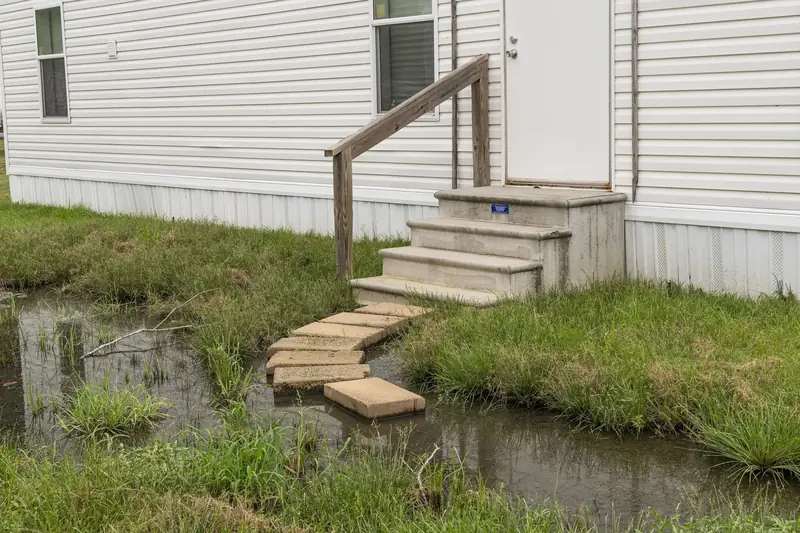
On Durham-area clay, the findings that matter most are signs that effluent is not soaking in: surfacing over the lines, soggy spots, lush green strips over trenches and a liquid level sitting above the tank outlet. EPA's failure signs include bright green, spongy grass over the drainfield even in dry weather, and NC State Extension's checklist asks whether problems show up when it rains or the ground is wet.
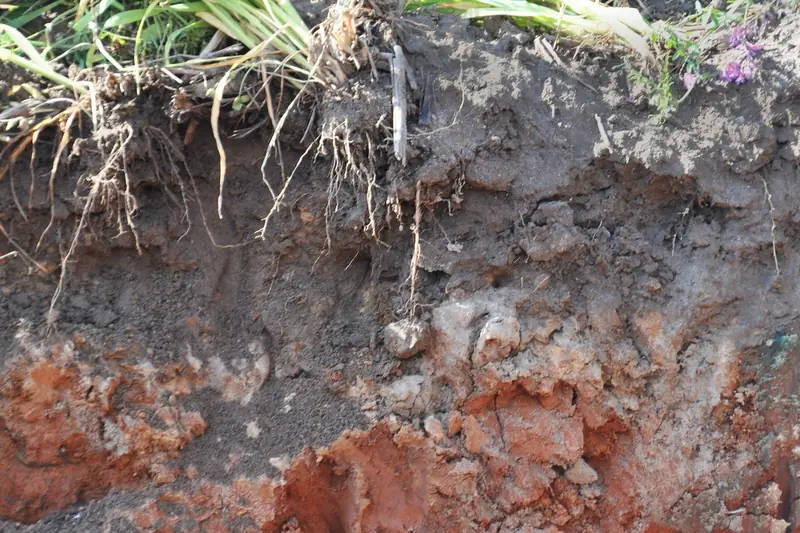
Clay soils take effluent slowly. State rules allow only 0.1 to 0.4 gallons per day per square foot on clay soils, against 0.8 to 1.2 on sands, so a drainfield on red clay is large and has little spare capacity. In the Triassic Basin parts of Durham, Granville, Orange and Chatham counties, soils such as White Store and Creedmoor are rated "very limited" for septic fields by USDA, which the Triassic Basin soils page explains.
Timing can mislead in both directions. Under 18E .1303, effluent within 3 inches of the surface counts toward a legal failure only when it shows up on two checks spaced a full day apart, both more than a day after the last rain. The inspection rule also stops short of soil work: inspectors are not required to evaluate soil beyond saturation or ponding, or to run a hydraulic load test.
Watch for things that add water. Downspouts, sump pumps or a water softener's discharge routed into the system are listed problems, and NCDHHS says none of them should reach the tank or drainfield.
What happens after a failed septic inspection?
A failed inspection becomes a county matter if the system is malfunctioning, and a negotiation between buyer and seller either way. The inspector's job ends with the report: under 21 NCAC 39 .1002, defects are referred to the local health department or a certified contractor, and .1004 bars the inspector from estimating repair cost, remaining life, market value or whether to buy.
If the system is failing, state rule says the owner shall contact the county health department, and repairs start with an application, not a shovel. The county evaluates the site and writes the repair permit; Chatham lists its repair permit at $0, while Person charges $150 for a gravity repair authorization and $300 for a pump repair (fee schedules checked October 2026; fees change). The septic repair page walks through that process.
Smaller items, such as a missing effluent filter, a cracked lid or a failed alarm float, are often maintenance rather than repair. Under 18E .1301(h), replacing a pump, filter or control panel with identical parts counts as maintenance and needs no repair permit.
Where this comes from
Drawn from the certification board's inspection rules (21 NCAC 39, readopted November 2025) and FAQ, G.S. 90A-71 and 90A-72, 15A NCAC 18E, NCDHHS guidance on 18E, the NC Real Estate board's septic permit bulletin, EPA and NC State Extension failure checklists, USDA soil ratings, and the record pages of the Durham, Granville-Vance, Orange, Chatham and Person health departments, all read in October 2026. Inspection prices, inspector reviews and anecdotes from sales were not used.
Questions worth asking
How long does a septic inspection take to come back?
The board's rule gives the inspector 10 business days after the inspection to deliver the written report. Inside a short due-diligence window, book early so the report and any county follow-up both fit.
Can a home inspector check the septic system?
Only if that person also holds the septic inspector certification from the state board. A general home inspection license does not cover septic systems, and the board's list shows who is certified in each county.
Does the inspector dig up the drainfield?
No. The rule calls for uncovering tank lids and distribution devices and probing where deterioration is suspected, not excavating trenches. A hydraulic load test is not required unless the contract adds it.
What if the inspector cannot find the tank?
The report must say so. Under the board's rule, anything that could not be located or inspected is listed with the reason, and finding the system is the owner's responsibility under 18E .0206.
Should a seller get a septic inspection before listing?
It is optional, but a seller who knows the permit's bedroom count and the tank's condition avoids surprises in due diligence. Pulling the county permit costs little time and settles the bedroom question early.
Does a passed inspection mean the drainfield will last?
No. The report describes condition on that day; the rule bars inspectors from predicting life expectancy. Clay drainfields can look fine in a dry month and struggle in a wet spring.
Is an inspection needed to add a bedroom or a pool?
That is a different paper: an existing system approval under 18E .0206, which a county, an Authorized On-Site Wastewater Evaluator or a certified inspector may issue when the flow does not increase. Adding bedrooms raises the flow and usually needs a new permit.
Read next
Filed under Septic notes · the front page of these Piedmont field notes