Wells
Well Water Softener: Does Your Well Need One?
A well water softener is worth it when a lab test shows hardness above about 7 grains per gallon; many granite-belt wells near Durham test softer than that, while Triassic basin wells often test harder.
Compiled by the Red Clay Septic & Well desk · Last revised
Ownership note. Red Clay Septic & Well has the same owners as two water-treatment stores, SoftPro Water Systems and Quality Water Treatment. Links on this page to either store go to equipment that store sells. Treatment advice here follows NC DHHS, NC State Extension and EPA guidance checked in October 2026; what a product listing says is the store's own claim, not a test by this site. More on ownership
In these notes
The short version
- Penn State Extension classes water above 7.0 gpg (120 mg/L) as hard and says levels below 7.0 gpg probably won't cause major scaling (Penn State Extension).
- EPA and NC DEQ have no standard for total hardness; NC DHHS reports private-well hardness from 3 to 2,600 mg/L.
- USGS found higher hardness in groundwater from the Triassic basin rocks than from crystalline-rock aquifers.
- A softener adds 7.5 mg of sodium per quart for each gpg removed, per Penn State Extension.
- NC State Extension says test iron and manganese before buying a softener, since both reduce its efficiency.
- The NCDHHS septic factsheet says not to direct softener discharge into the septic system or toward the drainfield.
White crust on shower heads, soap that won't lather and spots on glassware are the classic signs of hard water. They are nuisances, not health problems; Penn State Extension puts it bluntly, saying softening "simply removes hardness minerals and eliminates problems that are a nuisance and not a threat to human health." Whether a softener earns its place depends on the number on a lab report, not on the stains alone.
Does a Piedmont well need a water softener?
Only if a test shows hardness high enough to cause scale, which Penn State Extension puts at about 7 grains per gallon (120 mg/L). Below that, it says, hardness "will probably not cause major scaling and soap film," and many households simply live with it.
Plenty of wells around Durham never get close. Wells drilled into granite and slate-belt rock often give soft, slightly acidic water, and for those the more useful treatment may be a neutralizer, not a softener; see acidic well water. Wells in the Triassic basin are the ones more likely to need softening.
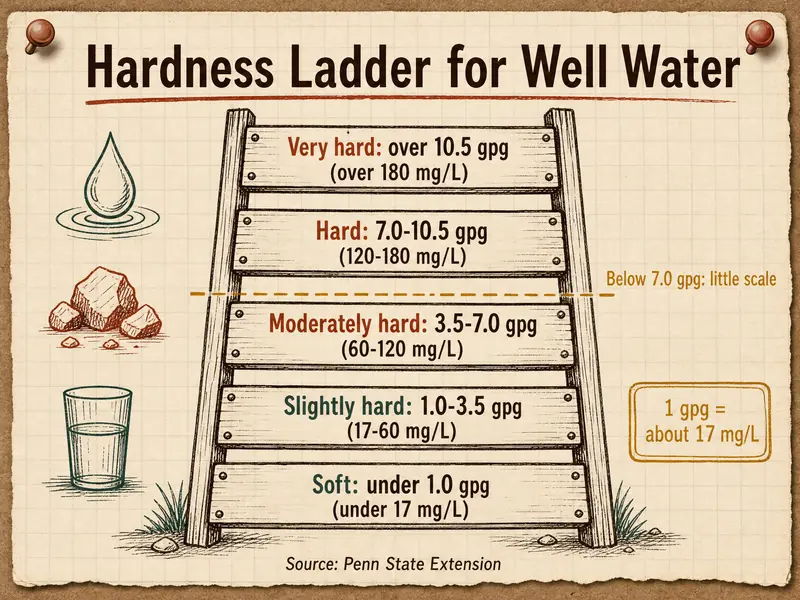
City water is a different story altogether. The City of Durham's reports put its water at 24-25 mg/L of hardness, about 1.4-1.5 gpg, which lands in the "slightly hard" rung of the ladder below, so a softener is not needed on city water (Durham water quality). Other sources draw the lines differently: the USGS calls everything up to 60 mg/L soft, so the same water is "soft" there.
How hard is well water around Durham?
It varies more by rock type than by county. A USGS study of Piedmont aquifers found that groundwater from the siliciclastic rocks of the Triassic basins had higher median and maximum hardness, calcium and alkalinity than water from the crystalline rocks around them. NC Geological Survey lists Chatham, Durham, Granville and Orange among the counties the Deep River Triassic basin crosses.
An older USGS survey of Orange County wells, mostly in crystalline rock, found a median hardness of 75 mg/L, which is moderately hard (about 4.4 gpg). Statewide, the NC DHHS hardness sheet records private wells from 3 to 2,600 mg/L, and notes that EPA and NC DEQ have not set any hardness standard.
The ladder below converts lab units. Most NC labs report hardness in mg/L as calcium carbonate; divide by about 17 to get grains per gallon.
How does a well water softener work?
A softener runs water through a tank of resin beads that trade sodium (or potassium) for the calcium and magnesium that make water hard. When the resin is full of hardness minerals, the unit regenerates: brine from the salt tank is flushed back through the resin to strip the minerals off and send them to the drain.
Penn State describes two kinds of control. Timed units regenerate on a clock whether the resin needs it or not, which wastes salt and water; demand-controlled units regenerate after a set number of gallons. NSF describes its NSF/ANSI 44 standard as covering softeners that use "a cation exchange resin that is regenerated with sodium or potassium chloride" (NSF).
Two side effects are worth knowing. NC DHHS notes that ion exchange may raise sodium or potassium in the water, and Penn State quantifies it: 7.5 mg of sodium per quart for each gpg of hardness removed. A softener also does nothing for arsenic, nitrate, bacteria, radon or low pH.
| Problem | Softener? | Usual treatment |
|---|---|---|
| Hardness (scale, soap film) | Yes | Cation exchange softener |
| Dissolved iron under about 5 mg/L | Sometimes, with pH above 6.7 | Softener or iron filter |
| Oxidized (orange) iron | No; fouls resin | Oxidizing iron filter first |
| Low pH | No | Neutralizer or soda ash feed |
| Nitrate | No | Anion exchange, RO or distillation |
| Coliform bacteria | No | Shock chlorination, then UV if it returns |
Can a well water softener handle iron?
A softener can take out modest amounts of dissolved iron, under the right conditions. Penn State Extension limits softeners for iron to water with pH over 6.7, between 3 and 20 gpg of hardness, and less than 5 mg/L of dissolved iron (Penn State Extension).
Outside those limits it struggles. Iron that has already oxidized, the kind that turns water orange in a glass, clogs the resin, and Penn State's softening guide recommends filtering it out before the softener. NC State Extension makes the same point from the buyer's side: test for iron and manganese before purchasing a softener, because both "decrease the efficiency of cation exchange softeners" (NC State Extension). The iron and manganese page covers the filters.
Is softener backwash a problem for a septic system?
It can be, and NC guidance says to keep it out. The NCDHHS septic factsheet says not to direct water softener discharge "into the septic system or toward the drainfield," and NC State Extension says a softener's backwash discharge pipe "should not be connected to the waste plumbing system or septic tank" (NC State Extension).
Volume is the measurable part. Penn State estimates about 50 gallons of water per regeneration cycle, which "may or may not cause hydraulic overload" depending on the system. On slow-draining clay drainfields around Durham, that extra water arrives in one burst. Neither NC DHHS nor NC State Extension addresses what brine does to drainfield soil, so the safe reading is the plain one: route the discharge somewhere other than the septic system, and ask the county or a licensed installer where. More on what a drainfield tolerates is on the septic care page.
How do you size a well water softener?
Size it to grains of hardness per day, then pick a capacity that lets it regenerate about once a week. Penn State Extension's worked example uses 75 gallons per person per day, 10 gpg of hardness and 4 people: 75 × 10 × 4 = 3,000 grains a day, so a 20,000-grain softener regenerates every 6 to 7 days.
To run your own numbers you need three things from a test and a meter: hardness in gpg, iron, and the household's water use. NC DHHS also asks well owners to know pH and turbidity before installing treatment (NC DHHS). Penn State recommends a third-party hardness test rather than relying on a seller's free one; county health departments run inorganic panels that include hardness, listed on the well water testing page. Flow matters too: the valve and resin tank should match your pump's gallons per minute.
Two well softeners from the linked stores
When the lab report shows hardness worth treating, these are two options. SoftPro Water Systems sells the ECO Well Water Softener (sold by SoftPro Water Systems, which has the same owners as this site) in 32,000, 48,000 and 64,000-grain sizes, alone or paired with an iron filter; the store describes it as reducing hardness for well-water homes and lists a lifetime warranty. Quality Water Treatment sells the Fleck 2510SXT well softener (sold by Quality Water Treatment, which has the same owners as this site) from 24,000 to 64,000 grains, with packages that add a KDF stage, a pH neutralizer or an iron filter; the store says the basic unit removes up to 3 ppm of iron with fine-mesh resin and stresses checking your pump's flow rate first.
Those claims come from the store listings. Neither softener treats arsenic, nitrate or bacteria, and the iron figures assume the conditions Penn State describes.
- 7.0 gpgHardness below which major scaling is unlikelyPenn State Extension
- 3-2,600 mg/LHardness range in NC private wellsNC DHHS
- 7.5 mg/qtSodium added per gpg of hardness removedPenn State Extension
- 50 galWater used per regeneration cycle (estimate)Penn State Extension
Where this comes from
This page relies on Penn State Extension's water softening and iron guides, NC DHHS guidance on hardness and choosing treatment, NC State Extension's testing and septic guides, the NCDHHS septic factsheet, USGS reports on Piedmont groundwater, NSF's description of its standards and the City of Durham's water quality reports (2022 data for hardness), all checked in October 2026. Store details are the stores' own listings. Not included: installer quotes, salt-brand comparisons, message-board stories, or testing of any equipment by Red Clay Septic & Well.
Questions worth asking
Can potassium chloride be used instead of salt in a well softener?
NSF's description of softeners covers resin regenerated with either sodium or potassium chloride. NC DHHS notes ion exchange can raise sodium or potassium in the water, depending on which you use.
Should drinking water bypass the softener?
That is a choice worth weighing if anyone in the house watches sodium. Penn State estimates 7.5 mg of sodium per quart for each gpg removed, so the added sodium grows with the hardness, and an installer can leave one cold tap unsoftened.
Does a softener make well water safe to drink?
No. Softening removes calcium and magnesium, which are nuisance minerals. It does not treat bacteria, arsenic, nitrate, radon or uranium, so the rest of a well test still needs reading.
How often should a well softener regenerate?
Penn State's sizing example lands at every 6 to 7 days. Demand-controlled units regenerate when a set volume has been softened, which uses less salt and water than a fixed timer.
Does a hardness of 75 mg/L, typical of Orange County wells, need a softener?
Usually not for scale. An older USGS survey of Orange County wells found a median of 75 mg/L, about 4.4 gpg, moderately hard on Penn State's ladder yet below its 7 gpg mark for major scaling. Your own lab number decides.
Why did the softener stop working after a year?
Iron fouling is a common cause. Penn State notes that oxidized iron clogs the resin, which is why iron should be tested, and filtered out if needed, before the softener.
Read next
Filed under Well notes · the front page of these Piedmont field notes