Wells
Acidic Well Water and How to Raise the pH
Acidic well water, below pH 6.5, has no health standard of its own, but it dissolves copper and lead from plumbing, which is why the treatment decision starts with a pH and metals test.
Compiled by the Red Clay Septic & Well desk · Last revised
Ownership note. Red Clay Septic & Well has the same owners as two water-treatment stores, SoftPro Water Systems and Quality Water Treatment. Links on this page to either store go to equipment that store sells. Treatment advice here follows NC DHHS, NC State Extension and EPA guidance checked in October 2026; what a product listing says is the store's own claim, not a test by this site. More on ownership
In these notes
The short version
- EPA's secondary guide for pH is 6.5-8.5; below that range water tastes bitter and metallic and corrodes plumbing (EPA).
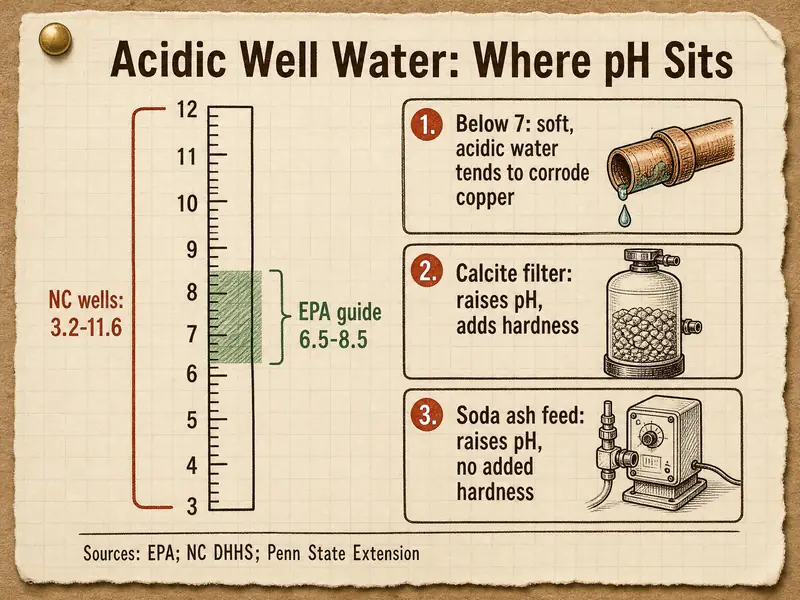
- NC DHHS reports private-well pH across the state ranging from 3.2 to 11.6, and says there are no health-based standards for pH.
- USGS found only about 10% of Piedmont crystalline-rock well samples above pH 7, against about 70% from the Triassic basin rocks.
- Acidic water leaches copper from pipes and makes lead more soluble, per NC DHHS.
- Calcite neutralizers raise pH but add hardness; soda ash injection raises pH without adding hardness (Penn State Extension).
- pH is on the 15A NCAC 18A .3803 test list for every new private well in North Carolina.
Blue-green rings under the faucet, a metallic taste in the first glass of the morning, and pinhole leaks in copper lines are the usual clues. Each points to water that is eating the plumbing. Around Durham, Orange, Person, Granville and Chatham counties that is common in wells drilled into granite and slate-belt rock, and much less common in the Triassic basin.
What causes acidic well water in the Piedmont?
Acidic well water mostly tracks the rock the well is drilled into. Water from the granite, gneiss and metavolcanic rock under much of the Piedmont tends to be soft and low in pH, while the sandstones and siltstones of the Triassic basin give harder water with more calcium and alkalinity.
The USGS study of Piedmont and Blue Ridge aquifers shows the split clearly. About 70 percent of groundwater samples from the basin's siliciclastic rocks had pH above 7, compared with only about 10 percent from crystalline rocks, and samples ranged from pH 4.7 to 8.2. An older USGS survey of Orange County wells put the median pH at 6.9.
So two neighbors a few miles apart can have very different water. A well in the Triassic basin near Durham or Chatham may test neutral or alkaline and hard, while one in the granite or slate belt to the north and west tests soft and acidic.
What pH is too low for well water?
Below 6.5 is the usual line, because that is the bottom of EPA's 6.5-8.5 secondary guide. EPA links low pH to a bitter metallic taste and corrosion, and high pH to a slippery feel, a soda taste and deposits.
That guide is aesthetic. NC DHHS states plainly that "there are no health-based standards for pH," and its pH sheet records private wells across North Carolina from 3.2 all the way to 11.6 (NC DHHS pH sheet). The concern with low pH is what the water picks up on its way to the tap.
Penn State Extension adds a useful nuance: water that is both soft and acidic, under pH 7.0, tends to be more corrosive. Hardness and alkalinity buffer the water, so a pH of 6.8 in soft granite-belt water can do more damage than the number suggests.
What does acidic well water do to pipes?
Acidic water dissolves copper from pipes and fittings and can pull lead from the solder that joins copper pipe. NC DHHS says acidic water "can cause copper to leach from pipes in the well components and home plumbing system," and that low pH can make lead compounds more soluble (NC DHHS copper sheet).
The signs Penn State lists are bluish-green stains in sinks, a metallic taste that is strongest in the first water of the morning, and small leaks in the plumbing. Copper stains appear above EPA's 1.0 mg/L secondary guide. For comparison, the copper action level for public water systems is 1.3 mg/L and the lead action level is 0.015 mg/L, dropping to 0.010 mg/L from November 1, 2027 (EPA). Neither applies by law to a private well, but they are reasonable yardsticks.
Lead is the reason not to wait on blue stains. You cannot see or taste it at levels that matter, and NC DHHS notes that EPA and CDC say no lead level is safe. A first-draw lead and copper test answers the question.
How does an acid neutralizer for well water work?
An acid neutralizer is a tank of alkaline media, usually calcite (crushed calcium carbonate), that dissolves slowly into the water as it passes through and raises the pH. Penn State Extension describes the media as limestone or marble chips, magnesium oxide or other alkaline material, and says the filter is usually installed after the pressure tank. Backwashing models flush trapped sediment out on a schedule.
The other approach is a chemical feed pump that injects soda ash or sodium hydroxide solution ahead of the pressure tank. NC DHHS lists "Neutralizing" treatment for low pH in its guide to choosing equipment (NC DHHS), and Penn State says soda ash is preferred over sodium hydroxide because it is safer to handle.
| Option | What it does | Trade-off |
|---|---|---|
| Calcite neutralizing filter | Raises pH and adds calcium | Adds hardness; media must be topped up |
| Other alkaline media (marble chips, magnesium oxide) | Raises pH the same way | Also adds hardness and needs refilling |
| Soda ash feed pump | Raises pH without adding hardness | Chemical solution to mix and a pump to maintain |
| Point-of-use RO, distillation or activated alumina | Removes lead and copper at one tap | Leaves the rest of the plumbing corroding |
| Flushing the tap for one minute | Clears water that sat in pipes overnight | Needs a retest to prove it works |
What are the trade-offs of raising pH?
The main trade-off is hardness: Penn State says a calcite filter "will increase the hardness of the water," because it works by dissolving calcium carbonate. On very soft granite-belt water that is often welcome. On water that is already moderately hard it can push you toward a softener, covered on the well water softener page.
Upkeep is the second. The tank has to be refilled with media as it dissolves, Penn State says on a schedule "ranging from weeks to months" depending on how acidic the water is and how much is used. Neutralizing filters can also reduce water pressure, which a soda ash feed ahead of the pressure tank avoids.
Third, the backwash has to go somewhere. Backwash from treatment equipment belongs outside the septic system, not piped into the tank, per NC State Extension (NC State Extension); see septic care for what the drainfield can and cannot take.
There is an upside beyond pipes. Penn State notes that birm iron filters need pH of at least 6.8 for iron and 7.5 for manganese, so raising pH first is often what makes an iron filter work on a low-pH well. The iron and manganese page has those ranges.
How do you test well water pH?
A certified lab test is the reliable way, and pH comes with most inorganic panels. North Carolina's new-well rule, 15A NCAC 18A .3803, includes pH, copper and lead on the list every new private well is tested for within 30 days.
For an existing well, NC DHHS suggests testing heavy metals, lead and copper every two years (NC DHHS FAQ). Durham County Environmental Health lists its inorganic panel, covering metals, pH and hardness, at $135 (form rev 08/2025); other counties' panels and fees are on the well water testing page. Fees change, so check before you sample.
For lead and copper, ask how the lab wants the sample taken. Penn State notes these are normally measured in first-draw water, the first water out of the tap in the morning, because it has sat in the pipes longest. Also give the lab your hardness and alkalinity if you have them; they decide which neutralizer fits.
Calcite neutralizers from the two linked stores
If the lab report confirms low pH, with or without copper or lead, here are two choices. SoftPro Water Systems lists its pH Neutralizer Calcite Filter (sold by SoftPro Water Systems, which has the same owners as this site) as a calcite filter for well water that raises the pH of acidic water, in 1.5, 2.0 and 2.5 cubic-foot sizes matched to 5-7, 8-10 and 10+ GPM well pumps. Quality Water Treatment lists the Fleck 2510SXT pH Neutralizer Calcite Filter (sold by Quality Water Treatment, which has the same owners as this site) in the same three pump ranges; elsewhere the store describes its 2510 calcite filters as backwashing units for acidity in the pH 6.0 to 6.9 range.
Those are the stores' own descriptions. Neither filter treats bacteria, arsenic or nitrate, and both add hardness. If the pH is well under 6, ask about other media or a soda ash feed before buying.
- 6.5-8.5EPA secondary guide for pHEPA
- 3.2-11.6pH range found in NC private wellsNC DHHS
- About 10%Piedmont crystalline-rock samples with pH above 7USGS SIR 2013-5072
- 1.3 mg/LCopper action level for public water systemsEPA
Where this comes from
This page is based on EPA's primary and secondary drinking water tables, NC DHHS guidance on pH, copper, lead and choosing treatment, the 15A NCAC 18A .3800 testing rule, USGS SIR 2013-5072 and an Orange County USGS well survey, Penn State Extension's corrosive water guide, NC State Extension's septic guide and the Durham County water sample form, all checked in October 2026. Store details are each store's own listing. Left out: contractor price quotes, plumbing-repair estimates, forum anecdotes and any lab testing by this site.
Questions worth asking
Is acidic well water safe to drink?
pH itself has no health-based standard, according to NC DHHS. The risk is the copper and lead that acidic water can dissolve from plumbing, so test for those metals before deciding the water is fine.
Why are the blue-green stains worst in the morning?
Water that sits in copper pipes overnight picks up the most metal. Penn State Extension notes that copper and lead are usually highest in the first water out of the tap for that reason.
Can a water softener raise the pH of well water?
No. A softener swaps calcium and magnesium for sodium or potassium and does not neutralize acid. Some stores sell softener and calcite packages because the two do different jobs.
How often does a calcite neutralizer need refilling?
Penn State Extension says the rate ranges from weeks to months, depending on how acidic the water is, how much water the house uses and the type of media. Check the media level at least every few months at first.
Will raising pH fix pinhole leaks that already exist?
It slows further corrosion, but pipe that has already thinned stays thin. Penn State lists replacing affected plumbing as one of the remedies alongside treatment.
Does City of Durham water have the same problem?
The City adjusts its water at the plant, adding sodium hydroxide for pH balance and orthophosphate to limit pipe corrosion. See the Durham water quality page for the city's report figures.
Read next
Filed under Well notes · septic and well notes for Durham