Septic
Septic Permits and Records by County
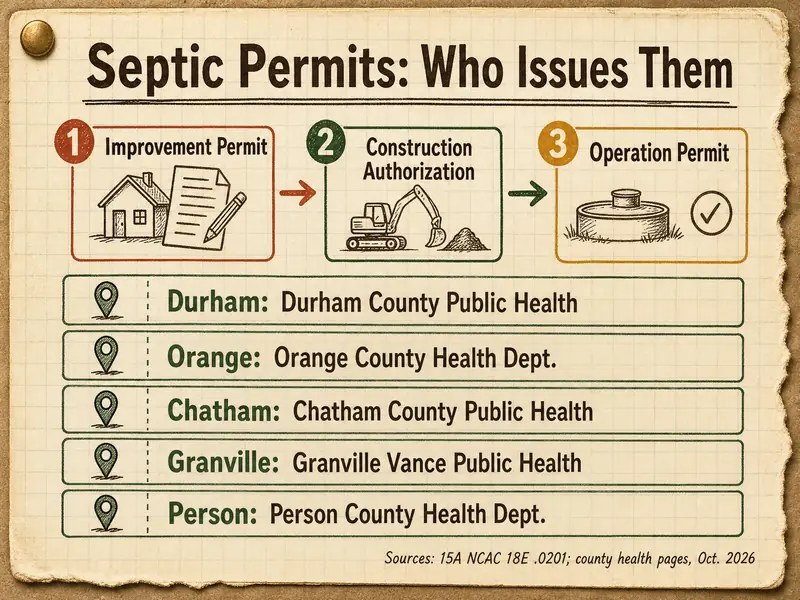
Septic permits and records around Durham come from each county's health department, which runs soil evaluations, issues permits, inspects installs and keeps the permit files; Granville's office is Granville Vance Public Health.
Compiled by the Red Clay Septic & Well desk · Last revised
In these notes
- Where do you get septic permits and records around Durham?
- How does Durham County handle septic permits and records?
- How do Orange and Chatham counties handle septic permits?
- How do Granville and Person counties handle septic permits?
- What do county septic permit fees look like?
- What can an Authorized On-Site Wastewater Evaluator do?
- Questions worth asking
The short version
- Under 15A NCAC 18E .0201, a system moves from application to Improvement Permit, Construction Authorization, then inspection and Operation Permit.
- Durham County's records page says "anyone can request" septic and well records held by its Environmental Health division.
- Chatham County lists a repair permit fee of $0 on the schedule effective July 1, 2026 (checked October 2026).
- Granville County permits run through Granville Vance Public Health, a two-county district.
- Person County posts septic records by tax map and parcel number, but notes they are "not available for all parcels."
- A licensed soil scientist certified as an Authorized On-Site Wastewater Evaluator can prepare a soil evaluation and permit plans under G.S. 130A-336.2.
Where do you get septic permits and records around Durham?
Septic permits and records come from the environmental health office of the county health department where the property sits. That office evaluates the soil, issues the Improvement Permit and Construction Authorization, inspects the system before it is covered, and keeps the file. Red Clay Septic & Well is a reference site, not one of these offices, and cannot issue or look up permits.
The state sets the rules, and the counties apply them. The NCDHHS On-Site Water Protection Branch provides "regulatory oversight" of septic systems statewide, while 15A NCAC 18E spells out the four steps every new system follows. A pending application expires 12 months after it is filed (18E .0202), and a repair needs an application before work starts.
For an existing home, the permit file is the starting point for everything else. NCDHHS tells owners to "ask your local health department for a copy of your septic permit and system layout." The layout shows where the tank, field and repair area are; the permit shows the bedroom count, which also fixes the tank size.
How does Durham County handle septic permits and records?
Durham County handles septic permits and records through the Durham County Department of Public Health's Environmental Health Division, in its On Site Water Protection section. Its program page says the section oversees "onsite wastewater (septic) systems, private drinking and irrigation water wells, and public swimming pools." The work listed includes site evaluations, construction inspections, well water testing and complaint investigations.
Records are open to the public. The county's septic and well records page says "anyone can request a copy" of records on file, by email, with the requester's name, the site address and the parcel number or PIN. Having the PIN from the county tax map ready speeds the search.
Durham's forms page lists a Construction Authorization for repairs, an Existing System Authorization application for additions and similar projects, a septic tank abandonment form, a septic system survey, and well permit and well repair or abandonment applications. For homes leaving septic for city sewer, see septic to sewer.
How do Orange and Chatham counties handle septic permits?
Orange and Chatham handle septic permits through their county health departments, each with a local twist on the state rules.
Orange County. The Orange County Health Department's Environmental Health division permits septic systems under the Orange County Rules for Onsite Wastewater Treatment and Dispersal Systems, adopted January 1, 2024 and revised November 27, 2024. They track 18E but add a local Wastewater Treatment Maintenance Program (WTMP) with scheduled inspections. The county's septic page says an addition that adds no bedrooms and does not affect the system needs an Existing System Authorization, while more bedrooms or a moved system will likely need a new Improvement Permit and Construction Authorization. Older records, before 2010, are requested through an online form, and the county warns they are not searchable by lot numbers or old subdivision names.
Chatham County. The Chatham County Public Health Department's Division of Environmental Health requires an Improvement Permit and Authorization to Construct before installation, and issues the Operation Permit after inspection. Its how-to-apply page lists the application, fee, site plan, flood plain determination and, when subdividing, a stream identification form. At the site visit, the applicant must be able to show where the property corners are. The Improvement Permit is valid for 5 years, and the Construction Authorization runs 5 years from the Improvement Permit's date. Chatham posts scanned septic and well permits online, takes a public records request by email when one is missing, and runs a monitoring program for systems with pumps, floats and control panels.
How do Granville and Person counties handle septic permits?
Granville uses a district health department and Person uses its own county office; both permit after a site and soil evaluation.
Granville County. Septic and well permits come from the Environmental Health Division of Granville Vance Public Health, which serves Granville and Vance counties. Its page says septic and well permits "are issued after site and soil evaluations are performed," that reconnection permits are also issued, and that certain alternative systems require maintenance management inspections. Forms include a Well and Septic Application, instructions and an Owner / Legal Representative Form. No separate records page turned up; the fee schedule lists a "Detailed Septic System Search" instead.
Person County. The Person County Health Department's Environmental Health office runs an Onsite Wastewater Program whose specialists "evaluate site and soil conditions and design, permit, and inspect all septic systems installed or repaired in Person County." The program also covers state-required pump system inspections and permits for building additions and mobile home replacements. Septic records can be searched by tax map and parcel number in the county's Laserfiche repository. For a failing system, the owner files an application with a Homeowner Questionnaire, and a specialist picks the repair option; a financial assistance application is linked on the same page.
What do county septic permit fees look like?
County septic permit fees run from $200 to about $480 for a 3- or 4-bedroom home's Improvement Permit, with Construction Authorization and well permit fees on top. The figures below are only what each county's posted schedule listed when checked in October 2026. Fees change, and several of these schedules took effect on July 1, so confirm with the county before applying. Contractor charges for design, installation and pumping are separate and are not set by the county.
| County office | Improvement Permit | Construction Authorization | Repair | Well permit |
|---|---|---|---|---|
| Durham County Public Health (current schedule) | $250 (2-acre limit) | $200 Type II or lower; $350 Type III pump; $525 Type IV-VI | No repair line listed | $425 |
| Orange County Health Dept. (FY2024-25 schedule) | $1 per gallon/day, $360 minimum | Same as IP; +$200 for Type IIIb and up | No septic repair line on that sheet | $500 |
| Chatham County Public Health (effective July 1, 2026) | $250 for 1-3 bedrooms; $300 at 4 bedrooms; $350 at 5; $400 at 6 | $235 up to Type III; $280 Type IV; $450 Type V; $1,000 Type VI | $0 | Not confirmed; ask the county |
| Granville Vance Public Health (effective July 1, 2025) | $400 conventional; $450 pump or LPP | No separate line | No repair line listed | $400 |
| Person County Health Dept. (effective October 2023) | $200 under 600 gal/day; $300 at 600 or more | $150 gravity; $300 pump; $400 Type IV; $500 Type V-VI | $150 gravity; $300 pump | $300 |
A few other line items are worth knowing. Durham lists $100 for structural alterations or additions and $200 for a wastewater system reconnection. Orange lists $200 for an existing system inspection with a field visit. Chatham's monitoring of Type III(b) pump systems costs $25 annually or $110 per five-year period. Granville Vance lists $100 for a detailed septic system search. Orange's newer schedules were not opened, so its current fees may differ.
What can an Authorized On-Site Wastewater Evaluator do?
An Authorized On-Site Wastewater Evaluator (AOWE) can do the soil and site evaluation and the permit paperwork that the county would otherwise do, for systems that do not need an engineer. Under G.S. 130A-336.2, an AOWE is a licensed soil scientist who is further certified by the NC On-Site Wastewater Contractors and Inspectors Certification Board, and may prepare "signed and sealed soil and site evaluations, specifications, plans, and reports."
An AOWE can also carry out the inspections needed before a system is covered and used, and files the written verification with the county health department within two business days (G.S. 130A-337). For engineered designs, the parallel route is the Engineered Option Permit, where a licensed professional engineer prepares the design and the owner files a Notice of Intent to Construct with the county (G.S. 130A-336.1).
The county still keeps the file and charges a smaller fee. Durham and Granville Vance list $35 for an EOP, Chatham and Person list $35 for an EOP or AOWE filing, and Chatham charges 40 percent of the standard fee for permits issued under the (a2) private soil scientist option. NCDHHS posts the common forms on its private permitting page. The new septic system page walks through both routes, and the Triassic Basin soils page explains why many lots here need a careful evaluation.
- $250Durham County Improvement Permit fee, 2-acre limit (schedule checked October 2026)Durham County Public Health fee schedule
- $400Granville Vance Public Health conventional Improvement Permit (effective July 1, 2025; checked October 2026)Granville Vance Public Health
- $0Repair permit on Chatham's schedule in force since July 1, 2026 (checked October 2026)Chatham County Environmental Health fee schedule
- 12 monthsTime before a pending septic application expires15A NCAC 18E .0202(d)
Where this comes from
This page is based on each county's environmental health pages, forms pages and posted fee schedules (Durham County, Orange County FY2024-25, Chatham County effective July 1, 2026, Granville Vance Public Health effective July 1, 2025, Person County effective October 2023), 15A NCAC 18E Sections .0201 and .0202, G.S. 130A-336.1, -336.2 and -337, and NCDHHS On-Site Water Protection pages, all checked in October 2026. Chatham and Person pages were read in a browser because they blocked automated requests. Left out: phone numbers, street addresses, contractor prices and older fee schedules.
Questions worth asking
Can a buyer get a copy of a septic permit before closing?
Yes. Durham County says anyone can request its septic and well records, and Chatham and Person post scanned records online. Records are public, so a buyer, agent or inspector can ask, not only the owner.
What if the county has no septic permit on file?
Some older systems were never recorded or were filed under a builder's name. NCREC tells brokers to disclose that a home has a septic system but the permit was not located. Under 18E .0206, the owner is responsible for locating an existing system when it cannot be found.
Is the Granville County health department the same as Granville Vance Public Health?
Yes, for septic and well permits. Granville Vance Public Health is the district health department for Granville and Vance counties, and its Environmental Health Division issues the permits.
How long is a septic Improvement Permit good for?
The statewide rule is G.S. 130A-335(f): a permit based on a surveyed plat has no expiration, while one based on a site plan is valid for 5 years. Chatham County describes the same five-year term for site-plan permits. The term is printed on the permit itself.
Do I need a permit to repair a septic system in NC?
Yes. 18E .0202 requires a repair application to the county health department before work starts, unless only maintenance is needed. Like-for-like replacement of a pump, effluent filter or control panel counts as maintenance.
Does a pool or shed near the septic system need county approval?
Often. 18E .0206 lets the county, an AOWE or a certified inspector issue an existing system approval for a site change that needs a building permit, such as a pool or storage shed, when flow does not increase.
Who handles septic records for homes inside Durham city limits?
Septic permits in NC are issued and kept by the county health department, not by cities, so Durham County's Environmental Health division is the office to ask.
Read next
Filed under Septic notes · Durham-area septic and well notes