Septic
Septic Repair in Durham: Permits and Common Fixes
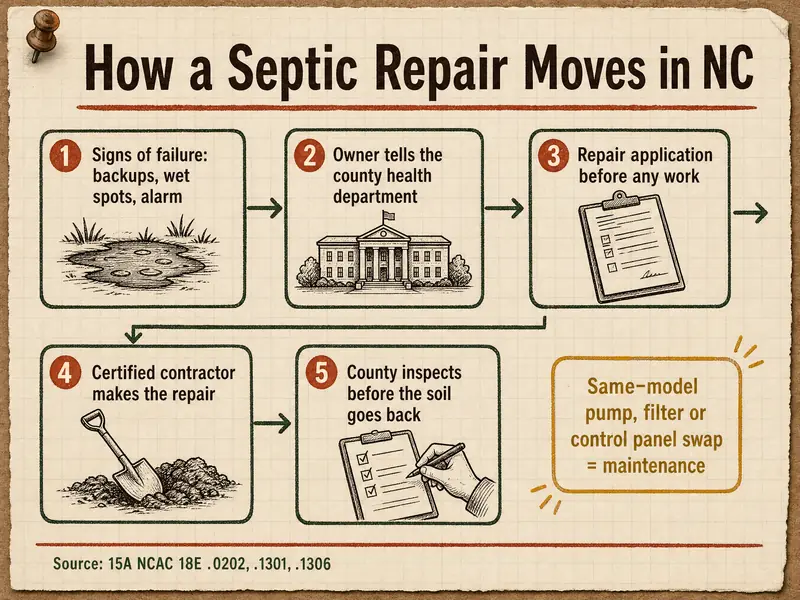
Septic repair in Durham, NC starts with a county application, not a shovel: state rules require one before any repair, and only same-model swaps of a pump, filter or control panel count as maintenance.
Compiled by the Red Clay Septic & Well desk · Last revised
In these notes
The short version
- 15A NCAC 18E .0202(c) requires an application to the county health department before a septic system is repaired.
- Replacing a pump, effluent filter or control panel with identical parts is maintenance under 18E .1301(h); tanks and drainfield media are not on that list.
- After a notice of violation, the owner has 30 days to repair unless the county sets another deadline.
- Repair fees vary: Chatham lists a $0 repair permit and Person charges $150 for a gravity repair or $300 with a pump (fee schedules checked October 2026).
- On clay, drainfield repairs often move to a low-pressure pipe design, sized at 0.05-0.2 gal/day per sq ft on clay under state rules.
- NC State Extension reports that 40 to 50 percent of advanced systems fail within six years without the required maintenance.
- 30 daysTime to repair after a county notice of violation, unless the notice says otherwise15A NCAC 18E .1306(c)
- $0Chatham County repair permit fee, effective July 1, 2026Chatham County Environmental Health fee schedule
- $150 / $300Person County repair authorization, gravity or pump systemPerson County Environmental Health fee schedule
- 40-50%Advanced systems that fail within six years without maintenanceNC State Extension AG-439-13
Which septic repairs are most common around Durham?
Septic repairs in the Durham area fall into two groups: small fixes to tank parts and controls, and drainfield repairs where effluent is no longer soaking into the clay. The first group is usually quick; the second involves a soil evaluation and a county permit.
Tank and control problems are the parts an inspector looks at under 21 NCAC 39 .1006: a missing or broken outlet baffle or tee, a clogged or missing effluent filter, cracked lids or risers, roots in the tank, and on pump systems a failed pump, float or alarm. Many of these are maintenance under state rules when the replacement part is identical.
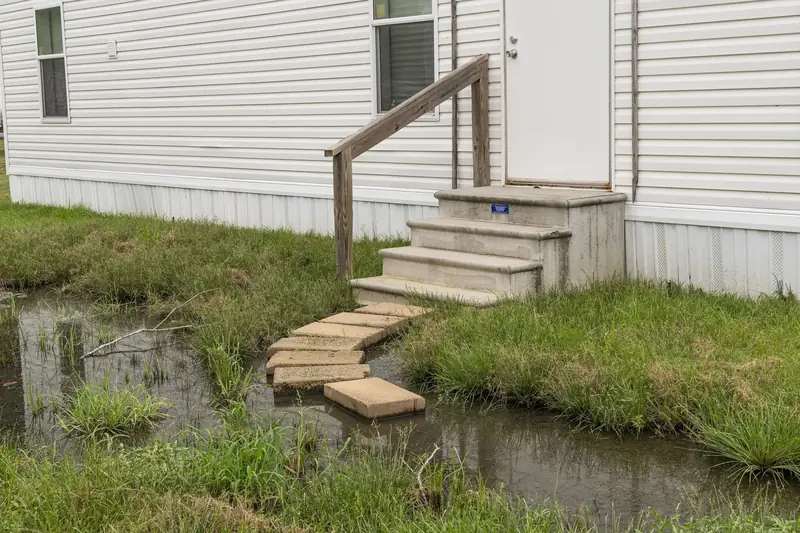
Drainfield problems show up as soggy ground, sewage odor or surfacing over the trenches, slow drains after rain, and backups. NCDHHS lists the same warning signs on its homeowner page, including a red light or beeping alarm on the septic panel. A field that has failed is the expensive repair, and the one that needs the county most.
Pipe faults sit between the two: a crushed line from a vehicle, a separated joint, or a downspout or sump pump tied into the system. NCDHHS says those discharges should never reach the system at all.
When does a septic repair need a county permit?
Any repair to the system itself needs a county application first; only like-for-like replacement of a pump, effluent filter or control panel is treated as maintenance. The NCDHHS homeowner factsheet puts it plainly: do not make or allow repairs without the permits the health department requires. NC State Extension adds a warning to be wary of any contractor who offers a repair without one.
The paperwork follows the same path as a new system on a smaller scale. The owner applies, county staff evaluate the site and the failing system, a repair authorization is issued, a certified contractor does the work, and the county inspects before anything is covered. State law under G.S. 130A-337 bars covering or using a repaired system until that inspection passes.
Each county has its own form and office:
- Durham County posts a "Construction Authorization - Repair" application on its Environmental Health forms page.
- Granville County repairs go through Granville-Vance Public Health, which permits septic systems in Granville and Vance counties after site and soil evaluations.
- Person County asks for an application with a Homeowner Questionnaire, then an Environmental Health Specialist evaluates the system and soil and picks the repair option; a financial assistance application is linked on the same page.
- Orange and Chatham run repairs through their Environmental Health divisions under the same state rule, with Orange adding its own local rules adopted in 2024.
Who does the work matters too. G.S. 90A-72 requires a certified contractor at the right grade for installing or repairing a system. The narrow exception is an owner building a single tank with a gravity gravel trench on land they own for their own household.
How is a failing drainfield repaired in clay soil?
A failing drainfield on Piedmont clay is usually repaired by building new trenches in the repair area set aside on the original permit, often with a pump and a pressure design so effluent spreads evenly over slow soil. NC State Extension notes that most sites permitted since the early 1980s were required to keep a repair area, and the owner's guide says the law protects it from building, pools and grading.
Clay limits what a new field can take. Under 18E, clay soils get a loading rate of 0.1-0.4 gal/day per sq ft for conventional trenches and 0.05-0.2 for low-pressure pipe, so repair fields run long. Extension describes LPP as an option on some clayey soils with a thick sandy surface, and pretreatment units as a way to treat effluent where the soil is too shallow for a standard field.
When the soil itself fails the evaluation, 18E .0509(b) lists the ways a site can be reclassified: site modifications, an interceptor drain to cut off perched water, advanced pretreatment, or an approved alternative system. On hard sites the county agent may also be asked to use best professional judgement under 18E .1306, though that cannot shrink the setback to a drinking water well below the rule.
Some shortcuts are against the law or simply do not work. Extension says piping sewage to a ditch, stream or old well is illegal, that piling soil on a wet, smelly spot does not fix it, and that pumping the tank will not revive a fully clogged field. Building trenches in wet clay can smear and seal the trench walls, so repair timing after a rainy spell matters. The red clay soil page and the drainfield page explain why.
While a repair is pending, the county can require pumping and hauling sewage to protect health, and a pump-and-haul permit is a last resort that the rules limit to five years at a time.
Can a septic tank itself be repaired?
Yes for many parts of a tank, no for the tank as a whole: baffles, outlet tees, lids, risers and effluent filters can be replaced, while a cracked or leaking tank is generally replaced under a repair permit. The maintenance exemption in 18E .1301(h) covers pumps, filters and control panels but expressly not tanks.
Older tanks often lack two things newer rules require. Systems permitted after January 1, 1999 must have an effluent filter, and state law requires the tank access to come within 6 inches of finished grade on new installs. Adding a filter or a riser to an older tank is a common upgrade, and NCDHHS tells owners to make sure a filter is installed.
A tank taken out of service has its own rule. Under 18E .1307 a permitted septage firm empties it, and it is removed, collapsed or otherwise made unable to hold liquid, then backfilled; Durham County posts a Septic Tank Abandonment Form for the record.
What does septic repair cost?
Contractors set repair prices, and no county or state source publishes them, so this site quotes only government fees. What drives the total:
- Whether the fix is a part swap or a new drainfield
- How much of the repair area has usable soil, and whether a pump or LPP design is needed
- Tank replacement, risers and filters
- Access for equipment, and restoring the lawn
- Ongoing costs if the repair adds a pump: an operator contract and county inspections
| County | Health department | Repair fee listed |
|---|---|---|
| Durham | Durham County Department of Public Health | No repair line on the fee schedule; repair uses a Construction Authorization application |
| Granville | Granville-Vance Public Health | No repair line; "Permit Update/Other" $150 and "On-Site Septic Modification" $400 are listed |
| Orange | Orange County Health Department | No septic repair line on the FY2024-25 schedule |
| Chatham | Chatham County Public Health | Repair Permit $0 |
| Person | Person County Health Department | Construction Authorization for repairs: $150 gravity, $300 pump |
Ask the county which line applies before work starts, since a repair that changes the system type can carry new permit and inspection fees.
How do you keep a repaired system working?
Keep up the schedule the new permit sets. A repair that adds a pump moves a system into a managed type: under Table XXXII of 18E .1301, a single-pump system gets a county compliance inspection every five years, and an LPP system a county inspection every three years plus operator visits twice a year. The operator contract has to stay in force as long as the system is used.
Chatham County charges a monitoring fee for single-pump systems of $25 a year or $110 for five years. NC State Extension's warning about advanced systems failing without maintenance applies to any repair that adds pretreatment.
The daily habits are the same as for any system: have the filter looked at every 2 to 3 years or sooner if drains slow, have the tank measured every 1 to 3 years, keep vehicles and new structures off the field and repair area, and send gutters and softener discharge elsewhere. The septic care page and the pump tank alarm page cover the details.
Where this comes from
Repair steps and fees here rest on 15A NCAC 18E (June 2026 amendments), G.S. 130A-337 and 90A-72, the NCDHHS homeowner factsheet and web page, NC State Extension's AG-439-13, owner's guide and failure checklist, the certification board's inspection rules, and the septic pages and fee schedules of the Person, Chatham, Orange, Granville-Vance and Durham health departments, checked October 2026. Contractor prices and repair stories from forums were left out.
Questions worth asking
Can a homeowner fix a broken septic line without a permit?
Not if it is a repair to the system. State rules require an application before any repair, and only an identical pump, filter or control panel swap counts as maintenance. A homeowner may install only a single tank with a gravity gravel trench on their own land under the statute's exemption.
What happens if the county sends a notice of violation?
The rule gives 30 days from the notice date to repair, unless the notice sets another time frame. The owner applies for the repair and may have to pump and haul sewage until it is done.
Is there help paying for a septic repair?
Person County links a financial assistance application on its onsite wastewater page. In Durham, the City runs a septic-to-sewer cost share only inside the Northeast Creek watershed; the septic to sewer page explains it.
Can a repair go closer to the well than the permit allowed?
No. Best professional judgement repairs cannot cut the setback to a drinking water well below what 18E .0601 requires, which is 50 feet for a single-family private well under current rules.
Does a repaired system need a new Operation Permit?
Yes. A repaired system gets a county inspection before it is covered or used, and the permit then reflects the system type, which can change the inspection schedule.
What if there is no repair area on an old lot?
Lots recorded on or before January 1, 1983 may be exempt from the repair-area requirement under 18E .0508, and systems from before 1977 can be repaired by best professional judgement. The county works from what the site allows, sometimes with pretreatment or a pressure design.
Read next
Filed under Septic notes · the front page of these Piedmont field notes