Wells
Well Permits and Construction Rules in NC
Well permits in NC come from the county health department before drilling starts, and the well must meet 15A NCAC 02C: 50 feet from a home's septic system, 20 feet of grout and casing.
Compiled by the Red Clay Septic & Well desk · Last revised
In these notes
The short version
- No one may build a private drinking water well in NC without a construction permit from the local health department, under 15A NCAC 02C .0304.
- A well permit is valid for five years; repairs and abandonment need permits too, but replacing a pump does not.
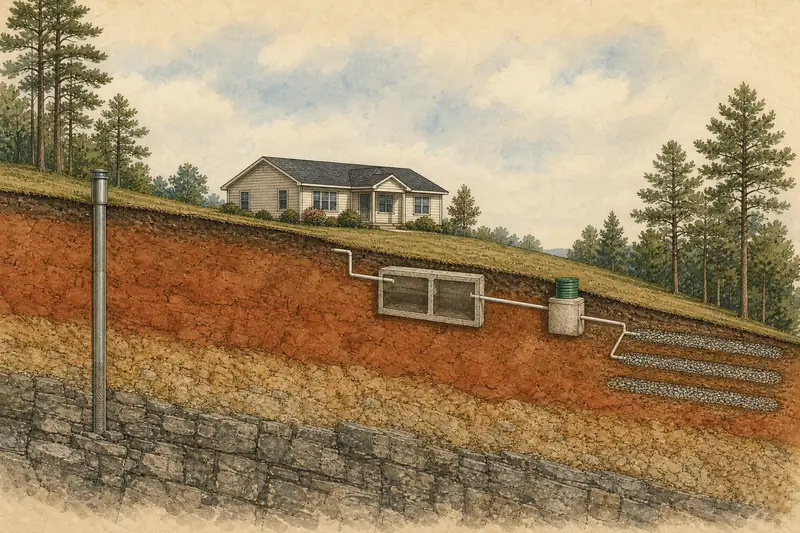
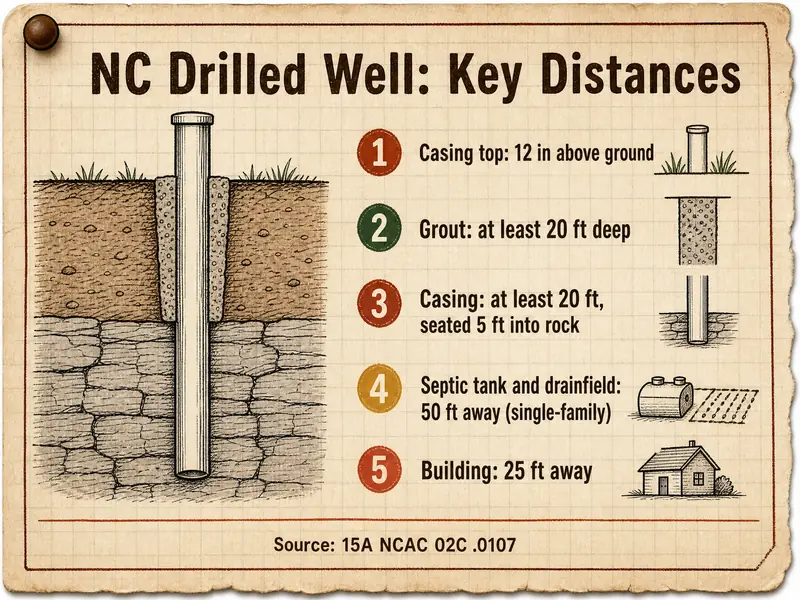
- The well must sit 50 ft from a single-family home's septic tank and drainfield and 25 ft from the house, per 15A NCAC 02C .0107.
- Casing and grout must reach at least 20 ft below the surface, and the casing top must stand 12 in above the ground.
- Only a certified well contractor may build, repair or abandon a well, under G.S. Chapter 87, Article 7A.
- County well permit fees around Durham run $300 to $500 (fee schedules checked October 2026).
- 50 ftWell to septic tank and drainfield, single-family home15A NCAC 02C .0107
- 20 ftMinimum depth of casing and of grout15A NCAC 02C .0107
- 5 yearsHow long a well construction permit stays valid15A NCAC 02C .0304
- 208 ftAverage depth of 649 inventoried Orange County wellsUSGS WRIR 00-4286
How do well permits in NC work?
Well permits in NC are issued by the county health department, and the rule is blunt: "No person shall construct a private drinking water well without first obtaining a well construction permit from the local health department." That sentence is 15A NCAC 02C .0304, part of the statewide private well program that took effect July 1, 2008. Repairs and abandonment also need a permit. Replacing or repairing a pump does not.
Before issuing the permit, the health department checks the site plan against the setbacks and searches state records to see whether the well would sit within 1,000 feet of a known contamination release. The permit then stays valid for five years. The grout step gets its own inspection: the contractor must call the health department to schedule it before grouting.
Fees are set locally and change. Fee schedules checked in October 2026 list $425 in Durham County, $500 in Orange County, $400 for Granville through Granville-Vance Public Health, and $300 in Person County. Durham lists a well repair permit at $0, and Chatham lists its repair or abandonment permit at $0. This site is not a health department; the county issues the permit and sets the price.
How far must a well be from a septic system?
A private well serving one single-family home must be at least 50 feet from that home's septic tank and drainfield, including the drainfield repair area. The distance is set in 15A NCAC 02C .0107, and the septic rules in 15A NCAC 18E Table IX now match it. The distance grows to 100 feet for a septic system built in saprolite, for other kinds of facilities, and for shared or public wells.
Older paperwork may say 100 feet. NC DHHS summarizes the change in its 18E quick reference guide: the distance for a single-family well "has been reduced to 50 feet." An older permit or Extension page showing 100 feet reflects the earlier rule. The drainfield page covers the septic side of the same line.
| From the well to | Minimum distance | Notes |
|---|---|---|
| Septic tank and drainfield, single-family home | 50 ft | Includes the drainfield repair area |
| Septic system in saprolite, or other facilities | 100 ft | Also any other subsurface disposal system |
| Water-tight sewer lateral from a house | 25 ft | Sewer mains built to water-main standards: 50 ft |
| House, garage, patio or deck | 25 ft | Any attached structure needing a building permit |
| Pond or lake | 50 ft | Streams and creeks: 25 ft |
| Animal barn, manure pile or chemical storage | 100 ft | Heating-oil tank: 50 ft |
The state rule sets no distance to a property line. Counties can. Chatham County's well setback guide adds 10 feet from property lines and counts septic systems on the neighbor's lot inside the 50 feet. On small lots where the full distances cannot fit, the rule allows shorter minimums but then requires deeper casing.
How deep must well casing and grout go?
Well casing and grout must both reach at least 20 feet below the land surface in the five counties around Durham. The casing must also be seated at least five feet into rock where it ends in consolidated rock, and its top must stand at least 12 inches above the ground. Deeper 43-foot casing is required only in eight named counties farther south and west, and on small lots with reduced setbacks; Durham, Orange, Chatham, Person and Granville are not on that county list.
Grout fills the gap between the casing and the borehole so surface water cannot run down the outside of the pipe. The rule sets the grout thickness at one-third of the casing's outside diameter or two inches, whichever is greater, and requires grouting within seven days after the casing is set. Openings for wiring and piping must enter at least 12 inches above the ground unless a pitless adapter is used, and the ground must slope water away.
How deep the well itself goes depends on where water turns up. A USGS inventory of 649 Orange County wells found an average depth of 208 feet with 53.6 feet of casing and a yield of 17.6 gallons per minute (USGS WRIR 00-4286). In the Triassic Basin, the NC Geological Survey warns that yields are often very low and many dry holes have been drilled; the Triassic Basin soils page explains why the same rocks trouble drainfields.
Who can drill a well in NC?
Only a certified well contractor can drill a well in NC. DEQ's permit directory says "a North Carolina certified well contractor must be present at all times when well contractor activities are being conducted," which covers construction, installation, repair, alteration or abandonment of any well (NC DEQ permit directory). A state certification board, with staff support from NC DHHS, issues the certificates under G.S. Chapter 87, Article 7A, and each one runs a single year, July 1 to June 30.
Ask to see the certification before work starts, and confirm the contractor or owner has the county permit in hand. The contractor also has duties after drilling: a capacity test of at least one hour, disinfection with chlorine, and the identification plate described below.
What happens after a new well is finished?
A new well cannot be used until the county issues a Certificate of Completion. Within 72 hours of finishing, the contractor must fix an identification plate to the well showing total depth, casing depth and diameter, yield in gallons per minute, static water level and completion date. The pump installer adds a threadless sampling tap at the wellhead, turned down and at least 12 inches above the ground.
The well must be disinfected after construction, with a chlorine solution of at least 100 parts per million left standing for 24 hours or more, then pumped until no chlorine remains. Within 30 days after the Certificate of Completion, the health department samples the water for bacteria and a set list of chemicals under 15A NCAC 18A .3802. The well water testing page lists that panel and what it leaves out.
How do you find an old well's records?
Find an old well's records by asking the county health department, which must keep a registry of permitted wells with their locations and water test results. Durham County says "anyone can request a copy" of septic and well records and takes requests by email with the site address and parcel number (Durham County records page). Orange County has an online form for records before 2010, and Chatham County posts scanned permits online.
Wells drilled before July 1, 2008 predate the statewide permit program, so there may be little on file. The ID plate on the casing, if it survives, is the next best record. The county permits and records page has the request details for each county, and the pump and pressure tank page covers the equipment that sits on top of the well.
Where this comes from
This page is based on 15A NCAC 02C .0100 and .0300 (well construction standards and private well permits), 15A NCAC 18A .3800 (new-well sampling), the NC DHHS 18E quick reference guide, the NC DEQ permit directory entry for well contractor certification, the NC Geological Survey Triassic Basin guide, USGS WRIR 00-4286, and county fee schedules and records pages, all checked in October 2026. The statute text of G.S. 87-97 was not reachable and was not quoted. Left out: drilling prices, contractor recommendations and forum reports.
Questions worth asking
Does replacing a well pump need a county permit in NC?
No. 15A NCAC 02C .0304 requires permits for construction, repair and abandonment of a well, but not for repairing or replacing the pump. The well must still be disinfected after a pump is installed, under 15A NCAC 02C .0111.
Can an old well be left open after a new one is drilled?
No. Abandoning a well takes a county permit and a certified well contractor, and a well that acts as a channel for contamination must be repaired or abandoned within 30 days of notice from the health department. An open or poorly sealed old well is a direct path for surface water into the aquifer.
Is a well permit needed for an irrigation well?
The health department permit rule in 02C .0304 is written for private drinking water wells. Durham County's Onsite Water Protection section says it oversees both private drinking and irrigation water wells, so ask the county before drilling either kind.
Why does my old septic permit show 100 feet to the well?
Earlier rules used 100 feet for most private wells. The current rules set 50 feet for a well serving one single-family home, while 100 feet still applies to shared wells, saprolite systems and some other cases. An older permit reflects the rule in force when it was written.
How deep are wells around Durham?
There is no single answer. A USGS study of the Piedmont described the average domestic well as 125 feet deep, and its Orange County inventory averaged 208 feet. Depth depends on where the drill meets water-bearing fractures.
What is on a well identification plate?
The plate lists total depth, casing depth and diameter, yield in gallons per minute, static water level and the completion date. The contractor must install it within 72 hours of finishing the well. It is often the only record of an older well's construction.
Does a new well need a state permit as well as a county permit?
Not for a home. A DEQ state permit is needed for wells designed to pump 100,000 gallons per day or more; private drinking water wells are permitted by the local health department.
Read next
Filed under Well notes · Durham-area septic and well notes