Wells
Well Pressure Tank and Pump Basics
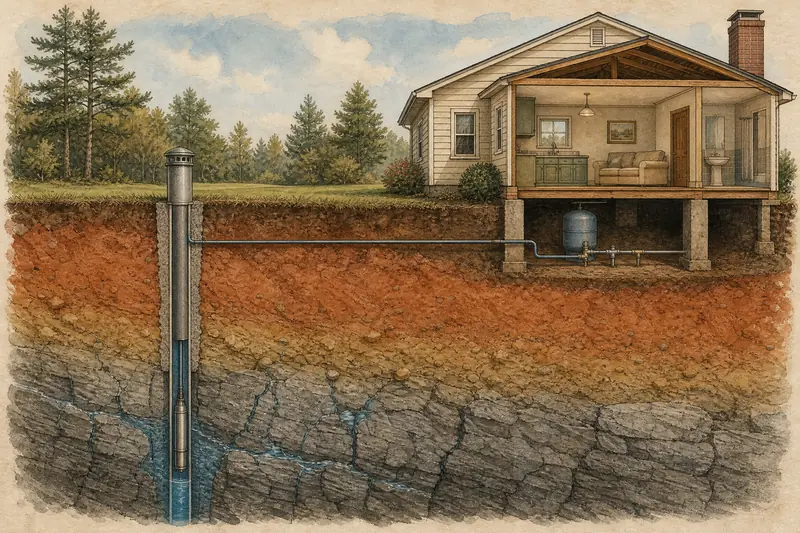
A well pressure tank holds water against a pocket of compressed air that keeps the taps running while the pump rests; once that air leaks away, the pump restarts far too often.
Compiled by the Red Clay Septic & Well desk · Last revised
In these notes
- How do a well pump and pressure tank work together?
- Why does the pump keep restarting when a well pressure tank loses air?
- What air pressure should a well pressure tank hold?
- Why do some wells near Durham run short of water?
- When is the pump, not the tank, the part at fault?
- Who swaps out a well pressure tank or pump, and is a permit needed?
- Questions worth asking
The short version
- Only about 20% of a pressure tank's capacity is usable water; Penn State Extension says a 42-gallon tank delivers about 8 gallons before the pump restarts.
- Pentair's tank manual puts the air charge 2 psi under the switch's cut-in pressure (28 psi on a 30/50 switch), measured with the tank empty of water.
- Triassic Basin wells average 11 to 12 gpm, the lowest of NC's rock settings in an NC State Extension summary; Piedmont wells average 18 to 21 gpm.
- Replacing a pump needs no county permit under 15A NCAC 02C .0304, but the well must be disinfected afterward under .0111.
- A low-yield well is usually fixed with storage, not a bigger pressure tank, according to Penn State Extension.
- 20%Share of a pressure tank's capacity that is usable waterPenn State Extension
- 2 psiAir charge below the pump's cut-in pressurePentair tank owner's manual
- 11-12 gpmAverage well yield in NC's Triassic BasinsNC State Extension
- 1,440 galDaily output of a well yielding only 1 gpmPenn State Extension
How do a well pump and pressure tank work together?
They split the job: the pump lifts water into the tank, and the air squeezed inside the tank delivers that water to the taps while the pump sits idle. A pressure switch referees the two, turning the pump on at a low reading (cut-in) and off at a high one (cut-out). In Penn State Extension's words, the tank's "primary purpose" is creating and maintaining pressure in the line.
Most modern tanks hold the air in a separate space from the water, behind a bladder or water cell, and come with an air charge from the factory. A Pentair owner's manual walks through one cycle: as water enters, the air compresses; at the cut-out setting the pump stops; as you draw water, the air pushes it out; when the water cell is nearly empty, the pump starts again.
The tank stores less than its size suggests. Penn State says about 20 percent of a tank's capacity is usable, so a 42-gallon tank gives about 8 gallons between pump starts. Pentair's own chart for its 35-gallon steel tank lists 10.7 gallons per cycle on a 30/50 switch. Tanks can be connected together to add drawdown; the same manual says two tanks of the same size double the supply.
Why does the pump keep restarting when a well pressure tank loses air?
A tank that has lost its air can store only a thin reserve of water, so the pump has to make up nearly every glass drawn. Pressure sags to cut-in moments after a tap opens, the pump kicks on, reaches cut-out fast and stops, then repeats in quick bursts, a pattern well people call short cycling. Every extra start wears the motor and the switch contacts.
Slow air loss is the common culprit. Pentair's manual warns that a missing or loose air valve cap "may allow loss of air pressure and eventually lead to tank waterlogging and water cell failure." Too much air hurts as well: the manual notes the charge can creep upward through long hot spells, which also cuts drawdown. A torn bladder lets water into the air side; Pentair's test is to drain the tank and see whether water comes out of the air valve.
A badly adjusted pressure switch can look similar. Pentair ties a cut-in setting that is too low to rattling or water hammer at pump start, and Penn State adds that a faulty electrical switch at the tank can leave the house without water. The air charge is the cheapest thing to rule out, so start there.
What air pressure should a well pressure tank hold?
A well pressure tank should hold an air charge 2 psi under the pressure switch's cut-in setting, read while the tank is empty of water. Pentair's PSP973 steel tank manual sets out the order: cut power to the pump, run a faucet close to the tank until the flow stops, then put a pressure gauge on the air valve, the same kind of valve found on a car wheel.
On the manual's three common switch ranges, that works out to 18 psi for 20/40, 28 psi for 30/50 and 38 psi for 40/60. A low reading calls for air from a compressor or a portable air tank; a high one calls for a short bleed at the valve. A dab of soapy water on the valve afterward shows a leaking core as steady bubbles. Variable-speed pump systems follow their own charge rule, set out in that equipment's manual.
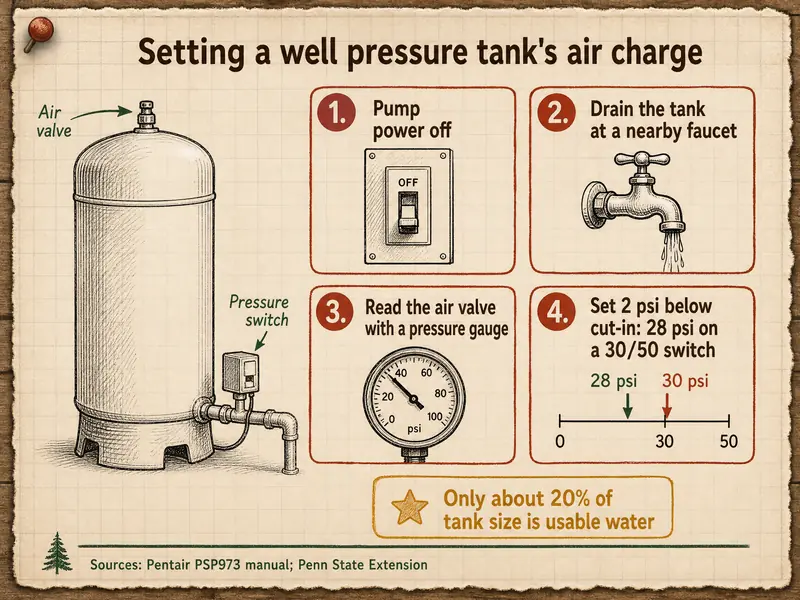
Work safely. The tank holds pressure and the pump runs on line voltage, so turn off the breaker before touching anything, and never open a tank's flange or remove a valve core with air still in it. If the charge will not hold, the bladder or tank needs replacing, which is the next section's subject.
| Pressure switch setting | Tank air charge | Example drawdown, Pentair 35-gal tank |
|---|---|---|
| 20/40 psi | 18 psi | 12.7 gal |
| 30/50 psi | 28 psi | 10.7 gal |
| 40/60 psi | 38 psi | 9.3 gal |
Why do some wells near Durham run short of water?
The rock under some lots releases water slowly, and the Triassic Basin is the clearest local case. An NC State Extension groundwater summary averages Triassic Basin wells at 11 to 12 gallons per minute, the lowest among the state's Piedmont and mountain rock types, against 18 to 21 gpm for most other Piedmont settings. The NC Geological Survey's homeowner guide is blunter: in Triassic rock, dry holes are common (NC Geological Survey).
Averages hide the slow wells. A USGS study notes that Piedmont domestic wells only need 2 to 10 gpm and that wells in draws and valleys average three times the yield of those on hills and ridges. Low yield shows up as sputtering taps or lost pressure during long showers, laundry or irrigation, then recovery after a rest. In drought, Penn State notes, the water level can drop below the pump.
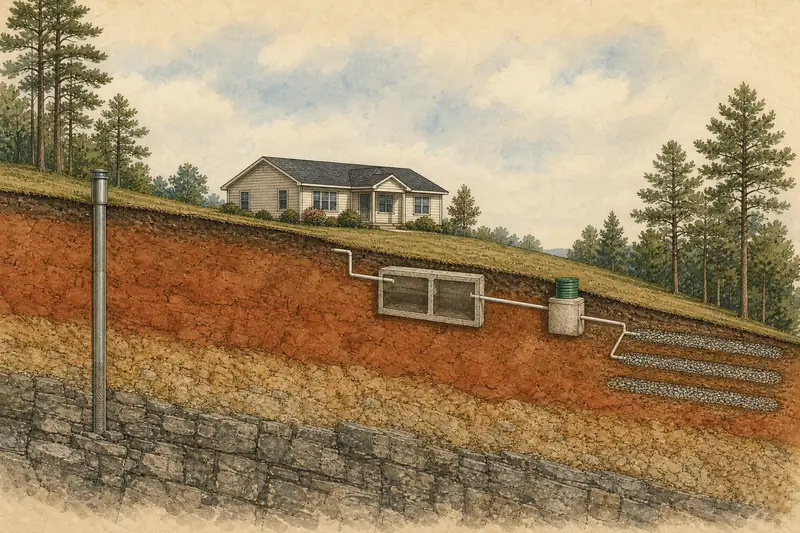
Penn State's low-yield well guide points out that even a 1 gpm well produces 1,440 gallons a day; the problem is peak demand. A bigger pressure tank adds only a little storage. The usual fixes are a non-pressurized storage tank sized at about 100 gallons per person, with USDA recommending at least 2,000 gallons, deepening the well to add borehole storage, or lowering the pump as a short-term step. The Triassic Basin soils page explains why the same rock troubles drainfields.
When is the pump, not the tank, the part at fault?
Suspect the pump itself when pressure drops and never comes back, when it runs and runs without reaching its cut-out setting, when its breaker keeps tripping, or when the taps spit air. A waterlogged tank, a worn pressure switch or a well drawn down by heavy use can produce several of those same symptoms, so they are worth ruling out first. Penn State's advice is to have a well driller or competent plumber pin down the cause.
A change in the water can be part of the picture too. Water quality problems such as iron bacteria and sediment can also clog the well and restrict flow, Penn State notes. The iron and manganese page covers iron bacteria, and the well water testing page covers when to test after any repair.
Who swaps out a well pressure tank or pump, and is a permit needed?
A certified well contractor or pump installer does the work, the county issues no permit for a pump, and the well gets disinfected once the new pump is in. Under 15A NCAC 02C .0304, permits cover building, repairing or abandoning a well, with pump repair and replacement exempt; 02C .0111 adds that anyone "installing a pump in a water supply well shall disinfect the well." NC DHHS also recommends a water test after any well component is repaired or replaced.
Durham County lists its well repair permit at $0 (fee schedule checked October 2026), which applies to work on the well itself rather than the pump. Contractors quote the pump, tank and labor; what drives the price is pump type and depth, tank size and how much pipe and wiring must come up. This site does not sell or install equipment. The well permits page covers who may work on a well, and the shock chlorination page covers disinfection.
Where this comes from
This page is based on Penn State Extension's guides to low-yield wells and drought, a Pentair owner's manual for steel pressure tanks (2012), NC State Extension's groundwater guide for the Piedmont, the Triassic Basin homeowner guide from the NC Geological Survey, USGS Water-Supply Paper 2341-A, 15A NCAC 02C and the Durham County fee schedule, all checked in October 2026. Manual figures are for one maker's tanks; follow the manual for your own equipment. Left out: pump and tank prices, brand comparisons and forum repair stories.
Questions worth asking
How often is the tank's air charge worth rechecking?
Pentair's manual ties it to drawdown: recheck whenever the water delivered per pump cycle drops noticeably. Doing it alongside the yearly wellhead look NC DHHS suggests keeps it on the calendar. Once the tank is drained, the gauge reading itself takes only minutes.
Why does a well pump run but no water comes out?
Possible causes include a water level that has dropped below the pump, a failed pump, a broken pipe or a lost prime on a jet pump. Penn State notes that in drought the water level can fall below a submersible pump. Shut the pump off to protect it and have the cause found.
Can you add a second pressure tank?
Yes. Pentair's manual says tanks of the same size can be connected together, with two tanks doubling the usable supply. That reduces pump starts but, as Penn State notes, does not fix a low-yield well.
What does a pressure gauge reading of zero mean?
With the pump on, zero usually means no water is reaching the tank: a tripped breaker, failed pressure switch, failed pump or dry well. Check the breaker and switch first. A well contractor can test the pump and measure the water level.
Does a new pump mean the water needs testing?
NC DHHS says well water should be tested after repairs or replacement of any well component, because contaminants can enter when the well is opened. The rule also requires disinfecting the well after a pump is installed.
Why does the tank make water hammer when the pump starts?
Pentair links rattling or water hammer at pump start to a cut-in setting that is too low. Check the switch setting and then reset the tank's air charge to 2 psi below the cut-in pressure.
Read next

Filed under Well notes · septic and well notes for Durham